The Eastern Ganga Dynasty was a major medieval Indian ruling house that governed Kalinga from about 498 CE and later ruled Trikalinga from 1038 to 1434-35 CE. It emerged in eastern India and controlled large parts of present day Odisha, Andhra Pradesh, West Bengal and Chhattisgarh. The dynasty is known for political expansion, temple construction and cultural patronage. It played a crucial role in shaping regional identity, religion and architecture in eastern India.
Eastern Ganga Dynasty Historical Background
The Eastern Ganga Dynasty emerged in Kalinga around the 5th century and gradually expanded their power over Trikalinga through military, political and matrimonial strategies.
- Origin: The dynasty began around 498 CE with Indravarman I, who established rule in Kalinga with Kalinganagara as capital and Dantapuram as secondary centre of administration.
- Expansion to Trikalinga: Vajrahasta III assumed the title Trikalingadhipat in 1028 CE and became the first ruler to control all three divisions of Kalinga, marking territorial consolidation.
- Imperial Phase: From 1038 to 1434-35 CE, the dynasty ruled extensively over Trikalinga, expanding from the Ganga River in the north to the Godavari River in the south.
- Political Alliances: The Eastern Gangas intermarried with the Cholas and Chalukyas, strengthening their position and engaging in continuous warfare and diplomacy with these powers.
Eastern Ganga Dynasty Rulers
The Eastern Ganga Dynasty was shaped by powerful rulers who expanded territory, resisted invasions and contributed to religion and architecture. Few of the major rulers of this dynasty are:
- Indravarman I: The first historical ruler, he defeated the Vishnu Kundin king Indrabhattaraka and established sovereignty over Kalinga, initiating the Ganga era in 498 CE.
- Vajrahasta III: He assumed the title Trikalingadhipat in 1028 CE, consolidating control over the three Kalinga regions and strengthening imperial authority.
- Anantavarman Chodagangadeva: He ruled from the Ganga to Godavari, unified Utkal and Kalinga and began construction of the Jagannatha temple at Puri in the late 11th century.
- Rajaraja I: He fought against the Cholas and Eastern Chalukyas and strengthened alliances by marrying the Chola princess Rajasundari, ensuring political stability.
- Anangabhima III: He repulsed Muslim invasions from Bengal and constructed the Megheshvara temple at Bhuvaneshvara, reinforcing religious patronage.
- Narasimha I: He invaded southern Bengal in 1243 CE, defeated Muslim rulers, captured Gauda and built the Sun Temple at Konark to commemorate victory.
- Rajaraja III: He ascended in 1198 CE but failed to resist the Muslim invasion of Odisha in 1206 CE, showing a temporary weakening of central authority.


Eastern Ganga Dynasty Administration and Governance
The Eastern Ganga Dynasty administration was a centralized monarchy supported by provincial divisions and local governance institutions ensuring efficient control.
- Administrative System: It followed Monarchy in which the king was the supreme authority and head of administration and military, assisted by ministers and commanders for governance and warfare.
- Provincial Division: The empire was divided into Maha mandalas governed by Mahamandalikas, further subdivided into mandalas and visayas, ensuring administrative efficiency.
- Local Governance: Villages functioned as self governing units led by Gramika, supported by officials like Karanika, Dandapani and Gramavatta.
- Military Organization: The army had structured ranks such as Maha Senapati, Senapati, Dalapati and Nayaka, along with a naval force during Chodaganga’s reign.
Eastern Ganga Dynasty Economy
The economy of the Eastern Ganga Dynasty was agrarian and trade oriented, supported by taxation and distinctive coinage systems reflecting advanced monetary practices.
- Agrarian Economy: Agriculture formed the economic base, supported by irrigation and fertile lands, with taxes collected from cultivators even on uncultivated land.
- Trade and Commerce: The empire maintained flourishing trade networks and ports, linking eastern India with other regions and supporting economic prosperity.
- Revenue System: Taxes included kara, hiranya, sulika and other levies on trade, agriculture and internal transactions, ensuring steady income.
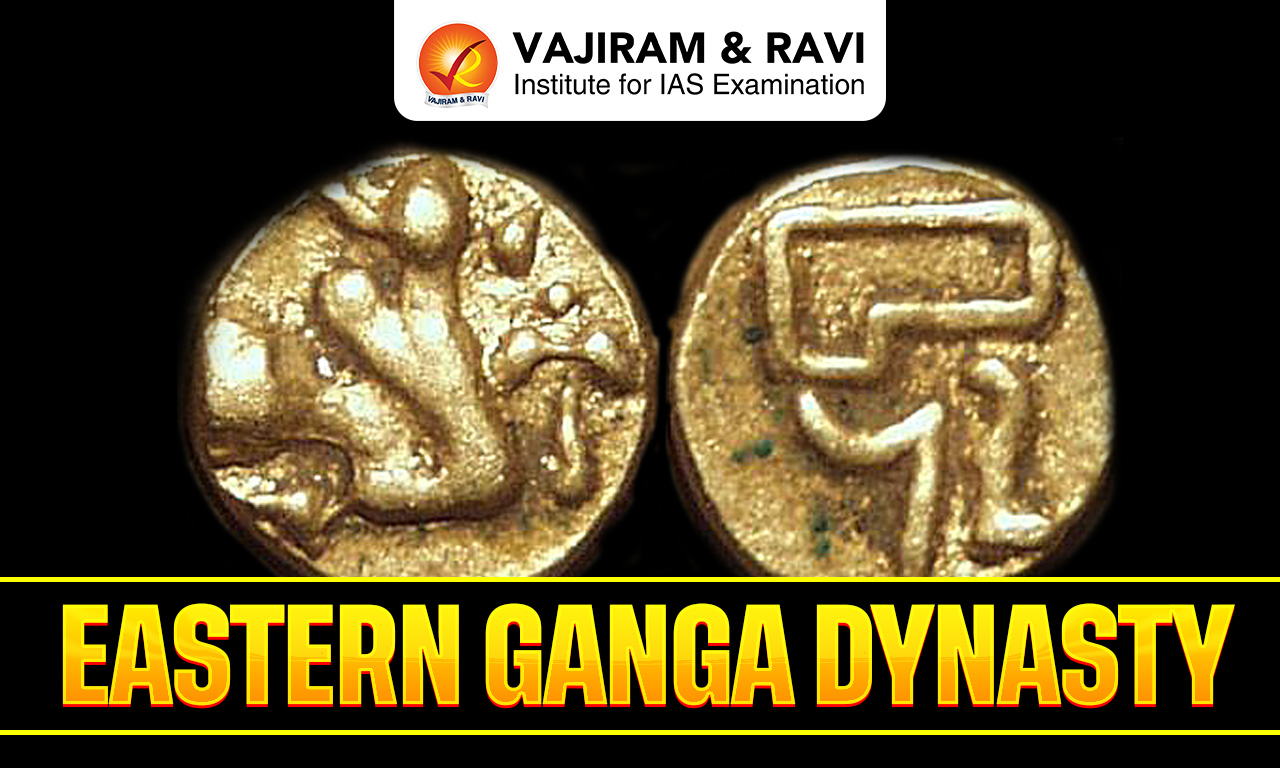
- Coinage Features: Coins known as Ganga fanams depicted a couchant bull on obverse and the letter “sa” with regnal year on reverse, indicating monetary standardization.
- Decimal System Innovation: Eastern Ganga coins used single digit symbols with positional value, marking one of the earliest uses of decimal system in Indian coinage.
Eastern Ganga Dynasty Society and Culture
The society under Eastern Ganga Dynasty reflected religious diversity, cultural richness and evolving traditions influenced by royal patronage and social hierarchy.
- Religious Orientation: Initially Shaivite, the rulers later adopted Vaishnavism under Anantavarman Chodagangadeva, promoting Vishnu worship and temple endowments.
- Social Structure: Society followed caste hierarchy, with Brahmins receiving land grants and playing key roles in religious and educational activities.
- Cultural Patronage: The rulers supported temples, scholars and religious institutions, leading to growth of art, traditions and regional identity.
- Language Development: Telugu served as early court language, later replaced by Odia as it evolved from Odra Prakrit during the later medieval period.
Eastern Ganga Dynasty Art and Architecture
The Eastern Ganga Dynasty were renowned for temple architecture, sculpture, inscriptions and literary patronage, reflecting cultural excellence.
- Temple Architecture: The Jagannath Temple at Puri and Sun Temple at Konark are masterpieces, showcasing advanced engineering and symbolic religious design.
- Konark Sun Temple: Built by Narasimha I, it was designed as a massive stone chariot with seven horses, symbolizing the Sun God Surya in motion.
- Sculptural Excellence: Odisha temples feature detailed carvings of celestial maidens, dancers and geometric designs, representing the peak of medieval Indian sculpture.
- Inscriptions: Copper plates like Jirjingi, Korni and Puri grants provide detailed records of genealogy, land grants and administrative practices.
- Literature: Sanskrit and regional literature flourished under royal patronage, with temples and courts acting as centers of intellectual activity.
Eastern Ganga Dynasty Decline
The decline of the Eastern Ganga Dynasty began after the mid 13th century due to internal weakness and external invasions.
- Post Narasimha Decline: After Narasimha I’s death in 1264 CE, the dynasty gradually weakened due to succession issues and reduced military strength.
- Delhi Sultanate Invasion: The Sultan of Delhi invaded Odisha in 1324 CE, weakening political authority and destabilizing the kingdom.
- Vijayanagar Conflict: In 1356 CE, Vijayanagar defeated Odia powers, further reducing territorial control and influence.
- Last Rulers: Narasimha IV ruled until 1425 CE, followed by Bhanudeva IV, whose weak rule marked the final phase of the dynasty.
- End of Dynasty: Minister Kapilendra usurped the throne in 1434-35 CE and founded the Suryavamsha dynasty, ending Eastern Ganga rule.

 Last updated on Oct, 2026
→ UPSC 2027 Notification will be released on 13 January 2027 at upsconline.nic.in.
→ Check Nobel Prize 2026 Winners List here.
→ Download PIB PRiSM Monthly Magazine 2026 here.
→ Check UPSC Monthly Current Affairs Magazine The Recitals here.
→ Check out the latest UPSC Syllabus here.
→ Download UPSC Model Answers for Mains 2026
→ UPSC Mains Question Paper 2026 is out now for Essay & GS Paper 1, 2, 3 & 4.
→ UPSC Calendar 2027 has been released.
→ Enroll in Vajiram & Ravi’s UPSC Mains Test Series 2027 for structured answer writing practice, expert evaluation, and exam-oriented feedback.
→ Join Vajiram & Ravi’s UPSC Mentorship Program 2027 for personalized guidance, strategy planning, and one-to-one support from experienced mentors.
→ Go through the UPSC Mains Previous Year Papers to enhance your preparation.
→ UPSC has released UPSC Toppers List 2025 with the Civil Services final result on its official website.
→ Also check Best UPSC Coaching in India
Eastern Ganga Dynasty FAQs
Q1. Who founded the Eastern Ganga Dynasty?+
Q2. Which region was ruled by the Eastern Ganga Dynasty?+
Q3. Who built the Jagannath Temple at Puri?+
Q4. Why is Narasimha I famous in the Eastern Ganga Dynasty?+
Q5. What led to the decline of the Eastern Ganga Dynasty?+
Tags: eastern ganga dynasty geography geography notes