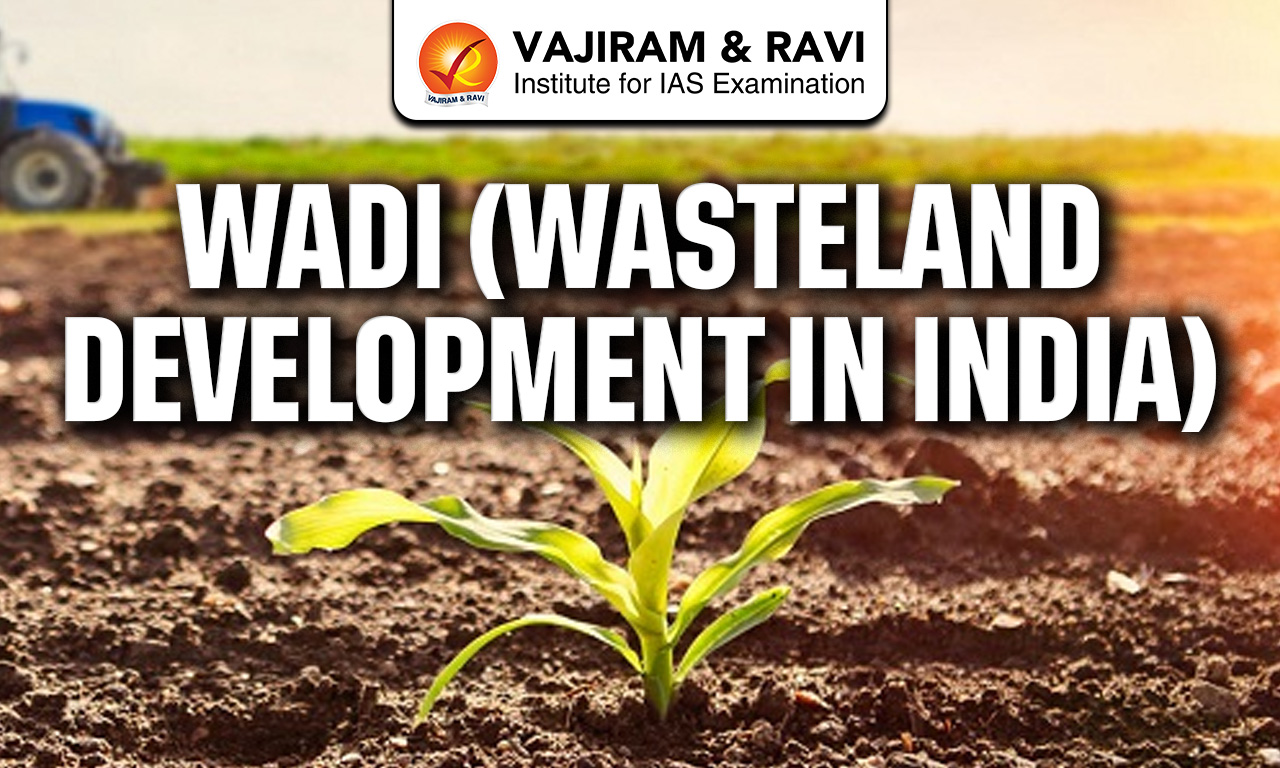
WADI (Wasteland Development) is an important rural development approach in India that focuses on improving degraded and unused land, especially in tribal and rural areas. It helps farmers turn barren land into productive farms by promoting tree-based farming systems.
The WADI model combines agriculture, horticulture, and forestry to create a sustainable source of income for small and marginal farmers. It is widely implemented by organizations like the National Bank for Agriculture and Rural Development (NABARD).
WADI (Wasteland Development in India) Objectives
The main aim of the WADI (Wasteland Development in India) program is to improve the economic condition of rural households while protecting the environment.
- To convert wasteland into productive land
- To increase farmers’ income through horticulture
- To promote sustainable agriculture practices
- To generate employment in rural areas
- To reduce poverty among tribal communities
- To improve soil and water conservation
Components of WADI Development
The WADI development model includes multiple integrated activities that focus on improving land productivity and ensuring sustainable livelihoods for rural and tribal farmers. It combines agriculture, horticulture, and natural resource management to provide both short-term and long-term benefits.
- Plantation of fruit trees such as mango, guava, cashew, or lemon to generate long-term income and ensure economic stability for farmers
- Intercropping with vegetables, pulses, and cereals between tree rows to provide immediate income during the initial years
- Soil conservation measures like bunding, trenching, and contour farming to prevent soil erosion and improve fertility
- Water resource development through farm ponds, check dams, and rainwater harvesting to ensure irrigation and water availability
- Use of organic manure and sustainable farming practices to maintain soil health and reduce dependency on chemicals
- Livelihood support through training, capacity building, and financial assistance for farmers to adopt improved practices
- Promotion of allied activities such as livestock rearing, poultry, or beekeeping to diversify income sources


Role of NABARD in WADI Development
The NABARD plays a central role in planning, funding, and implementing the WADI (Wasteland Development) program in India. It acts as a key institution that supports rural and tribal development by promoting sustainable livelihood models.
- Provides financial assistance and grants for the implementation of WADI projects across rural and tribal regions
- Identifies suitable areas and beneficiaries, especially small and marginal farmers with wasteland
- Partners with NGOs, community-based organizations, and local agencies for effective execution
- Offers technical guidance on plantation, soil conservation, and water management practices
- Supports capacity building by organizing training programs and skill development for farmers
- Promotes integrated tribal development through WADI-based livelihood models
- Ensures regular monitoring, evaluation, and impact assessment of projects
- Encourages sustainable and eco-friendly farming practices to improve long-term productivity
- Facilitates market linkages to help farmers sell their produce at better prices
Impact of WADI in India
The WADI model has brought significant positive changes in rural and tribal areas by transforming unproductive land into sustainable sources of livelihood.
- Conversion of wasteland into productive agricultural and horticultural land, increasing overall land use efficiency
- Rise in farmers’ income through fruit tree cultivation and intercropping practices over time
- Generation of employment opportunities in rural areas, reducing seasonal and distress migration
- Improvement in soil fertility and reduction in land degradation through conservation practices
- Better water availability due to rainwater harvesting and watershed management activities
- Strengthening of food security with the production of fruits, vegetables, and other crops
- Promotion of sustainable and eco-friendly farming methods, reducing dependence on chemical inputs
- Empowerment of tribal communities by enhancing their skills, confidence, and participation in development activities
- Diversification of livelihoods through allied activities like livestock, poultry, and small enterprises

 Last updated on Oct, 2026
→ UPSC 2027 Notification will be released on 13 January 2027 at upsconline.nic.in.
→ Check Nobel Prize 2026 Winners List here.
→ Download PIB PRiSM Monthly Magazine 2026 here.
→ Check UPSC Monthly Current Affairs Magazine The Recitals here.
→ Check out the latest UPSC Syllabus here.
→ Download UPSC Model Answers for Mains 2026
→ UPSC Mains Question Paper 2026 is out now for Essay & GS Paper 1, 2, 3 & 4.
→ UPSC Calendar 2027 has been released.
→ Enroll in Vajiram & Ravi’s UPSC Mains Test Series 2027 for structured answer writing practice, expert evaluation, and exam-oriented feedback.
→ Join Vajiram & Ravi’s UPSC Mentorship Program 2027 for personalized guidance, strategy planning, and one-to-one support from experienced mentors.
→ Go through the UPSC Mains Previous Year Papers to enhance your preparation.
→ UPSC has released UPSC Toppers List 2025 with the Civil Services final result on its official website.
→ Also check Best UPSC Coaching in India
WADI (Wasteland Development in India) FAQs
Q1. What does WADI stand for?+
Q2. Who implements WADI in India?+
Q3. Who benefits from WADI?+
Q4. What crops are grown under WADI?+
Q5. Why is WADI important?+
Tags: environmental science interdisciplinary wadi (wasteland development in india)