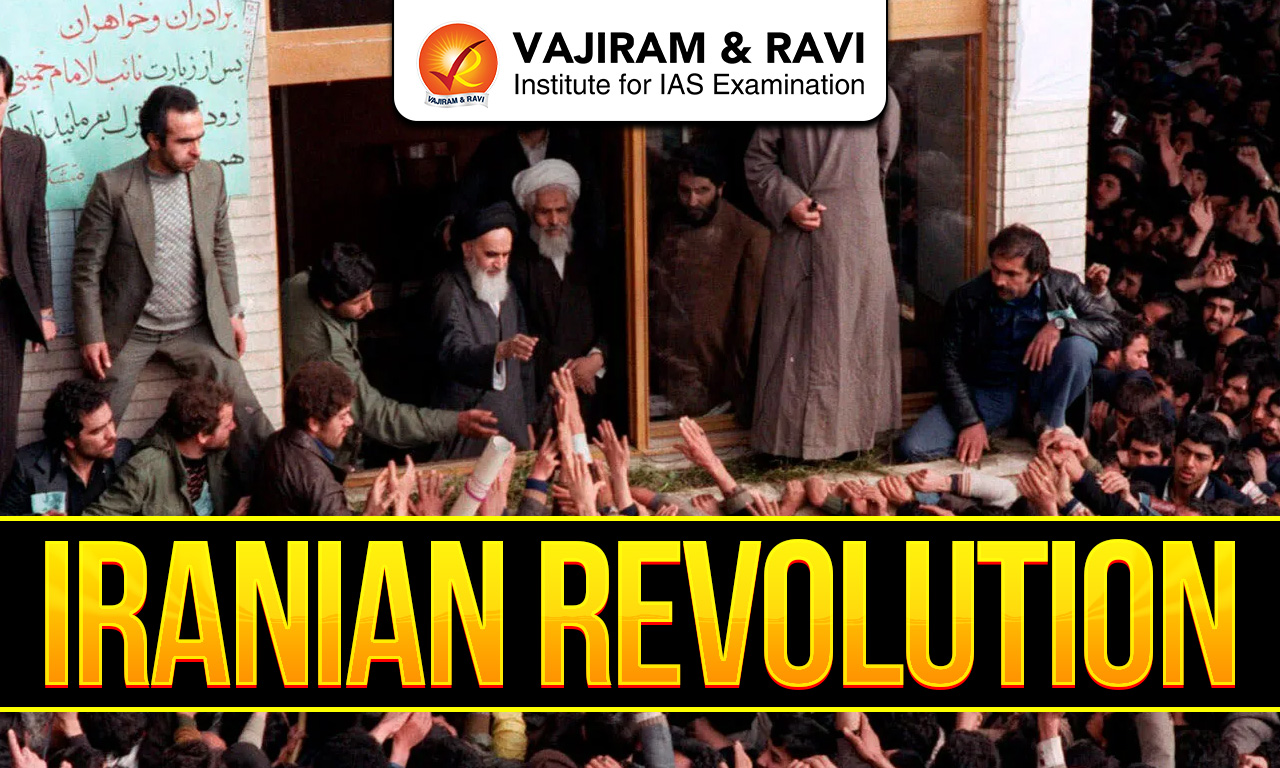
The Iranian Revolution (1978-1979) was a major political transformation that led to the overthrow of Shah Mohammad Reza Pahlavi and the establishment of an Islamic Republic under Ayatollah Ruhollah Khomeini. The revolution occurred between 7 January 1978 and 11 February 1979, and replaced a pro Western monarchy with a theocratic system. The revolution was unique due to its relatively non violent nature and its profound impact on Iran’s political structure, ideology and global geopolitical position.
Iranian Revolution Historical Background
Iranian Revolution history reflects monarchy, foreign influence and socio-religious mobilisation shaping political developments over decades.
- Pahlavi Monarchy and Modernisation: Mohammad Reza Pahlavi ruled from 1941 to 1979 and introduced the White Revolution in 1963, including land reforms, industrialisation, women’s rights expansion and education reforms, which modernised society but disrupted traditional power structures.
- Role of Shia Clergy: The Shia ulema historically influenced Iranian society, evident during the 1891 Tobacco Protests where clergy led boycotts forced cancellation of British concessions, demonstrating religious authority over political decisions.
- Foreign Intervention and 1953 Coup: Prime Minister Mohammad Mossadegh nationalised oil but was overthrown with CIA and MI6 support in 1953, restoring the Shah and increasing anti Western sentiment among Iranians.
- Authoritarian Governance and SAVAK: The Shah’s regime suppressed dissent through SAVAK, a secret police accused of torture and surveillance, while one party dominance weakened democratic institutions and political participation.
- Westernisation and Cultural Tensions: Rapid Westernisation policies replaced Islamic cultural norms, creating resistance among clergy, rural elites and traditional classes who viewed reforms as threats to Iranian identity.
Iranian Revolution Causes
Multiple political, economic, cultural and international factors combined to create widespread dissatisfaction and revolutionary mobilisation leading to the Iranian Revolution.
- Political Repression: Lack of democratic institutions, concentration of power in monarchy and suppression of opposition created widespread dissatisfaction and delegitimised the Shah’s authority among intellectuals and common citizens.
- Economic Inequality: Oil boom of the 1970s led to uneven growth, rising inflation, unemployment and widening income gaps, increasing frustration among urban workers, middle classes and youth populations.
- Cultural and Religious Opposition: Secularisation and Western lifestyle influences triggered fears of erosion of Islamic identity, leading to mobilisation by Shia clerics under Ayatollah Khomeini advocating cultural revival.
- Anti Western Sentiment: Close ties with the United States and Israel created perception of the Shah as a Western puppet, intensifying nationalist resentment and anti imperialist attitudes.
- Social Discontent and Urbanisation: Rapid urbanisation expanded intelligentsia and working classes, both of whom became politically active and critical of the regime’s policies and governance failures.


Iranian Revolution Events
The Iranian Revolution unfolded through protests, strikes and political developments that ultimately dismantled the monarchy.
- January 1978 Protests in Qom: Demonstrations began after criticism of Khomeini in a newspaper, leading to clashes with police and deaths, which triggered nationwide protests and mobilisation.
- Nationwide Demonstrations and Strikes: Protests spread across cities with funeral processions becoming mass demonstrations, while oil sector strikes crippled the economy and weakened state authority.
- Death of Mostafa Khomeini: The mysterious death of Khomeini’s son in 1977, believed by many to involve SAVAK, intensified public anger and strengthened revolutionary momentum.
- Shah Leaves Iran January 1979: Facing uncontrollable unrest, the Shah fled Iran and armed forces declared neutrality, effectively ending monarchical rule and creating a power vacuum.
- Khomeini’s Return and Final Overthrow: Khomeini returned on 1 February 1979 and by 11 February, rebel forces defeated loyalist troops, marking the collapse of the Pahlavi regime.
Iranian Revolution Leaders
Key figures from religious and political spheres played crucial roles in mobilising support and shaping the outcomes of the Iranian Revolution.
- Ayatollah Ruhollah Khomeini: The central leader who opposed the Shah’s reforms, mobilised masses from exile and established the doctrine of Velayat-e-Faqih, becoming Supreme Leader after the revolution.
- Mohammad Reza Shah Pahlavi: The last Shah whose policies of modernisation, authoritarian governance and Western alignment triggered widespread opposition leading to his eventual exile.
- Mohammad Mossadegh: Former Prime Minister whose 1953 overthrow symbolised foreign intervention, contributing to long term distrust of Western powers among Iranians.
- Shia Clergy and Ulema: Religious leaders organised protests, guided ideological direction and played a major role in mobilising masses through mosques and religious networks.
- Secular Intellectuals and Leftists: Various groups including nationalists and leftists supported the anti Shah movement but were later sidelined by clerical leadership after the revolution.
Iranian Revolution Impacts
The Iranian Revolution reshaped Iran’s political system, society and international relations with long term global implications.
- Establishment of Islamic Republic: A referendum in April 1979 established Iran as an Islamic Republic, with a constitution based on Velayat-e-Faqih giving supreme authority to the Supreme Leader.
- U.S. Embassy Hostage Crisis: In 1979, Iranian students seized the U.S. Embassy in Tehran, holding 52 diplomats hostage for 444 days, leading to severed diplomatic relations with the United States.
- Iran-Iraq War 1980-1988: Initiated by Saddam Hussein, the war lasted eight years, caused heavy casualties and strengthened revolutionary nationalism and consolidation of clerical power.
- Domestic Transformation: Islamisation of legal and education systems, creation of Islamic Revolutionary Guard Corps, suppression of opposition and increased role of religion in governance marked internal restructuring.
- Regional and Global Impact: Iran shifted from pro Western monarchy to anti Western state, supported Shia movements, intensified Sunni-Shia rivalry and influenced conflicts in Iraq, Syria, Lebanon and Yemen.
- Long Term Significance: The revolution established a durable theocratic system, redefined religion state relations, inspired political Islam movements globally and continues to shape global geopolitics and security debates.

 Last updated on Oct, 2026
→ UPSC 2027 Notification will be released on 13 January 2027 at upsconline.nic.in.
→ Check Nobel Prize 2026 Winners List here.
→ Download PIB PRiSM Monthly Magazine 2026 here.
→ Check UPSC Monthly Current Affairs Magazine The Recitals here.
→ Check out the latest UPSC Syllabus here.
→ Download UPSC Model Answers for Mains 2026
→ UPSC Mains Question Paper 2026 is out now for Essay & GS Paper 1, 2, 3 & 4.
→ UPSC Calendar 2027 has been released.
→ Enroll in Vajiram & Ravi’s UPSC Mains Test Series 2027 for structured answer writing practice, expert evaluation, and exam-oriented feedback.
→ Join Vajiram & Ravi’s UPSC Mentorship Program 2027 for personalized guidance, strategy planning, and one-to-one support from experienced mentors.
→ Go through the UPSC Mains Previous Year Papers to enhance your preparation.
→ UPSC has released UPSC Toppers List 2025 with the Civil Services final result on its official website.
→ Also check Best UPSC Coaching in India
Iranian Revolution FAQs
Q1. What was the Iranian Revolution?+
Q2. What were the main causes of the Iranian Revolution?+
Q3. Who was the main leader of the Iranian Revolution?+
Q4. What major event followed the Iranian Revolution in 1979?+
Q5. What was the global impact of the Iranian Revolution?+
Tags: history iranian revolution world history