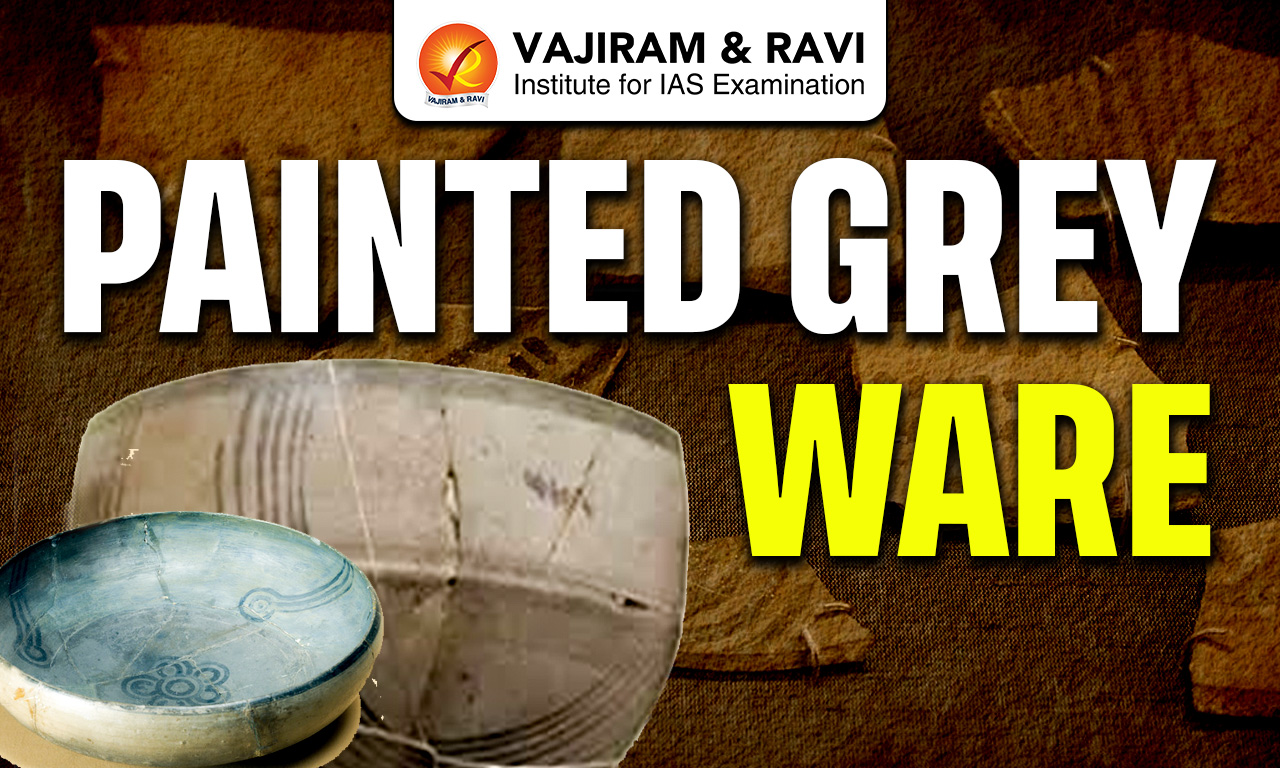
Painted Grey Ware is a type of ancient pottery known for its smooth grey colour and simple painted designs, usually in black. It was used by early communities in India and shows a clear improvement in pottery-making skills. The pots were well-made, light, and neatly designed, reflecting a more developed and settled way of life. This pottery is important because it helps us understand the culture and daily life of people in ancient times.
About Painted Grey Ware
- Meaning: Painted Grey Ware (PGW) is an ancient pottery style recognized by its fine grey finish and neat black designs, mostly in geometric shapes. It reflects the improvement and growing skill in pottery-making during early Indian times.
- Time Period: PGW belongs to the Iron Age in India and is generally dated between 1200 BCE to 600-500 BCE. This was a period when society was becoming more settled and organized, with important technological developments.
- Region / Distribution: It is mainly found in the western Gangetic plain and the Ghaggar-Hakra valley, covering regions of present-day Haryana, Uttar Pradesh, Punjab, and Rajasthan. Many important archaeological sites like Hastinapur and Ahichchhatra have yielded PGW pottery, showing its wide spread.
- Cultural Association: PGW is associated with early village and town settlements, indicating the beginning of urban life. It is also linked with the use of iron tools, domestication of horses, and crafts like ivory working, which show economic and social development. Some historians also connect PGW culture with the later Vedic period due to similarities in region and lifestyle.
- Features: PGW pottery is thin, light, and well-made, showing better craftsmanship than earlier pottery types. It has a smooth grey surface and is usually decorated with black painted designs such as lines, dots, spirals, circles, and other geometric shapes. Some pieces also include simple designs of plants and animals.
- Technique: Most of the pottery was made using the potter’s wheel, which helped in creating uniform shapes and smooth surfaces. It was fired at high temperatures in a controlled environment, which gave it strength and the typical grey colour. The improved firing technique shows better knowledge and skill of ancient potters.
- Shapes and Structure: The pots generally have simple and functional shapes with flat bases, making them easy to place and use. Common forms include bowls, dishes, vases, and storage containers. The design focuses more on usefulness and neat finishing rather than heavy decoration.
- Decoration: The decoration is mainly done with black paint on the grey surface, usually in geometric patterns. In some cases, polychrome designs (more than one colour) are also found. The neat and consistent patterns show a high level of skill and artistic sense.
- Special Types: Some perforated pots (pots with small holes) have been discovered. These were likely used for special purposes such as straining liquids or preparing food and beverages.
- Production: PGW pottery was often mass-produced using the wheel, which means many pieces look similar. This shows some level of organization, specialization of labour, and control in production, leaving less room for individual creativity.
- Lifestyle and Economy: People of the PGW culture lived in settled villages and early towns, practiced agriculture, and used iron tools, which improved farming and daily activities. The presence of both simple and high-quality pottery suggests economic differences in society, with some people having access to better goods.
- Uses: PGW was mainly used as tableware, such as bowls and dishes for eating and serving food. Some fine-quality pottery may have been used by wealthier sections or for special occasions.
- Significance: Painted Grey Ware is very important because it shows the transition to a more advanced and organized society in ancient India. It reflects developments in technology (especially iron use), settlement patterns, and social structure. It also helps historians understand the cultural changes during the later Vedic period and the early stages of urbanization in the Gangetic region.
Also Read: Indian Paintings


 Last updated on Oct, 2026
→ UPSC 2027 Notification will be released on 13 January 2027 at upsconline.nic.in.
→ Check Nobel Prize 2026 Winners List here.
→ Download PIB PRiSM Monthly Magazine 2026 here.
→ Check UPSC Monthly Current Affairs Magazine The Recitals here.
→ Check out the latest UPSC Syllabus here.
→ Download UPSC Model Answers for Mains 2026
→ UPSC Mains Question Paper 2026 is out now for Essay & GS Paper 1, 2, 3 & 4.
→ UPSC Calendar 2027 has been released.
→ Enroll in Vajiram & Ravi’s UPSC Mains Test Series 2027 for structured answer writing practice, expert evaluation, and exam-oriented feedback.
→ Join Vajiram & Ravi’s UPSC Mentorship Program 2027 for personalized guidance, strategy planning, and one-to-one support from experienced mentors.
→ Go through the UPSC Mains Previous Year Papers to enhance your preparation.
→ UPSC has released UPSC Toppers List 2025 with the Civil Services final result on its official website.
→ Also check Best UPSC Coaching in India
Painted Grey Ware FAQs
Q1. What is Painted Grey Ware (PGW)?+
Q2. What is the time period of PGW?+
Q3. Where was PGW mainly found?+
Q4. What are the main features of PGW?+
Q5. How was PGW made?+
Tags: history history notes painted grey ware