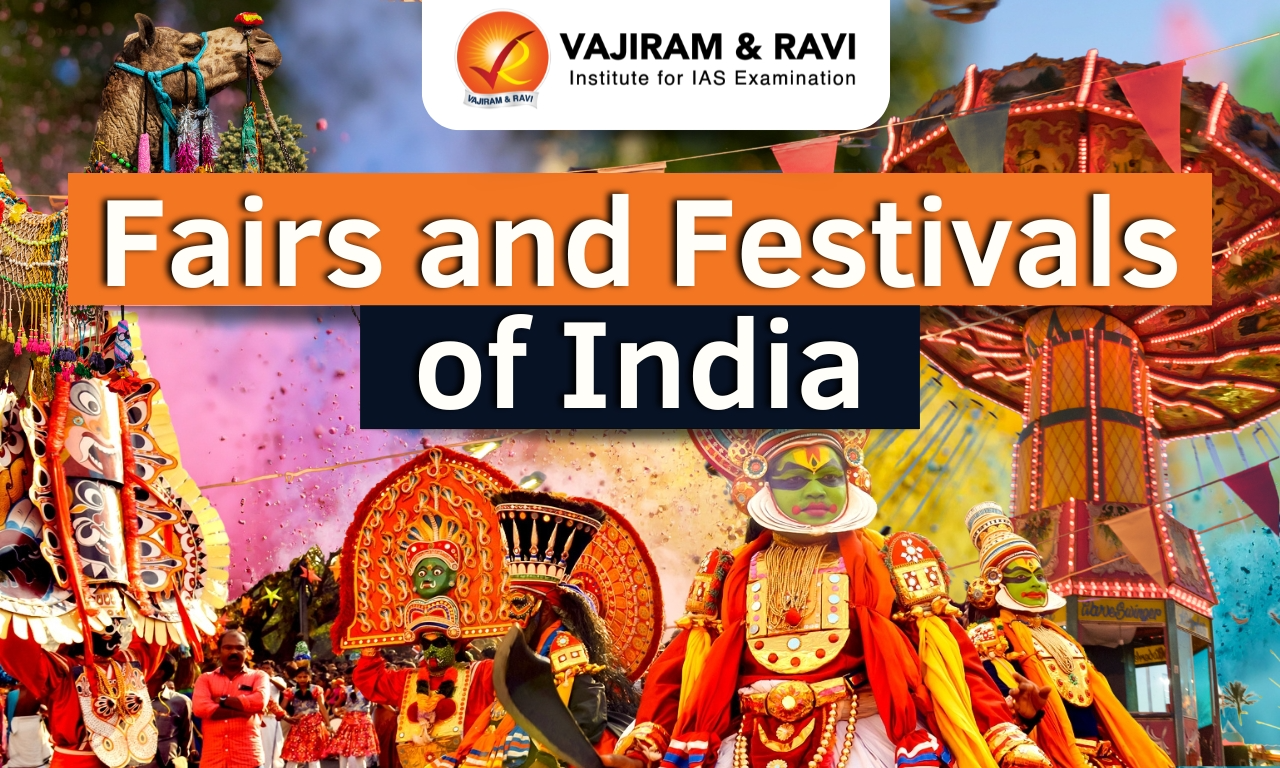
India is often described as a land of festivals because its cultural life is deeply rooted in traditions, religion, and community celebrations. Fairs and festivals in India are not merely occasions of joy; they reflect the country’s diversity, social cohesion, agricultural cycles, and spiritual beliefs. They play an important role in preserving cultural heritage and promoting unity in diversity.
Fairs of India 2026
Fairs in India are large public gatherings that combine religious rituals, trade, entertainment, and cultural exchange. They often have historical origins and are linked with pilgrimage sites, seasonal changes, or local traditions.
Kumbh Mela
- Location: Prayagraj (Uttar Pradesh), Haridwar (Uttarakhand), Ujjain (Madhya Pradesh), Nashik (Maharashtra)
- Kumbh Mela is the largest religious gathering in the world, attended by millions of devotees over several weeks.
- It is based on the myth of Samudra Manthan, where Lord Vishnu spilled drops of amrit (nectar) from a kumbh (pot). These drops are believed to have fallen at four places – Prayagraj, Haridwar, Ujjain, and Nashik, making them sacred pilgrimage sites.
- Devotees take a holy dip during the Mela, which is believed to purify sins and help attain salvation (moksha).
- The Kumbh Mela is held every 3 years in rotation among the four locations.
- The Maha Kumbh Mela takes place once every 12 years at Triveni Sangam, considered the holiest site.
- The timing and location are determined by the astrological positions of the Sun, Moon, and Jupiter.
- It has been recognized by UNESCO as an Intangible Cultural Heritage of Humanity.
Sonepur Mela
- Location: Sonepur, Bihar
- Sonepur Mela is one of Asia’s largest cattle fairs and is held annually on Kartik Purnima.
- It has ancient origins, with Chandragupta Maurya buying elephants and horses from across the Ganges.
- Today, it includes traditional bathing, temple visits, stalls, and amusement parks.
Chitra Vichitra Fair
- Location: Sabarkantha, Gujarat
- This tribal fair is held near the Gujarat-Rajasthan border and is associated with ancestral rituals.
- People mourn the death of their loved ones and then celebrate life through fairs and cultural events.
- The fair takes place near the confluence of the Sabarmati, Wakal, and Aakal rivers.
Shamlaji Mela
- Location: Shamlaji, Gujarat
- Shamlaji Mela is held near the Shamlaji Temple during Kartik Purnima.
- Tribal communities, including Bhils and Garasias, actively participate in the fair.
- Devotees perform ritual bathing in the Meshwo river as part of the celebrations.
Pushkar Fair
- Location: Pushkar, Rajasthan
- Pushkar Fair is one of the largest camel and livestock fairs in the world.
- The fair combines livestock trading with cultural events, competitions, and entertainment.
- It attracts both Indian and international tourists for its vibrant atmosphere and traditional festivities.
Jaisalmer Desert Festival
- Location: Jaisalmer, Rajasthan
- The festival is held in the Thar Desert before the full moon in the month of Magh.
- It showcases Rajasthani culture through folk music, dance, and traditional performances.
- Unique competitions such as turban tying, camel races, and longest moustache contests are key attractions.
Kolayat Fair
- Location: Kolayat, Bikaner, Rajasthan.
- Kolayat Fair is held in honour of Sage Kapil, who is believed to have performed ‘tapasya’ here for the redemption of humanity.
- Devotees take ritual baths at the 52 ghats surrounding the lake.
Surajkund Crafts Mela
- Location: Surajkund, Haryana
- Surajkund Crafts Mela is one of the largest handicraft fairs in the world.
- It showcases traditional handicrafts, handlooms, and cultural performances from across India.
Gangasagar Mela
- Location: Gangasagar, West Bengal
- Gangasagar Mela is held at the confluence of the Ganga and Bay of Bengal during Makar Sankranti.
- It is the second-largest religious gathering in India after Kumbh Mela.
- Devotees take a holy dip in the waters and visit the Kapil Muni Ashram for blessings.
Goa Carnival
- Location: Goa
- The Goa Carnival is a pre-Lenten festival introduced by the Portuguese.
- It features colourful parades, music, dances, and cultural performances led by King Momo.
- The festival reflects Goa’s unique Indo-Portuguese heritage and attracts tourists from around the world.
Joydev Kenduli Mela
- Location: Birbhum, West Bengal
- This fair is famous for gatherings of Baul singers and mystic musical performances.
- It is held at the birthplace of poet Jayadeva, who composed the Gita Govinda.
- The fair celebrates the Baul tradition, which is recognized by UNESCO as intangible cultural heritage.
Chillai Kalan
- Location: Kashmir Valley
- Chillai Kalan is a 40-day period of severe winter in Kashmir, from December 21 to late January.
- During this period, temperatures drop drastically, and heavy snowfall occurs.
- Local traditions include preparing special winter foods and adapting daily life to harsh weather conditions.
Major Festivals of India 2026
India is a land of vibrant festivals, where every celebration reflects the country’s rich cultural heritage, religious diversity, seasonal cycles, and social traditions.”
Hindu Festivals
- Diwali: A five-day festival celebrating the victory of light over darkness and good over evil, associated with Lord Rama’s return to Ayodhya and the worship of Goddess Lakshmi for prosperity.
- Holi: Known as the festival of colors, it marks the arrival of spring and celebrates joy, social harmony, and the triumph of good over evil through the story of Prahlad.
- Navratri and Dussehra: Navratri involves nine days of worship of Goddess Durga, symbolizing feminine power, and concludes with Dussehra, commemorating Lord Rama’s victory over Ravana.
- Makar Sankranti: Celebrated as the Sun enters Capricorn, this festival marks the end of winter and is observed with kite flying, feasts, and ritual dips in holy rivers.
- Chhath Puja: Dedicated to the Sun God, mainly celebrated in Bihar and eastern India, it involves rigorous fasting and offering prayers at riverbanks.
- Onam: Kerala’s harvest festival celebrating the homecoming of King Mahabali, marked with cultural programs, feasts, and traditional games.
- Pongal: Tamil Nadu’s harvest festival, expressing gratitude to the Sun God, involving preparation of the Pongal dish and thanksgiving rituals.
- Ratha Yatra: Held in Puri, Odisha, this festival features grand chariot processions of Lord Jagannath, attracting thousands of devotees.
Islamic Festivals
- Eid-ul-Fitr: Celebrated at the end of Ramadan, it involves prayers, charity (Zakat), and festive feasting.
- Eid-ul-Adha: Commemorates Prophet Ibrahim’s willingness to sacrifice his son in obedience to God, marked by sacrificial offerings and charitable acts.
- Muharram: A period of mourning for Shia Muslims, remembering the martyrdom of Imam Hussain at the Battle of Karbala.
Christian Festivals
- Christmas: Celebrates the birth of Jesus Christ, observed with prayers, decorations, and exchange of gifts.
- Good Friday and Easter: Good Friday commemorates the crucifixion of Jesus, while Easter celebrates his resurrection and victory over death.
Sikh Festivals
- Gurpurab: Marks the birth anniversaries of Sikh Gurus, especially Guru Nanak, with kirtans, processions, and community meals (langar).
- Baisakhi: Celebrates the formation of the Khalsa and the harvest season in Punjab.
Jain Festivals
- Mahavir Jayanti: Commemorates the birth of Lord Mahavira with processions, prayers, and religious gatherings.
- Paryushana: A major festival emphasizing fasting, self-discipline, and forgiveness, observed by Jains across India.
Buddhist Festivals
- Buddha Purnima: Marks the birth, enlightenment, and Mahaparinirvana of Gautama Buddha.
- Losar and Hemis Festival: Celebrated in Himalayan regions, these festivals reflect Tibetan Buddhist traditions and local culture.
Regional and Tribal Festivals
- Bihu: Assam’s agricultural festival celebrating the harvest season, music, and dance.
- Hornbill Festival: Nagaland’s festival showcasing Naga traditions, culture, and heritage.
- Bathukamma: Telangana’s floral festival highlighting women’s participation and regional culture.


 Last updated on Oct, 2026
→ UPSC 2027 Notification will be released on 13 January 2027 at upsconline.nic.in.
→ Check Nobel Prize 2026 Winners List here.
→ Download PIB PRiSM Monthly Magazine 2026 here.
→ Check UPSC Monthly Current Affairs Magazine The Recitals here.
→ Check out the latest UPSC Syllabus here.
→ Download UPSC Model Answers for Mains 2026
→ UPSC Mains Question Paper 2026 is out now for Essay & GS Paper 1, 2, 3 & 4.
→ UPSC Calendar 2027 has been released.
→ Enroll in Vajiram & Ravi’s UPSC Mains Test Series 2027 for structured answer writing practice, expert evaluation, and exam-oriented feedback.
→ Join Vajiram & Ravi’s UPSC Mentorship Program 2027 for personalized guidance, strategy planning, and one-to-one support from experienced mentors.
→ Go through the UPSC Mains Previous Year Papers to enhance your preparation.
→ UPSC has released UPSC Toppers List 2025 with the Civil Services final result on its official website.
→ Also check Best UPSC Coaching in India
Fairs and Festivals of India FAQs
Q1. Where is Kumbh Mela celebrated and how?+
Q2. Where is Pushkar Fair held?+
Q3. Where is Sonepur Mela celebrated and how?+
Q4. Where is Pongal celebrated and how?+
Q5. Where is Bihu celebrated?+
Tags: fairs and festivals of india indian art and culture