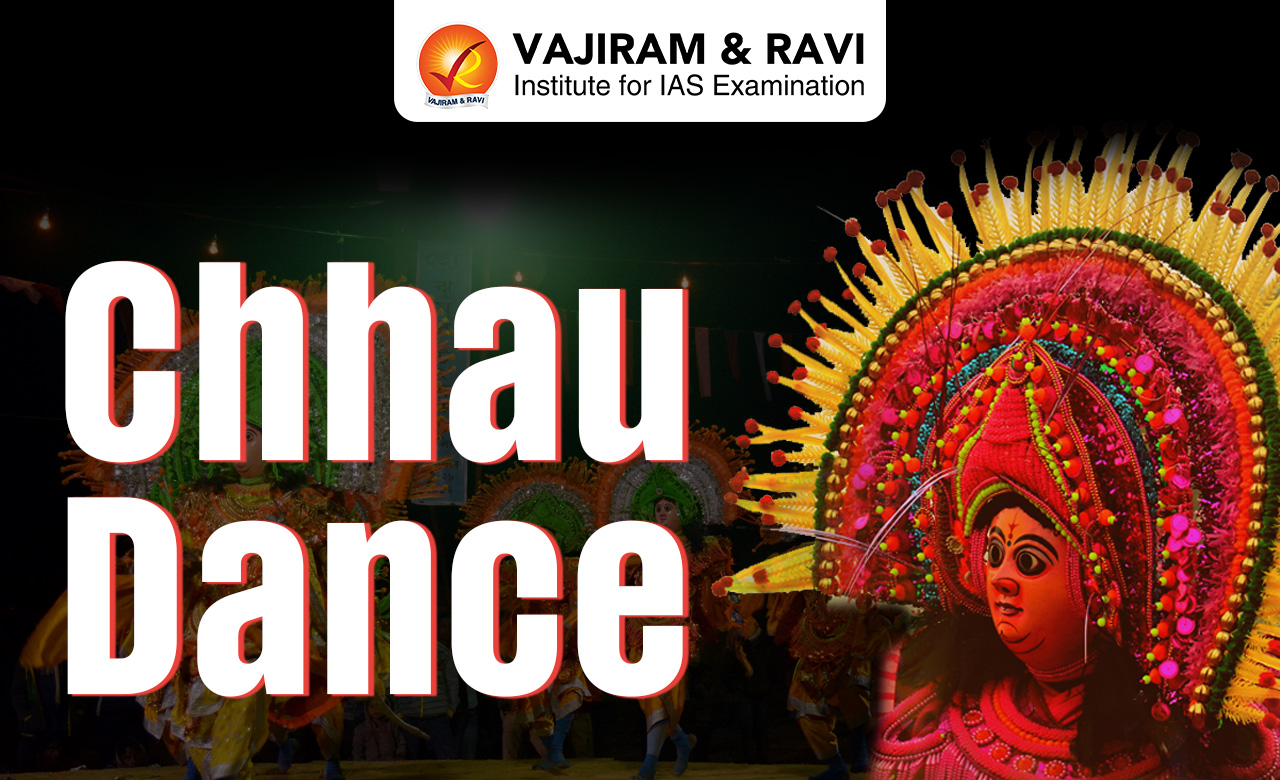
Chhau Dance is a vibrant semi classical dance form from eastern India that blends martial traditions with folk and tribal elements. It originated in the Kalinga region and is practiced mainly in Odisha, Jharkhand and West Bengal. The dance enacts stories from the Mahabharata, Ramayana, local folklore and abstract themes. It was traditionally performed by male artists. It reflects community life, cultural identity and is closely linked to festivals like Chaitra Parva.
Chhau Dance Features
Chhau Dance combines martial arts, storytelling and folk traditions, creating a powerful visual and rhythmic performance deeply rooted in community celebrations.
- Origin: Chhau is a semi classical Indian dance that evolved from indigenous martial practices and tribal traditions of eastern India, especially the Kalinga region, blending combat techniques with artistic expression.
- Regional Styles: It exists in three main styles: Purulia Chhau of West Bengal, Seraikella Chhau of Jharkhand and Mayurbhanj Chhau of Odisha, each differing in technique, costume and presentation.
- Themes and Narratives: The dance portrays episodes from the Ramayana, Mahabharata, Puranas, local folklore and abstract concepts, along with natural themes like Sarpa Nritya and Mayur Nritya.
- Festival: Chhau is closely linked to the spring festival Chaitra Parva, usually lasting around 13 days, where entire communities participate in performances and celebrations.
- Performance: It is performed at night in open spaces called akhada or asar, where dancers use body movements rather than facial expressions to convey emotions and stories.
- Martial Elements: The dance includes mock combat techniques known as khel, stylized movements of birds and animals like chalis and topkas and daily life inspired gestures called uflis.
- Music and Instruments: Performances are accompanied by traditional instruments like mohuri and shehnai, along with drums such as dhol, dhumsa and kharka, creating strong rhythmic beats.
- Participation: Traditionally performed by male dancers from local communities or artist families, though recent developments include participation by women, such as the Mitali Chhau Maldi troupe.
- Movement Style: The dance combines the energetic tandava style associated with Shiva and the graceful lasya elements derived from Nachni dance, adding both power and elegance.
- Cultural Significance: Chhau acts as a unifying force, bringing together diverse communities across social and linguistic backgrounds, though modern challenges like industrialization are reducing participation.
Chhau Mask
Chhau Masks are a defining feature of the dance, especially in Purulia and Seraikella styles, adding dramatic identity to characters and enhancing visual storytelling.
- Mask Usage: Masks are used in Purulia and Seraikella styles to depict characters, while Mayurbhanj Chhau does not use masks, relying instead on facial expressions and body movements.
- Symbolic Role: Masks represent gods, animals, demons and mythological figures, helping dancers portray roles effectively since their faces remain expressionless during performance.
- Crafting Community: These masks are traditionally made by artisans from the Sutradhar community, who specialize in clay based artistic creations of deities and cultural figures.
- Making Process: The process involves layering 8-10 sheets of paper with glue on a clay mould, adding clay features, applying cloth and mud layers, drying, polishing and final decoration.
- Decoration Style: Masks are painted in bright colours and decorated with materials like shola, making them visually striking and suitable for theatrical representation of mythological themes.
- Geographical Indication: The Purulia Chhau Mask has received Geographical Indication (GI) status, recognizing its uniqueness and traditional craftsmanship linked to the region.
- Cultural Identity: Masks not only enhance performance aesthetics but also preserve traditional knowledge passed orally across generations, making them integral to Chhau’s cultural heritage.


Chhau Dance Recognitions
Chhau Dance has received national and international recognition for its cultural significance, artistic value and role in preserving traditional heritage.
- UNESCO Recognition: In 2010, Chhau Dance was inscribed on the UNESCO Representative List of the Intangible Cultural Heritage of Humanity, highlighting its global cultural importance.
- Institutional Support: The Government of Odisha established institutions like the Mayurbhanj Chhau Nritya Pratisthan in Baripada to promote training, preservation and performance of this art form.
- Cultural Promotion: The Sangeet Natak Akademi has set up a National Centre for Chhau Dance (Chhau Kendra) in Bokaro Jharkhand, supporting research, documentation and dissemination of this traditional dance.
- Popularity: Chhau gained wider recognition through its appearance in the Hindi film Barfi!, where Purulia Chhau performances were featured prominently.

 Last updated on Oct, 2026
→ UPSC 2027 Notification will be released on 13 January 2027 at upsconline.nic.in.
→ Check Nobel Prize 2026 Winners List here.
→ Download PIB PRiSM Monthly Magazine 2026 here.
→ Check UPSC Monthly Current Affairs Magazine The Recitals here.
→ Check out the latest UPSC Syllabus here.
→ Download UPSC Model Answers for Mains 2026
→ UPSC Mains Question Paper 2026 is out now for Essay & GS Paper 1, 2, 3 & 4.
→ UPSC Calendar 2027 has been released.
→ Enroll in Vajiram & Ravi’s UPSC Mains Test Series 2027 for structured answer writing practice, expert evaluation, and exam-oriented feedback.
→ Join Vajiram & Ravi’s UPSC Mentorship Program 2027 for personalized guidance, strategy planning, and one-to-one support from experienced mentors.
→ Go through the UPSC Mains Previous Year Papers to enhance your preparation.
→ UPSC has released UPSC Toppers List 2025 with the Civil Services final result on its official website.
→ Also check Best UPSC Coaching in India
Chhau Dance FAQs
Q1. What is Chhau Dance?+
Q2. Which states are associated with Chhau Dance?+
Q3. What are the three styles of Chhau Dance?+
Q4. What are Chhau Masks used in Chhau Dance?+
Q5. When was Chhau Dance recognized by UNESCO?+
Tags: chhau dance history notes indian history