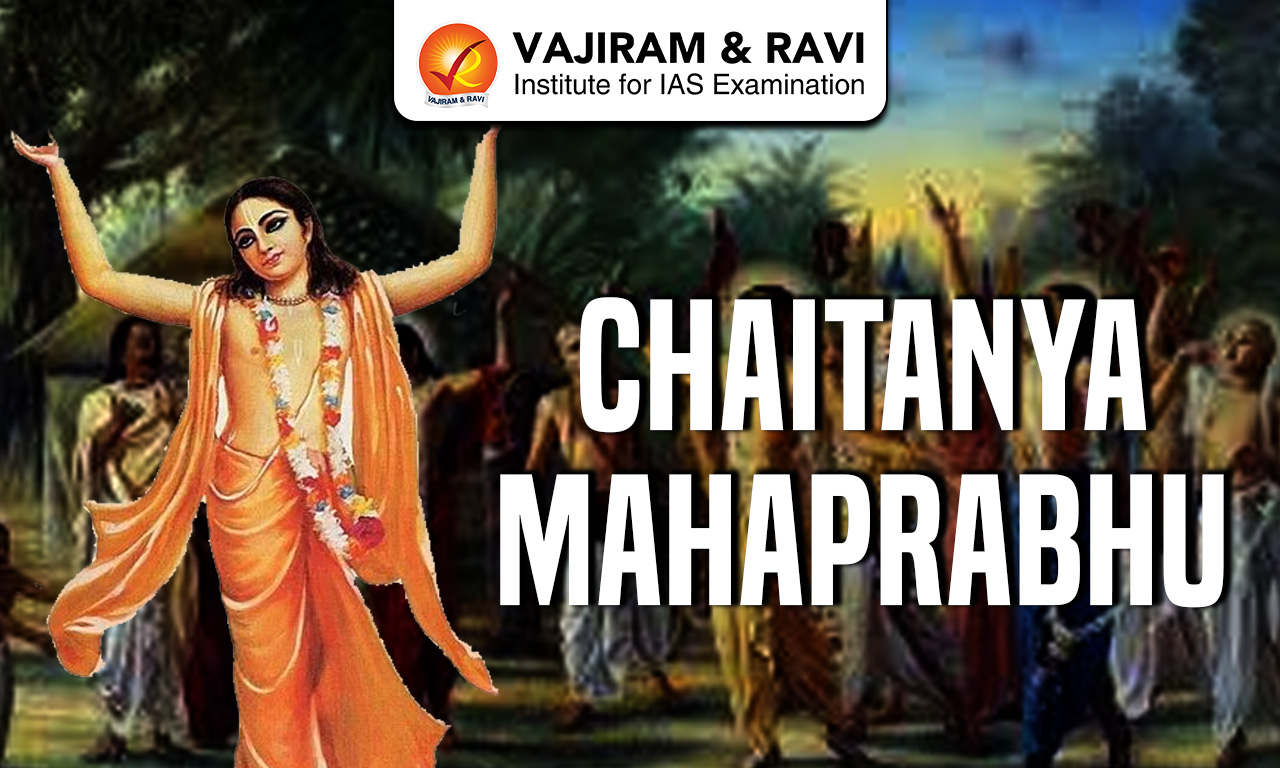
Chaitanya Mahaprabhu was a great saint and spiritual teacher who is remembered for spreading love and devotion towards Lord Krishna. He believed that true happiness comes from chanting God’s name and having a pure heart. Through his simple teachings and emotional devotion, he connected with people from all sections of society. His life inspired many to follow the path of bhakti (devotion), kindness, and unity.
About Chaitanya Mahaprabhu
- Birth and Early Life: Chaitanya Mahaprabhu was born in 1486 on the occasion of Phalguni Purnima at Nabadwip (Mayapur) in Bengal, and he was originally named Vishwambhar, later known as Nimai Pandit due to his scholarly nature, before becoming famous as Chaitanya Mahaprabhu after adopting a spiritual life.
- Names and Identity: He was also popularly known as Gauranga because of his fair complexion and Vishwambhar, and his different names reflect various phases of his life from a learned scholar to a devoted spiritual leader.
- Spiritual Guru and Influence: He became a disciple of Keshav Bharati, under whom he accepted sannyasa (renunciation), which marked a turning point in his life as he fully devoted himself to spiritual preaching.
- Role in Bhakti Movement: Chaitanya Mahaprabhu was one of the most important Bhakti reformers from Bengal, and he played a major role in spreading the message of devotion (bhakti), love, and equality among people, especially in eastern India.
- Devotion to Krishna: He was a great devotee of Lord Krishna and encouraged people to develop a personal connection with God through love and faith, treating devotion as the simplest path to spiritual fulfillment.
- Spread of Vaishnavism: He actively preached Vaishnavism in regions like Bengal and Odisha, and his teachings gave rise to a new tradition known as Gaudiya Vaishnavism, which focused on devotion to Radha and Krishna.
- Centre of Activities: Puri in Odisha became the main centre of his activities, where he spent a large part of his life spreading his teachings and engaging in devotional practices.
- Introduction of Kirtan Tradition: He popularized the practice of singing devotional songs (kirtans) as a form of worship, making spirituality more accessible and emotional, and encouraging collective participation in devotion.
- Popular Chanting Tradition: He widely promoted the chanting of “Hare Rama, Hare Krishna” as a simple and powerful way to connect with God, especially in the age of Kali Yuga.
- Philosophy of Achintya Bheda-Abheda: He taught the philosophy of Achintya Bheda-Abheda, which means the relationship between God and the world is both different and non-different at the same time, a concept that tries to balance unity and diversity in spiritual understanding.
- Nature of His Philosophy: His ideas were influenced by earlier traditions like those of Madhvacharya and Ramanuja but developed into a unique system that combined elements of dualism and qualified non-dualism.
- Teachings and Message: His teachings emphasized love for God (prema), devotion through chanting, equality among people, and the idea that the ultimate goal of life is to achieve divine love and spiritual realization.
- Siksastakam and Literary Contribution: Although he did not write many texts himself, his teachings were preserved in the form of eight verses called Siksastakam, which explain the core ideas of devotion and are considered very important in his tradition.
- Role of Disciples: His followers, especially the Six Goswamis of Vrindavan, later organized and spread his teachings in a systematic way through various texts and practices.
- Universal Religion Idea: He believed in a universal path of religion where people from all backgrounds could come together by chanting the name of God, promoting unity and reducing conflicts in society.
- Belief in Divine Incarnation: Followers of Gaudiya Vaishnavism consider him to be an incarnation of Lord Krishna who appeared in human form to show the path of devotion in the Kali Yuga.
- Cultural and Religious Impact: His influence spread widely across eastern India, and his devotional practices, especially kirtans and bhajans, continue to be an important part of religious life even today.
- Legacy and Importance: Chaitanya Mahaprabhu is remembered as a great spiritual reformer who simplified religion, emphasized love and devotion, and brought people together through faith, music, and collective worship.


 Last updated on Sep, 2026
→ UPSC 2027 Notification will be released on 13 January 2027 at upsconline.nic.in.
→ Asian Games 2026 are being held in Aichi-Nagoya, Japan, from 19 September to 4 October.
→ Check out the latest UPSC Syllabus here.
→ Download UPSC Model Answers for Mains 2026
→ UPSC Mains Question Paper 2026 is out now for Essay & GS Paper 1, 2, 3 & 4.
→ UPSC Calendar 2027 has been released.
→ Enroll in Vajiram & Ravi’s UPSC Mains Test Series 2027 for structured answer writing practice, expert evaluation, and exam-oriented feedback.
→ Join Vajiram & Ravi’s UPSC Mentorship Program 2027 for personalized guidance, strategy planning, and one-to-one support from experienced mentors.
→ Go through the UPSC Mains Previous Year Papers to enhance your preparation.
→ UPSC has released UPSC Toppers List 2025 with the Civil Services final result on its official website.
→ Also check Best UPSC Coaching in India
Chaitanya Mahaprabhu FAQs
Q1. Who was Chaitanya Mahaprabhu?+
Q2. Where and when Chaitanya Mahaprabhu was born?+
Q3. What was his main contribution to the Bhakti Movement?+
Q4. What is the philosophy of Achintya Bheda-Abheda?+
Q5. What role did kirtans play in his teachings?+
Tags: art and culture art and culture notes