Iran US talks Latest News
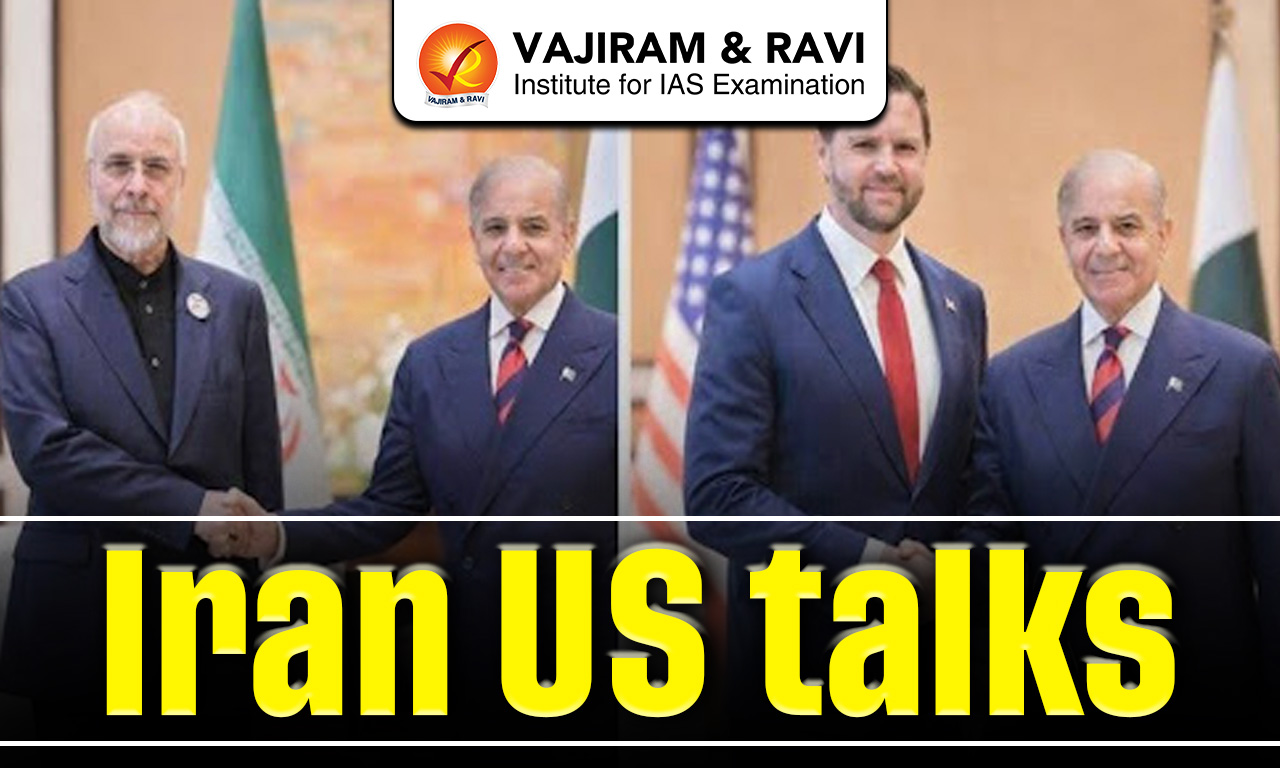
- High-stakes negotiations between the United States and Iran aimed at securing a ceasefire and a broader diplomatic framework collapsed after nearly 21 hours of intense discussions in Islamabad.
- The talks, mediated by Pakistan, ended without an agreement, with US Vice President JD Vance confirming that American negotiators returned home empty-handed.
- Despite the failure, the meeting itself was historically significant — marking the first high-level political contact between the US and Iran since the 1979 Islamic Revolution.
Core Issues That Led to the Breakdown
- The Nuclear Question — The Central Sticking Point
- The US demand for an unambiguous commitment from Iran to not pursue nuclear weapons — or the tools that would enable rapid acquisition of nuclear capability — remained the fundamental obstacle.
- Tehran insists that uranium enrichment is its sovereign right as a signatory of the Nuclear Non-Proliferation Treaty (NPT), which commits it to never building a nuclear weapon but does not prohibit civilian enrichment.
- Before the war began, Iran had offered to suspend nuclear operations for a few years — but refused to surrender its stockpile of 440+ kg of highly enriched uranium or permanently give up enrichment capability.
- The war has only hardened Iran’s position.
- Strait of Hormuz
- The US has demanded that Iran immediately reopen the Strait of Hormuz to all international maritime traffic.
- Iran, after 39 days of conflict, has come to recognise that the Strait — through which one-fifth of the world’s energy supply passes — is its single greatest strategic leverage, far more powerful than drones, missiles, or nuclear stockpiles.
- It is deeply reluctant to surrender this leverage without substantial concessions in return.
- Mutual Distrust
- Iran’s foreign ministry combined resolve with deep scepticism, stating that Iran has “not forgotten and will not forget the experiences of America’s breaches of promise.”
- This underlying trust deficit complicated even procedural progress.
- Iran’s Frozen Assets and Reparations
- Iran has demanded the release of approximately $27 billion in frozen revenues held in Iraq, Luxembourg, Bahrain, Japan, Qatar, Turkey, and Germany for post-war reconstruction.
- Additionally, Tehran has sought war reparations for damage caused by six weeks of airstrikes.
- The Americans have refused both demands. This has been Iran’s consistent position even from the pre-war negotiating period.


Positions of Each Side
- United States
- Immediate priority: Preventing Iran from acquiring nuclear weapons capability.
- Unwilling to move forward without an affirmative Iranian commitment on the nuclear question.
- Characterised the failure as “bad news for Iran more than for the USA.”
- Iran
- Insists on recognition of its legitimate rights, including uranium enrichment.
- Demands sanctions relief, war reparations, and a complete cessation of hostilities in the region.
- Accuses the US of maximalist and unlawful demands.
- Views diplomacy as a tool to secure national interests — alongside all other available means.
The Deadlock — and the Silver Lining
- Despite the collapse, neither side has walked away entirely.
- Vance left the door ajar, indicating that the US proposal remains “a final and best offer” for Iran to consider.
- The fact that Iran’s maximalist 10-point plan has been whittled down to three core sticking (Strait of Hormuz; Nuclear and Issue of Frozen Assets) points itself suggests some underlying progress.
- Iran has indicated it will consult with the IRGC, clergy, and the Supreme Leader before any further movement.
- Both sides retain a two-week ceasefire window to negotiate, and the willingness to talk — even without agreement — signals that diplomacy is still alive.
Pakistan’s Mediating Role
- Pakistan elevated its diplomatic profile significantly by hosting the talks.
- However, the lack of a breakthrough — and the apparent disconnect between the two sides — has raised questions about Pakistan’s effectiveness as a message carrier, given that Vance and Iranian negotiators appeared to be working from fundamentally different frameworks.
Impact on India
- India has been watching the negotiations with acute concern, given the severe economic impact of the conflict on its domestic economy.
- Key pressure points include gas shortages affecting LPG supply, potential petrol price hikes, disruption to sectors ranging from ceramics, plastics, and textiles to fertilisers, helium, agriculture, healthcare, and semiconductors.
- India has navigated the diplomatic space carefully — maintaining continuous engagement with Iran over six weeks and expressing concern over Israeli strikes on Lebanon without naming Israel.
- India has managed to secure passage for about eight to nine vessels through the Strait of Hormuz, highlighting just how dependent India is on the free flow of energy through this critical chokepoint.

 Last updated on Oct, 2026
→ UPSC 2027 Notification will be released on 13 January 2027 at upsconline.nic.in.
→ Asian Games 2026 are being held in Aichi-Nagoya, Japan, from 19 September to 4 October.
→ Check Nobel Prize 2026 Winners List here.
→ Download PIB PRiSM Monthly Magazine 2026 here.
→ Check UPSC Monthly Current Affairs Magazine The Recitals here.
→ Check out the latest UPSC Syllabus here.
→ Download UPSC Model Answers for Mains 2026
→ UPSC Mains Question Paper 2026 is out now for Essay & GS Paper 1, 2, 3 & 4.
→ UPSC Calendar 2027 has been released.
→ Enroll in Vajiram & Ravi’s UPSC Mains Test Series 2027 for structured answer writing practice, expert evaluation, and exam-oriented feedback.
→ Join Vajiram & Ravi’s UPSC Mentorship Program 2027 for personalized guidance, strategy planning, and one-to-one support from experienced mentors.
→ Go through the UPSC Mains Previous Year Papers to enhance your preparation.
→ UPSC has released UPSC Toppers List 2025 with the Civil Services final result on its official website.
→ Also check Best UPSC Coaching in India
Iran US talks FAQs
Q1. Why did Iran US talks collapse?+
Q2. What was the main issue in Iran US talks?+
Q3. What role did the Strait of Hormuz play in Iran US talks?+
Q4. What was Pakistan’s role in Iran US talks?+
Q5. How do Iran US talks affect India?+
Tags: Iran US talks mains articles upsc current affairs upsc mains current affairs