Delimitation and Women’s Reservation Bill Latest News
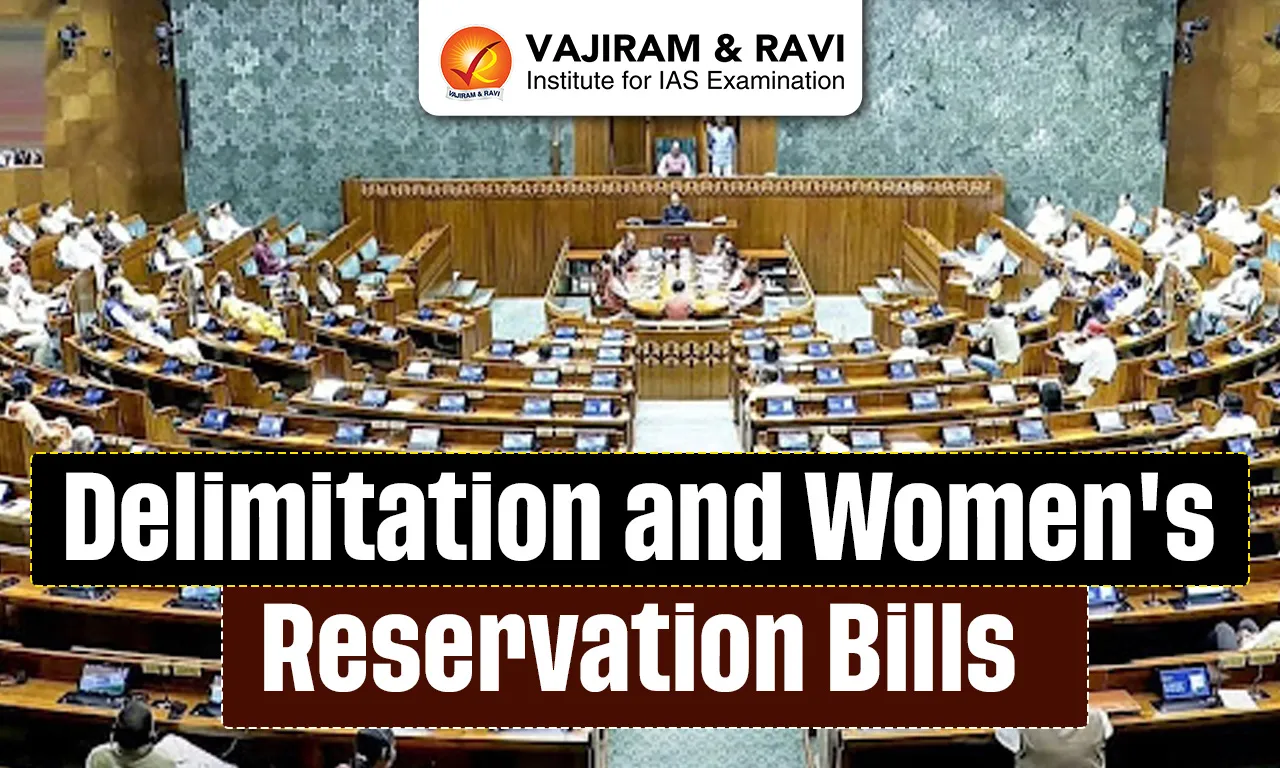
- The Union government has introduced three key Bills, including the Constitution (131st Amendment) Bill, 2026, to operationalise 33% reservation for women in the Lok Sabha and State Assemblies.
- These Bills also propose a major overhaul of the delimitation process, which has remained frozen since the 1970s.
The Legislative Package
- The Constitution (131st Amendment) Bill, 2026 — proposes expansion of Lok Sabha and amends Articles 81 and 82.
- The Delimitation Bill, 2026 — establishes a new Delimitation Commission framework.
- A third Bill facilitating women’s reservation in State Assemblies and Union Territory (UT) legislatures.


Key Provisions
- Expanding the Lok Sabha:
- From the current strength from the current 543 seats to up to 850, by revising the cap to 815 MPs from States and 35 from UTs.
- This represents a 50% increase over existing strength — and aligns with the seating capacity of 888 members in the new Parliament building (expandable to 1,272 for joint sittings). Larger membership would technically mean smaller constituency sizes geographically.
- Women’s reservation (The 2029 target):
- Although the Constitution (106th Amendment) Act, 2023 had already legislated 33% reservation for women, its implementation was tied to a post-Census delimitation.
- Since the 2021 Census remains ongoing with no clear completion timeline, the government now proposes conducting delimitation on the basis of the 2011 Census (the “latest Census”).
- Hence, the central government is targeting implementation from the 2029 Lok Sabha elections onwards.
- Redefining “Population” under Article 81:
- Shifting from “the last preceding Census” to “population as ascertained at such Census as Parliament may by law determine”.
- This grants Parliament the discretion to choose which Census data underpins any given delimitation exercise, introducing political flexibility into a previously constitutional-mechanical process.
The North-South Divide – A Political Fault Line
- Delimitation – a politically sensitive issue:
- Southern states — TN, Kerala, Karnataka, Andhra Pradesh, Telangana — achieved lower population growth rates by successfully implementing family planning policies.
- A straight population-based delimitation would therefore reduce their share of Lok Sabha seats relative to high-growth northern states.
- This concern led Parliament to freeze delimitation twice (in 1976 and 2001) — postponing seat readjustment until after the first Census post-2026.
- New mechanism:
- The new Bills propose removing this time-linked freeze, replacing it with a Parliament-triggered process.
- However, the constitutional principle (Article 81) that the population-to-seat ratio must be “as far as practicable, the same for all States” — directly conflicts with the commitment to preserve current regional seat proportions.
- Reconciling these two positions is expected to be the sharpest point of parliamentary debate.
Structural Shift in Delimitation
- Renaming Article 82: From “Readjustment after each Census” to “Readjustment of constituencies”, simultaneously removing the mandatory link between delimitation and decadal Census cycles.
- From two-thirds to simple majority:
- Historically, any deferral of delimitation required a two-thirds constitutional majority — precisely to prevent political manipulation of electoral boundaries.
- The proposed framework lowers this threshold to a simple parliamentary majority, potentially giving future ruling coalitions greater leverage to time delimitation exercises to political advantage.
- Delimitation Commission:
- The Delimitation Bill, 2026 provides for a Commission that will work on the basis of the “latest Census figures” and established criteria such as administrative boundaries, physical features, and public convenience.
- However, no allocation formula is specified for distributing seats across states, leaving a visible gap between political assurance and legal architecture.
Challenges
- Constitutional tension: The “one person, one vote, one value” principle under Article 81 is difficult to reconcile with the promise of maintaining existing seat proportions for southern states.
- Lowered constitutional safeguards: Moving delimitation from a constitutionally-triggered to a legislatively-triggered process reduces institutional protection against political misuse.
- Census delay: The ongoing 2021 Census has already derailed one implementation cycle; relying on the 2011 Census is a workaround, not a structural fix.
- Women’s reservation timeline: The 2029 target remains contingent on the delimitation process running smoothly and on time.
Way Forward
- Parliament must debate and define a clear seat-allocation formula that satisfies both the constitutional requirement of equitable representation and the political commitment to regional fairness.
- A transparent and independent Delimitation Commission with defined terms of reference — rather than broad legislative discretion — would strengthen public trust in the process.
- Restoring some form of constitutional safeguard around the frequency and triggers of delimitation would prevent future politicisation of constituency boundaries.
- The 2021 Census must be expedited, as continued delays will perpetuate uncertainty around future delimitations and reservation implementation.
Conclusion
- The proposed Bills mark a transformative moment in India’s electoral and constitutional framework.
- While the intent to fast-track representation reform is evident, the shift from a rule-based to discretion-based system raises critical concerns about federal balance, electoral fairness, and constitutional integrity.
- The success of these reforms will depend on transparency, institutional safeguards, and political consensus, ensuring that the democratic promise of inclusive and equitable representation is truly realised.

 Last updated on August, 2026
→ UPSC Mains 2026 commenced on 21st August 2026 and will continue through 30th August 2026, as per the official examination schedule.
→ UPSC Mains Question Paper 2026 is out now for Essay & GS Paper 1, 2, 3 & 4.
→ UPSC Mains GS Paper 1 2026 is out now.
→ UPSC Mains GS Paper 2 2026 is out now.
→ UPSC Mains GS Paper 3 2026 is out now.
→ UPSC Mains GS Paper 4 2026 is out now.
→ UPSC Mains Indian Language Paper & English Compulsory Paper are out now.
→ Check out the latest UPSC Syllabus 2026 here.
→ UPSC Mains Admit Card 2026 is now out.
→ Enroll in Vajiram & Ravi’s UPSC Mains Test Series 2027 for structured answer writing practice, expert evaluation, and exam-oriented feedback.
→ Join Vajiram & Ravi’s UPSC Mentorship Program 2027 for personalized guidance, strategy planning, and one-to-one support from experienced mentors.
→ Go through the UPSC Mains Previous Year Papers to enhance your preparation.
→ Download UPSC Mains Essay Paper 2025, UPSC Mains GS Paper-I 2025, UPSC Mains GS Paper-II 2025, UPSC Mains GS Paper-III 2025, UPSC Mains GS Paper-IV 2025, UPSC Mains English (Compulsory) Paper 2025, UPSC Mains Hindi (Qualifying) Paper 2025 here.
→ UPSC has released UPSC Toppers List 2025 with the Civil Services final result on its official website.
→ UPSC Calendar 2027 has been released.
→ Also check Best UPSC Coaching in India
Delimitation and Women's Reservation Bills FAQs
Q1. What is the significance of the Constitution (131st Amendment) Bill, 2026? +
Q2. How the proposed changes to Article 82 alter the nature of delimitation in India? +
Q3. What are the challenges in implementing women’s reservation in legislatures? +
Q4. How does the delimitation debate reflect tensions between federalism and electoral equality? +
Q5. What are the implications of redefining ‘population’ under Article 81?+
Tags: delimitation and women’s reservation bill mains articles upsc current affairs upsc mains current affair