Delimitation Latest News
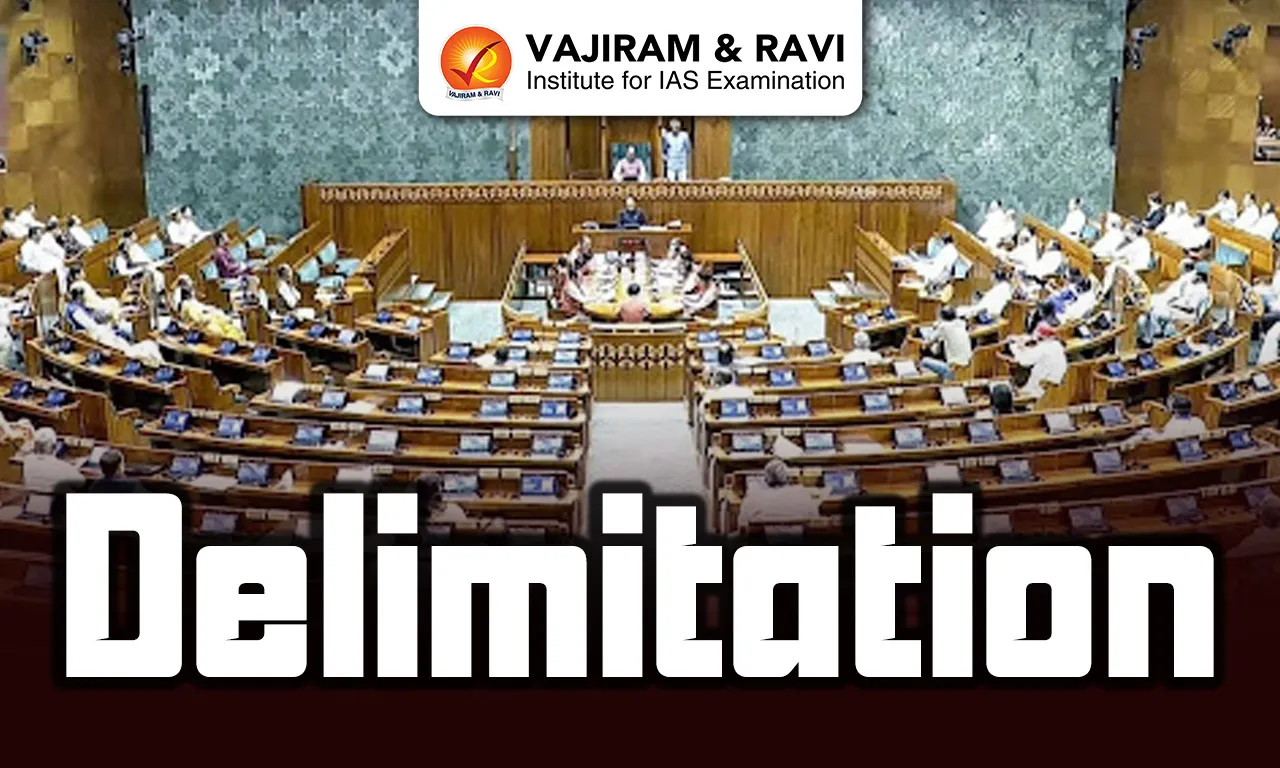
- Parliament’s Budget Session has reconvened to consider two major constitutional changes that could significantly reshape Indian democracy.
- The first proposes expanding the Lok Sabha from 543 to up to 850 seats through a new delimitation exercise led by a Delimitation Commission. The second links this process to the implementation of the Women’s Reservation Act (2023), which provides for one-third reservation for women in Parliament and state Assemblies, pending seat reallocation.
- Together, these reforms aim to make India’s democratic system more representative, inclusive, and equitable.
Delimitation Fast-Tracked to Enable Women’s Reservation
- Although women’s reservation was constitutionally approved in 2023, its implementation was tied to a delimitation exercise expected after the post-2026 Census.
- The government has now decided to expedite delimitation by amending provisions that had earlier imposed a freeze on it.
- This move makes delimitation the central focus of the current Parliamentary session, aimed at enabling the early rollout of women’s reservation in elections.


Constitutional Basis of Delimitation in India
- Delimitation is guided by the constitutional principle that each vote should carry equal weight.
- This requires constituencies across the country to have roughly equal populations, ensuring fair representation.
Constitutional Provisions Governing Delimitation
- Article 82 mandates the readjustment of Lok Sabha and Assembly constituencies after every Census, which may involve changing seat numbers or boundaries.
- Article 81 ensures that the ratio of population to seats is similar across states, so MPs represent comparable population sizes.
- This framework also applies to state Assemblies.
Freeze on Delimitation Since 1976
- Delimitation has not been conducted since 1976, primarily due to concerns from states with slower population growth.
- A 1976 Constitutional amendment froze delimitation for 25 years.
- In 2001, the freeze was extended for another 25 years until 2026.
- These states feared a loss of representation compared to faster-growing states.
Emerging Debate on Ending the Freeze
- The current government has indicated it will not extend the freeze beyond 2026.
- However, states with slower population growth remain concerned about widening representation disparities due to demographic differences.
Government’s Delimitation Proposal: Key Changes
- The government has proposed increasing the Lok Sabha strength from 543 to up to 850 seats (815 from States and 35 from Union Territories).
- While earlier assurances suggested a uniform 50% increase across states, the Bill does not explicitly guarantee this.
- The idea of proportional increase was aimed at protecting states with slower population growth from losing representation.
- However, the absence of a clear provision in the Bill leaves uncertainty over seat distribution.
Major Constitutional Changes Proposed
- Delinking Delimitation from Census – The amendment removes the requirement of conducting delimitation after every Census. Delimitation can now be carried out whenever Parliament approves it.
- Flexible Use of Census Data – Instead of using the latest Census, Parliament can decide which Census to use. This changes the definition of population from “last preceding Census” to “as determined by Parliament”.
- Enabling Immediate Delimitation – The changes allow the government to conduct delimitation based on the 2011 Census, without waiting for the next Census (expected around 2027). This provides greater flexibility in seat allocation and timing.
Delimitation Debate: Balancing Representation and Vote Value
- Uncertainty Over Seat Allocation – The absence of a clear provision for a uniform 50% increase in seats across states has created uncertainty, potentially leading to political disagreements over seat distribution.
- Trade-off: Proportionality vs Equality – A flat increase in seats across states may preserve existing representation proportions, but it would undermine the principle of “one vote, one value”, as population differences remain unaddressed.
Unequal Value of Votes
- Currently, disparities already exist:
- An MP in Himachal Pradesh represents ~17.16 lakh people
- An MP in Haryana represents ~25.35 lakh people
- This means a voter in Haryana has less representational weight than one in Himachal Pradesh.
- The goal of delimitation is to minimise such disparities by aligning constituencies closely with population size, ensuring more equal representation.
Impact of Population-Based Redistribution
- Strict population-based seat allocation could significantly alter state representation:
- Uttar Pradesh seats may rise from 80 to around 140
- Tamil Nadu may increase only marginally (39 to ~51)
- This could lead to major shifts in political power among states.
Opposition Criticism and Government Response on Delimitation Bills
- Opposition parties argue that the Bills do not guarantee maintaining the existing proportion of seats across states, contradicting earlier government assurances.
- They contend that the proposals may benefit states with higher population growth, effectively “rewarding” those that did not successfully implement family planning.
- The Opposition has also criticised the idea of a 50% increase in seats for all states, warning that it would widen the absolute gap between states with stabilised and growing populations.
- Telangana Chief Minister Revanth Reddy proposed a hybrid model combining population with economic indicators like GSDP.
Government’s Response
- Proposal to Add a Schedule – The government has indicated it will include a Schedule in the Bill specifying the proportionate increase in seats for each state.
- Addressing Southern States’ Concerns – This move aims to reassure southern states that their share of Lok Sabha seats will not decline.
- Greater Transparency in Allocation – The Schedule is expected to provide clear details on seat distribution, helping reduce uncertainty and political opposition.
Source: IE

 Last updated on Oct, 2026
→ UPSC 2027 Notification will be released on 13 January 2027 at upsconline.nic.in.
→ Check Nobel Prize 2026 Winners List here.
→ Download PIB PRiSM Monthly Magazine 2026 here.
→ Check UPSC Monthly Current Affairs Magazine The Recitals here.
→ Check out the latest UPSC Syllabus here.
→ Download UPSC Model Answers for Mains 2026
→ UPSC Mains Question Paper 2026 is out now for Essay & GS Paper 1, 2, 3 & 4.
→ UPSC Calendar 2027 has been released.
→ Enroll in Vajiram & Ravi’s UPSC Mains Test Series 2027 for structured answer writing practice, expert evaluation, and exam-oriented feedback.
→ Join Vajiram & Ravi’s UPSC Mentorship Program 2027 for personalized guidance, strategy planning, and one-to-one support from experienced mentors.
→ Go through the UPSC Mains Previous Year Papers to enhance your preparation.
→ UPSC has released UPSC Toppers List 2025 with the Civil Services final result on its official website.
→ Also check Best UPSC Coaching in India
Delimitation FAQs
Q1. What is delimitation and why is it important?+
Q2. What changes are proposed in delimitation reforms?+
Q3. How will delimitation affect states differently?+
Q4. What is the main criticism of delimitation proposals?+
Q5. How is delimitation linked to women’s reservation?+
Tags: Delimitation mains articles upsc current affairs upsc mains current affairs