MLFF Tolling Latest News
- The National Highway Authority of India (NHAI) has directed FASTag-issuing banks to verify and validate vehicle registration numbers (VRNs) linked to FASTags.
- This follows complaints of mismatches between scanned and actual license plates. Banks have been asked to blacklist incorrect or invalid FASTags.
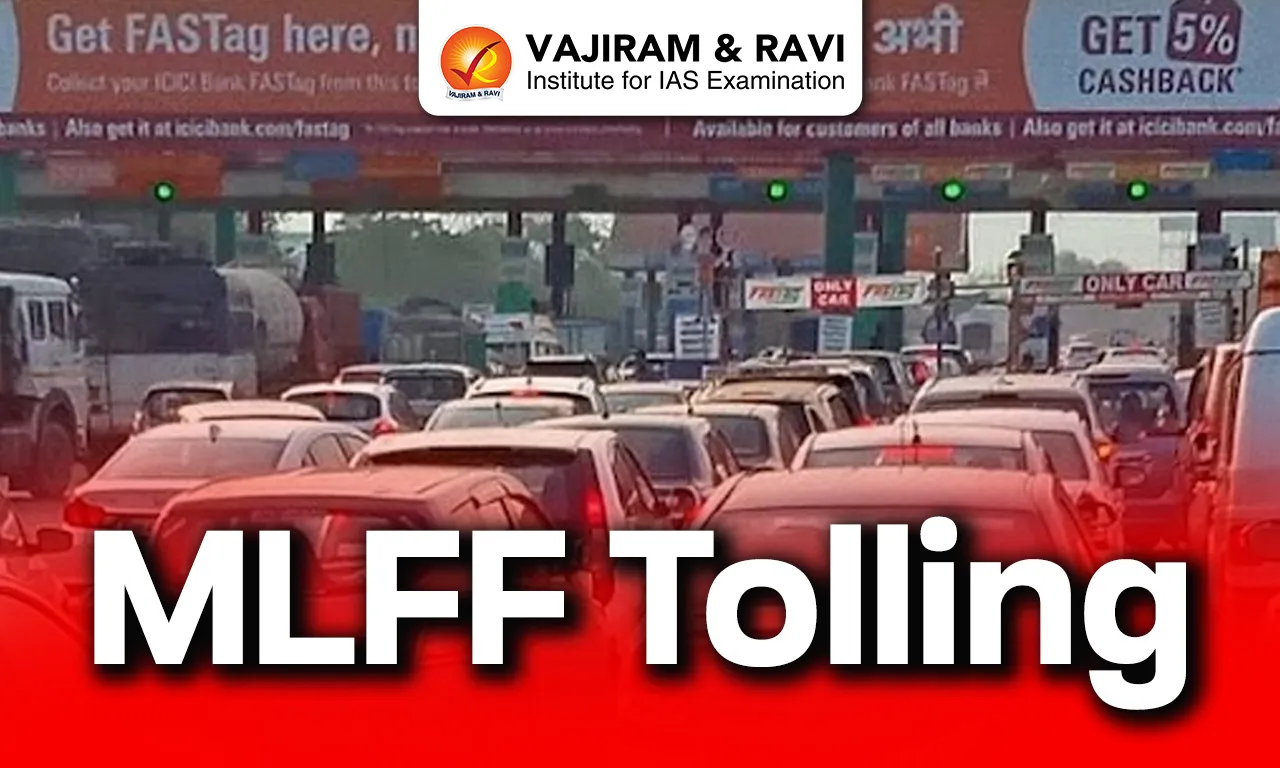
- The move is crucial for the rollout of the Multi-Lane Free Flow (MLFF) tolling system, which requires accurate VRN mapping for seamless, high-speed toll collection without stopping at plazas.
Multi-Lane Free Flow (MLFF) Tolling
- MLF tolling is a barrier-less, electronic system that allows vehicles to pay tolls at highway speeds (100+ kmph) without stopping or slowing down.
- It uses overhead gantries with RFID readers, ANPR cameras, and GNSS to automatically identify vehicles and deduct charges via FASTag.
Advantages of MLFF Tolling
- Seamless and Faster Toll Collection – The MLFF system enables vehicles to pass through toll points without stopping or slowing down, unlike the current system that requires halts at toll plazas. This significantly improves traffic flow and reduces congestion, especially on busy highways.
- Improved Efficiency for Commuters and Transporters – By eliminating manual checks and physical barriers, MLFF ensures quicker transit for both private and commercial vehicles, saving time and fuel while enhancing overall travel efficiency.
How MLFF Works
- MLFF relies on:
- Radio Frequency Identification (RFID) readers linked to FASTags
- Automatic Number Plate Recognition (ANPR) cameras
- These systems capture vehicle details and deduct tolls automatically without human intervention.
- Unlike traditional toll plazas, MLFF operates without boom barriers, making toll collection fully automated and continuous.
Challenges and Importance of Accurate Data
- Risk of Revenue Leakage – Without human verification, mismatches between FASTag data and vehicle registration numbers (VRNs) can allow vehicles to pass without paying tolls.
- Dependence on Verified Vehicle Data – Effective enforcement—such as electronic notices for non-payment—depends on accurate and validated vehicle identification.
- Legacy Issues in FASTag Data – Many mismatches arise from older FASTags issued before integration with the VAHAN database, when validation relied heavily on manual processes, leading to inconsistencies.


Additional Measures to Strengthen MLFF Tolling
- To ensure smooth implementation of the MLFF system and prevent misuse, the government has introduced new toll enforcement rules.
- In cases of unpaid toll, commuters must pay double the fee, but if payment is made within 72 hours, only the original amount is charged.
- An e-notice system has been introduced, detailing vehicle information, location, and payable fee.
- Additionally, a grievance redressal mechanism allows users to challenge notices within 72 hours; if unresolved within five days, the toll claim is cancelled.
Rollout of MLFF Tolling in India
- The Ministry of Road Transport and Highways (MoRTH) has awarded tenders for 16 toll plazas to implement the Multi-Lane Free Flow (MLFF) system.
- These include key locations across multiple states such as Haryana, Gujarat, Rajasthan, Delhi, Tamil Nadu, Andhra Pradesh, and Maharashtra.
- The initiative aims to eliminate queues, reduce congestion, save travel time, and improve fuel efficiency and toll collection.
First Barrier-Free Toll Plaza
- The Choryasi toll plaza in Gujarat is set to become India’s first fully barrier-free toll plaza, marking the beginning of MLFF implementation in the country.
- The government has already invited bids for an additional 36 toll plazas, indicating a phased expansion of MLFF across the national highway network.
- Major toll plazas selected include:
- Haryana: Gharaunda, Badarpur Faridabad
- Gujarat: Choryasi, Boariach
- Rajasthan: Daulatpura, Manoharpura, Shahjahanpur
- Delhi: Mundaka
- Tamil Nadu: Nemili, Chenasamudram, Paranur
- Andhra Pradesh: Kasepalli, Amakathadu, Marur
- Maharashtra: Chalakwadi, Hiwargaon Pavsa
Scale of FASTag-Based Tolling
- Currently, FASTag-enabled tolling on national highways is already substantial:
- Average daily collection: ~₹186 crore
- Average daily transactions: ~1.05 crore (FY 2025–26 till December 2025)
Conclusion
- The phased rollout of MLFF marks a major shift towards fully digital, high-speed tolling infrastructure, with significant potential to enhance efficiency, reduce congestion, and modernise India’s highway ecosystem.

 Last updated on Oct, 2026
→ UPSC 2027 Notification will be released on 13 January 2027 at upsconline.nic.in.
→ Check Nobel Prize 2026 Winners List here.
→ Download PIB PRiSM Monthly Magazine 2026 here.
→ Check UPSC Monthly Current Affairs Magazine The Recitals here.
→ Check out the latest UPSC Syllabus here.
→ Download UPSC Model Answers for Mains 2026
→ UPSC Mains Question Paper 2026 is out now for Essay & GS Paper 1, 2, 3 & 4.
→ UPSC Calendar 2027 has been released.
→ Enroll in Vajiram & Ravi’s UPSC Mains Test Series 2027 for structured answer writing practice, expert evaluation, and exam-oriented feedback.
→ Join Vajiram & Ravi’s UPSC Mentorship Program 2027 for personalized guidance, strategy planning, and one-to-one support from experienced mentors.
→ Go through the UPSC Mains Previous Year Papers to enhance your preparation.
→ UPSC has released UPSC Toppers List 2025 with the Civil Services final result on its official website.
→ Also check Best UPSC Coaching in India
MLFF Tolling FAQs
Q1. What is MLFF tolling?+
Q2. Why is FASTag validation important for MLFF tolling?+
Q3. What new rules has the government introduced?+
Q4. What are the advantages of MLFF tolling?+
Q5. Where is MLFF tolling being implemented in India?+
Tags: mains articles MLFF tolling upsc current affairs upsc mains current affair