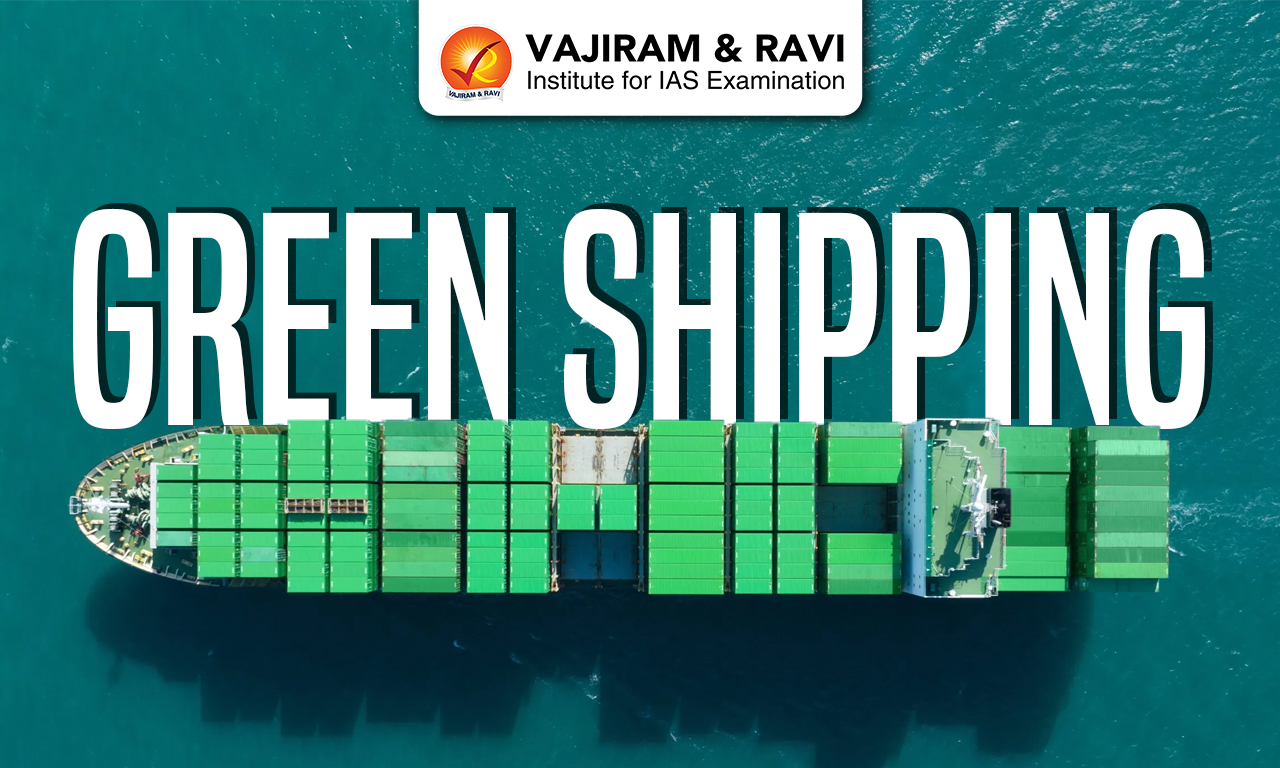
India’s maritime sector is a key part of its trade and infrastructure system, with nearly 95% of external trade by volume moving through ports. In FY 2024-25, major ports handled about 855 million tonnes of cargo, rising significantly from 581 million tonnes in FY 2014-15, reflecting strong growth under the vision of Atmanirbhar Bharat.
However, this expansion has also increased environmental stress. Ports contribute to air and water pollution as well as greenhouse gas emissions, affecting fragile coastal ecosystems like mangroves, coral reefs, and lagoons. In this context, green shipping has emerged as a necessary approach to balance economic growth with environmental sustainability and India’s climate commitments under its Intended Nationally Determined Contributions (INDCs).
Need for Green Shipping
The shift towards green shipping is driven by both global climate commitments and India’s own developmental priorities. Maritime transport is essential for global trade, but it is also a significant source of greenhouse gas emissions and marine pollution.
The International Maritime Organization (IMO) has set an ambitious target of reducing carbon emissions from international shipping by at least 40% by 2030, pushing countries to adopt cleaner maritime practices.
At the same time, sustainable shipping is crucial for protecting fragile marine ecosystems, achieving long-term climate goals, and ensuring the competitiveness and resilience of India’s growing maritime economy.
Key Dimensions of Green Shipping Transformation
The transition towards green shipping involves a comprehensive transformation of port and maritime operations across energy use, emissions control, resource management, and waste handling to ensure environmental sustainability.
- Renewable Energy Integration in Ports: Ports are increasingly adopting solar, wind, and hybrid energy systems. Several ports such as V.O. Chidambaranar Port Authority, and Paradip have made significant progress in solar energy installation. Emerging technologies such as floating solar plants, offshore wind, and tidal energy pilots are also being explored.
- Air Quality and Emission Reduction: Ports are shifting towards cleaner fuels such as LNG, electrified cargo handling equipment, and shore power systems. Electrification targets aim to cover over 50% of material handling equipment by 2030.
- Water Management: Ports are focusing on wastewater treatment, oil spill response systems, and water recycling. Technologies such as mist cannons and atomisers reduce water consumption significantly.
- Solid Waste and Dredging Management: Ports are improving waste segregation, recycling, and disposal systems in line with Swachh Bharat Mission objectives.


Policy Framework for Green Maritime Development in India
India’s green shipping strategy is anchored in a structured policy ecosystem aimed at aligning economic growth with environmental responsibility.
- Maritime India Vision 2030: The Maritime India Vision 2030 provides a comprehensive roadmap with over 150 initiatives to modernise ports, enhance efficiency, and promote sustainability. It emphasises renewable energy adoption, emission reduction, water conservation, waste management, and safety systems across ports.
- Maritime Amrit Kaal Vision 2047: The Maritime Amrit Kaal Vision 2047 offers a long-term blueprint for India’s maritime transformation with investments of nearly ₹80 lakh crore. It aims to position India as a global maritime leader through green ports, green shipping, and advanced shipbuilding ecosystems.
- Indian Ports Act, 2025: The Indian Ports Act, 2025 replaces the colonial-era framework and institutionalises modern environmental safeguards. It strengthens pollution control, disaster preparedness, and aligns Indian maritime regulations with international conventions such as MARPOL and ballast water management standards.
- Harit Sagar Green Port Guidelines: The Harit Sagar Green Port Guidelines provide measurable sustainability targets for ports, including: Reduction in carbon emissions per tonne of cargo by 30% by 2030 and 70% by 2047, increase in renewable energy usage to over 60% by 2030 and over 90% by 2047, electrification of more than 50% of port equipment by 2030, expansion of green cover and improvement in water reuse and conservation systems and implementation of shore-to-ship power supply systems in phases.
Major Government Initiatives Supporting Green Shipping
India’s green shipping transition is being advanced through a mix of infrastructure development programmes, clean fuel adoption strategies, institutional mechanisms, and innovation-led policies aimed at decarbonising the maritime sector while sustaining economic growth.
- Sagarmala Programme: The Sagarmala Programme promotes port-led development, logistics efficiency, and green infrastructure. It focuses on modernising ports, improving connectivity, and reducing logistics costs while also lowering emissions through sustainable port projects.
- Green Tug Transition Programme: The Green Tug Transition Programme facilitates the replacement of conventional fuel-based harbour tugs with green hybrid and alternative fuel-powered vessels. It strengthens clean port operations and supports domestic shipbuilding under the “Make in India” initiative.
- Harit Nauka Initiative: The Harit Nauka Guidelines aims to transition inland water transport towards green fuels and energy-efficient technologies, with a long-term vision of achieving fully green inland vessels by 2047.
- National Green Hydrogen Mission: The National Green Hydrogen Mission promotes the production and adoption of green hydrogen in shipping, ports, and heavy industries. It also envisages development of select ports as hydrogen hubs to enable clean fuel ecosystems.
- Institutional Support: The National Centre of Excellence in Green Ports and Shipping, developed in collaboration with TERI, supports research, innovation, and policy development in green maritime technologies, focusing on renewable energy integration and circular economy solutions.
Challenges in Green Shipping Transition
The transition to green shipping faces multiple structural, technological, and economic barriers that need coordinated intervention.
- High cost of transition: The shift to green fuels, electrification, and modern port infrastructure requires significant upfront capital investment, making adoption financially challenging.
- Limited fuel infrastructure: The absence of widespread bunkering and refuelling facilities for alternative fuels such as hydrogen and ammonia restricts large-scale deployment.
- Technological immaturity: Several green fuel technologies are still in early stages of development and lack full commercial viability at scale.
- Global coordination gaps: Inconsistent international regulatory frameworks slow down uniform implementation of emission reduction standards across countries.
- Competitiveness concerns: Balancing environmental sustainability with cost efficiency remains a key challenge for shipping operators in a highly competitive global market.
Way Forward
The future of green shipping depends on coordinated policy action, technological innovation, and strong financial support mechanisms.
- Scaling green fuels: Expansion of green hydrogen, ammonia, and advanced biofuels is essential for decarbonising maritime transport and reducing dependence on fossil fuels.
- Modernising port infrastructure: Ports must accelerate electrification, renewable energy adoption, and shore power systems to support low-emission operations.
- Strengthening R&D ecosystem: Increased investment in research and development is required to build indigenous capabilities in green shipbuilding, propulsion systems, and clean maritime technologies.
- Global regulatory alignment: Stronger cooperation under International Maritime Organization frameworks is necessary to ensure uniform emission standards and avoid regulatory fragmentation.
- Promoting green finance: Expansion of climate finance, blended finance models, and public–private partnerships is critical to support large-scale transition in the maritime sector.

 Last updated on Sep, 2026
→ UPSC 2027 Notification will be released on 13 January 2027 at upsconline.nic.in.
→ Asian Games 2026 are being held in Aichi-Nagoya, Japan, from 19 September to 4 October.
→ Check out the latest UPSC Syllabus here.
→ Download UPSC Model Answers for Mains 2026
→ UPSC Mains Question Paper 2026 is out now for Essay & GS Paper 1, 2, 3 & 4.
→ UPSC Calendar 2027 has been released.
→ Enroll in Vajiram & Ravi’s UPSC Mains Test Series 2027 for structured answer writing practice, expert evaluation, and exam-oriented feedback.
→ Join Vajiram & Ravi’s UPSC Mentorship Program 2027 for personalized guidance, strategy planning, and one-to-one support from experienced mentors.
→ Go through the UPSC Mains Previous Year Papers to enhance your preparation.
→ UPSC has released UPSC Toppers List 2025 with the Civil Services final result on its official website.
→ Also check Best UPSC Coaching in India
Green Shipping FAQs
Q1. What is green shipping?+
Q2. Why is green shipping important for India?+
Q3. Which fuels are used in green shipping?+
Q4. What are the main technologies used in green shipping?+
Q5. Which government initiatives promote green shipping in India?+
Q6. What are the main challenges in implementing green shipping?+
Tags: green shipping