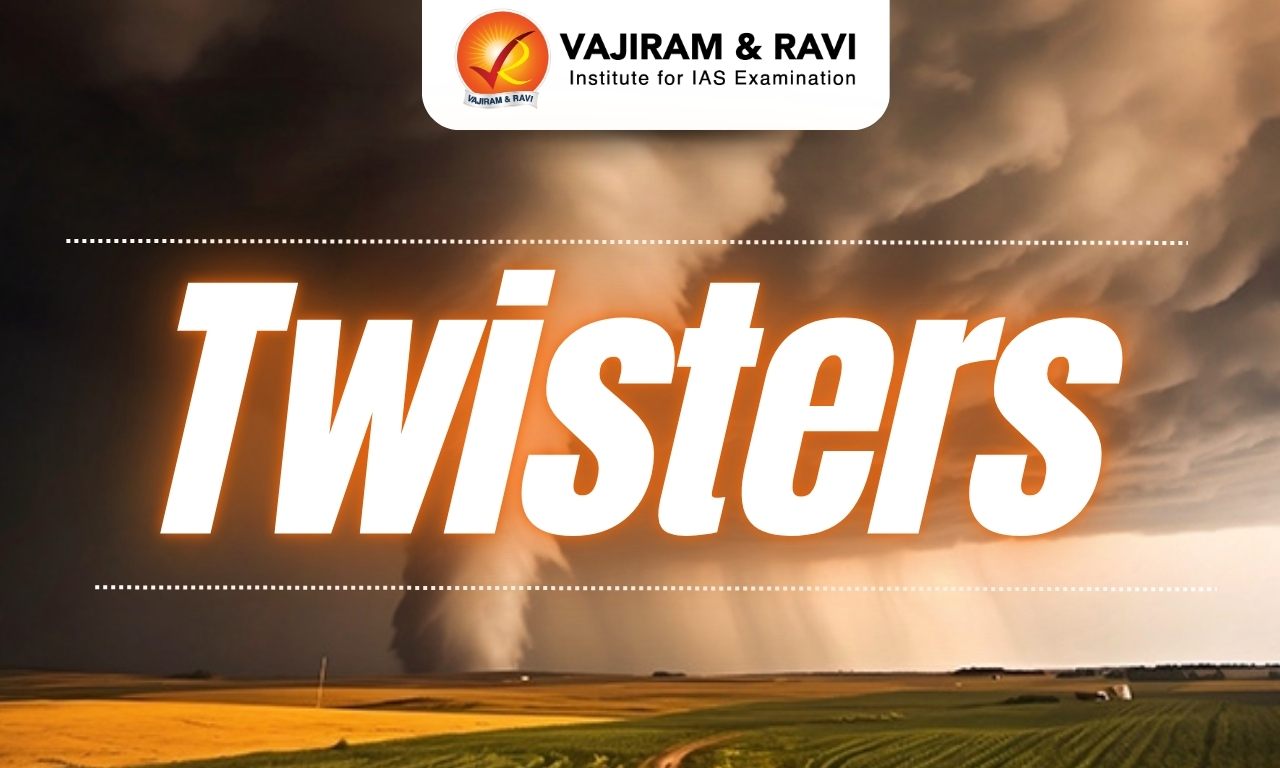
Twisters, commonly known as tornadoes, are among the most violent weather events on Earth. They are rapidly rotating columns of air that extend from a thunderstorm to the ground, capable of causing massive destruction within a short span of time.
What are Twisters?
Twisters, or tornadoes, are rapidly rotating columns of air that extend from a thunderstorm to the ground.
- They usually form during intense thunderstorms.
- The air begins to rotate at high speed, creating a funnel-shaped structure.
- This rotating column connects the base of the cloud with the Earth’s surface.
- Wind speeds are very high and can cause serious damage.
- It is termed a tornado only when this rotating air reaches the ground.
Formation of Twisters
The formation of twisters involves atmospheric instability, moisture, and changing wind patterns.
Key Conditions Required:
- Warm, moist air near the surface and cold, dry air above create strong atmospheric instability.
- Wind shear, which is a change in wind speed and direction with height, initiates horizontal rotation.
- Strong updrafts in thunderstorms tilt this rotation into a vertical position and intensify it.
Process: Twisters form when strong heating of the Earth’s surface creates a powerful thunderstorm with rising air. This rising air begins to rotate, and as it becomes stronger, it forms a spinning column inside the storm. At the same time, some air starts moving downward, which helps pull this rotating column closer to the ground. As the air cools, a visible funnel-shaped cloud appears. When this rotating column finally touches the ground, it becomes a tornado or twister. This entire process can happen very quickly, sometimes within a short period.


Characteristics of Twisters
Twisters display several distinct physical and dynamic features.
- They appear as a funnel-shaped cloud, sometimes visible only when dust and debris are lifted.
- Their colour may vary depending on surroundings, ranging from white or grey to dark brown or black.
- Their width can range from a few metres to more than 3 kilometres in extreme cases.
- Most tornadoes last less than 10 minutes, although stronger ones may persist for longer durations.
- They follow an unpredictable path and rotate counter-clockwise in the Northern Hemisphere and clockwise in the Southern Hemisphere.
- Flying debris is the primary cause of damage and casualties.
Types of Twisters
Twisters vary in structure and intensity.
- Supercell tornadoes are the strongest type of twisters. They form from highly organised thunderstorms that contain a rotating air column called a mesocyclone, and they are responsible for most severe damage.
- Landspouts are weaker tornadoes that form without a mesocyclone. They are generally short-lived and less destructive compared to supercell tornadoes.
- Waterspouts are tornado-like systems that form over water bodies such as seas or lakes. In some cases, they may move onto land and cause damage.
- Multiple-vortex tornadoes consist of two or more smaller rotating columns within a larger tornado. These sub-vortices increase the intensity and destructive capacity of the storm.
Measurement and Classification of Twisters
Twisters are measured using the Enhanced Fujita (EF) Scale, which classifies them based on damage and estimated wind speeds. The scale is based on observed damage rather than direct measurement of wind speed. Most tornadoes fall in the weaker categories, while the strongest ones cause maximum destruction.
| Measurement and Classification of Twisters | ||
| EF Category | Wind Speed (km/h) | Damage Level |
|
EF0 |
105-137 |
Light |
|
EF1 |
138-178 |
Moderate |
|
EF2 |
179-218 |
Considerable |
|
EF3 |
219-266 |
Severe |
|
EF4 |
267-322 |
Devastating |
|
EF5 |
Above 322 |
Catastrophic |
Twisters Global Distribution
Twisters (tornadoes) are more common in certain regions due to favourable climatic conditions.
- The United States of America records the highest frequency of tornadoes globally. The central plains region, popularly known as Tornado Alley, experiences the maximum number of events due to the collision of warm, moist air from the Gulf of Mexico with cold, dry air from Canada. In recent years, the southeastern United States, referred to as Dixie Alley, has also emerged as a significant high-risk zone.
- Bangladesh and parts of the Indian subcontinent, particularly eastern and northeastern India, also experience tornadoes. These are often associated with severe pre-monsoon thunderstorms (Nor’westers), which create conditions for intense but short-lived tornado formation.
- Argentina, especially the Pampas region, is another important tornado-prone area due to strong seasonal atmospheric instability and interaction of tropical and polar air masses.
- Other regions such as Canada, Australia, South Africa, and parts of Europe experience occasional tornadoes when favourable weather conditions develop.
- Globally, tornadoes have been recorded on all continents except Antarctica, as it lacks the necessary warm surface conditions required for thunderstorm development.
Twisters in India
Twisters (tornadoes) are relatively less frequent in India compared to countries like the United States, but they do occur, especially under specific seasonal and regional weather conditions. They are generally associated with severe thunderstorms and are most commonly observed in the eastern and northeastern parts of the country.
- In India, twisters are mainly linked with pre-monsoon thunderstorms known as Nor’westers (Kal-baishakhi). These storms are common during April and May when intense surface heating creates unstable atmospheric conditions.
- The most affected regions include West Bengal, Odisha, Bihar, Jharkhand, Assam, and parts of the northeastern states. These areas experience strong convective activity due to the interaction between hot continental air and moist air from the Bay of Bengal.
- Twisters in India are usually short-lived but highly destructive, as they often strike without strong forecasting systems and affect densely populated rural regions.
- Although less frequent, India has witnessed some notable tornado events, such as the 2010 Bihar tornado, which caused significant loss of life and property, and severe events reported in Odisha and West Bengal.
- Occasional waterspouts over rivers and coastal areas have also been recorded, particularly in eastern India.
Overall, while India is not a major tornado-prone region globally, its eastern belt remains vulnerable during the pre-monsoon thunderstorm season.
Impacts of Twisters
Twisters have severe environmental and socio-economic impacts.
- Destruction of houses, infrastructure, and public utilities
- Loss of life and injuries due to strong winds and flying debris
- Damage to agriculture, including crops and livestock
- Disruption of transport, communication, and essential services
- Economic losses and displacement of affected populations
Twisters Management and Mitigation
Although twisters cannot be prevented, their impact can be reduced through effective measures.
- Development of advanced weather forecasting and early warning systems
- Use of Doppler radar to detect rotation within storms
- Construction of strong buildings and designated storm shelters
- Public awareness regarding safety measures during tornado events
- Effective disaster response and evacuation planning
- Integration of tornado risk into disaster management policies, especially in vulnerable regions

 Last updated on Oct, 2026
→ UPSC 2027 Notification will be released on 13 January 2027 at upsconline.nic.in.
→ Check Nobel Prize 2026 Winners List here.
→ Download PIB PRiSM Monthly Magazine 2026 here.
→ Check UPSC Monthly Current Affairs Magazine The Recitals here.
→ Check out the latest UPSC Syllabus here.
→ Download UPSC Model Answers for Mains 2026
→ UPSC Mains Question Paper 2026 is out now for Essay & GS Paper 1, 2, 3 & 4.
→ UPSC Calendar 2027 has been released.
→ Enroll in Vajiram & Ravi’s UPSC Mains Test Series 2027 for structured answer writing practice, expert evaluation, and exam-oriented feedback.
→ Join Vajiram & Ravi’s UPSC Mentorship Program 2027 for personalized guidance, strategy planning, and one-to-one support from experienced mentors.
→ Go through the UPSC Mains Previous Year Papers to enhance your preparation.
→ UPSC has released UPSC Toppers List 2025 with the Civil Services final result on its official website.
→ Also check Best UPSC Coaching in India
Twisters FAQs
Q1. What are twisters?+
Q2. What is the difference between a twister and a tornado?+
Q3. How do twisters form?+
Q4. Where do twisters occur most in the world?+
Q5. Are twisters common in India?+
Q6. How are twisters measured?+
Q7. Why are twisters so destructive?+
Tags: twisters