3D Glass Semiconductor Latest News
- The foundation stone for India’s first advanced 3D chip packaging unit was laid in Bhubaneswar, Odisha.
- Approved under the India Semiconductor Mission (ISM) at a cost of ₹1,934 crore, the facility is led by US-based 3D Glass Solutions and has received investments from Intel, Lockheed Martin, and other venture capital and private equity funds.
- It is being described as the project that will put India “at the cutting edge of technology” in advanced chip packaging.
What are Semiconductors and Why Do They Matter
- A semiconductor is a material (usually silicon) that can conduct electricity under certain conditions — making it the foundation of all modern electronics, from smartphones and laptops to missiles and satellites.
- Chips (or integrated circuits) are tiny devices made from semiconductors that process and store information.
- Every digital device —phone, car, ATM — runs on chips. Countries that can design and manufacture chips hold enormous technological, economic, and strategic power.


Moore’s Law and its Limitations
- Moore’s Law, formulated in 1965 by Gordon Moore (co-founder of Intel), states that the number of transistors on a chip doubles approximately every two years, driving exponential improvements in computing power while reducing costs.
- For decades, this was the guiding principle of the semiconductor industry — chips kept getting smaller, faster, and cheaper.
- However, chips are now approaching physical and thermal limits — one simply cannot keep shrinking transistors indefinitely.
- As a result, the industry is now pursuing alternative strategies to sustain performance improvements — the most promising of which are advanced packaging, chiplets, and 3D integration.
Traditional Chips vs. 3D Glass Chips — What’s the Difference
- Traditional chips are built on silicon wafers, with all components arranged side by side on a flat, planar surface.
- This works well up to a point, but as one tries to fit more and more components onto the same flat surface, he/she inevitably hit physical limits.
- There is only so much space on a single layer, and beyond a certain point, components simply cannot be made any smaller or packed any tighter without causing errors, overheating, or signal interference.
3D Glass Chips — The Next Generation
- Think of 3D chips as skyscrapers instead of bungalows — instead of spreading components sideways, stack them vertically, dramatically increasing computing power within the same physical footprint.
- Key advantages of glass-based 3D chips include:
- Better thermal stability — glass handles heat more efficiently than silicon.
- Lower signal loss — signals travel more cleanly through glass substrates.
- Higher precision — enables more advanced and finer chip nodes.
- Heterogeneous Integration — allows combining different types of chips (logic processors, memory chips, sensors) into a single 3D package, enabling faster AI models, more efficient data centres, and advanced defence electronics.
- The Odisha facility specifically uses glass substrates (instead of traditional silicon) and 3D Heterogeneous Integration (3DHI) technology — making it genuinely cutting-edge and novel even by global standards.
About the Odisha Facility
- Location – Bhubaneswar, Odisha
- Cost- ₹1,934 crore
- Technology – 3D Glass Chip Packaging and 3DHI modules
- Lead Company – 3D Glass Solutions (USA)
- Key Investors – Intel, Lockheed Martin, VC/PE funds
- Applications – Artificial Intelligence, 5G, Defence, Data Centres
- This is the only project among the ten approved under ISM that represents truly advanced packaging — making it strategically distinct from all other approved plants.
India Semiconductor Mission (ISM) — Overview
- Launched in 2021 with a total outlay of ₹76,000 crore, ISM was conceived as India’s state-backed push to build a full-stack chip ecosystem — covering fabrication, packaging, testing, design, and display manufacturing.
- Key Achievements So Far:
- 10 semiconductor projects approved across six states.
- Total investments attracted: over ₹1.6 lakh crore.
- Projects include:
- Chip fabrication plant by Tata Group.
- OSAT (Outsourced Semiconductor Assembly and Test) units — including Micron Technology (USA).
- OSAT – the stage after chip fabrication where chips are assembled into usable packages and tested for quality.
- India currently has more OSAT capacity than fabrication capacity, reflecting where it is in the semiconductor value chain.
- The Odisha 3D glass packaging facility.
ISM 2.0 — What’s Next
- The government is working on the next iteration of ISM with an expected outlay of approximately $11 billion.
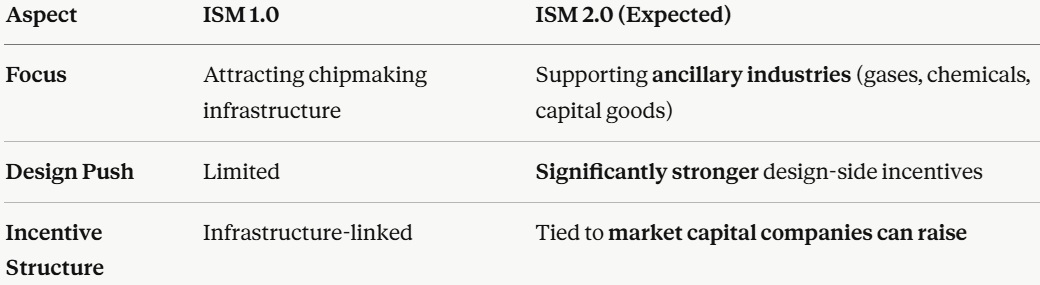
- Key shifts from ISM 1.0 to ISM 2.0:
- ISM 2.0 reflects a more mature, ecosystem-wide approach — moving beyond just building plants to strengthening the entire semiconductor supply chain within India.
Conclusion
- This development highlights the fact that India is moving beyond basic chip assembly toward genuinely cutting-edge packaging technology that even advanced nations are only beginning to deploy.
- From a strategic perspective, investments by Lockheed Martin and Intel signal that India’s semiconductor push is being taken seriously by global defence and technology majors.
- From an economic perspective, ISM is a textbook example of industrial policy — using state support to build strategic industries that the private sector alone would not develop fast enough.
- From a geopolitical perspective, reducing dependence on imported chips — especially from Taiwan and China — is directly tied to India’s supply chain resilience and strategic autonomy.
Source: IE

 Last updated on Oct, 2026
→ UPSC 2027 Notification will be released on 13 January 2027 at upsconline.nic.in.
→ Check Nobel Prize 2026 Winners List here.
→ Download PIB PRiSM Monthly Magazine 2026 here.
→ Check UPSC Monthly Current Affairs Magazine The Recitals here.
→ Check out the latest UPSC Syllabus here.
→ Download UPSC Model Answers for Mains 2026
→ UPSC Mains Question Paper 2026 is out now for Essay & GS Paper 1, 2, 3 & 4.
→ UPSC Calendar 2027 has been released.
→ Enroll in Vajiram & Ravi’s UPSC Mains Test Series 2027 for structured answer writing practice, expert evaluation, and exam-oriented feedback.
→ Join Vajiram & Ravi’s UPSC Mentorship Program 2027 for personalized guidance, strategy planning, and one-to-one support from experienced mentors.
→ Go through the UPSC Mains Previous Year Papers to enhance your preparation.
→ UPSC has released UPSC Toppers List 2025 with the Civil Services final result on its official website.
→ Also check Best UPSC Coaching in India
3D Glass Semiconductor FAQs
Q1. What is 3D glass semiconductor India project?+
Q2. Why is 3D glass semiconductor India important?+
Q3. How does 3D glass semiconductor India differ from traditional chips?+
Q4. What is the role of India Semiconductor Mission in 3D glass semiconductor India?+
Q5. How does 3D glass semiconductor India impact global supply chains?+
Tags: 3D glass semiconductor mains articles upsc current affairs upsc mains current affairs