What’s in today’s article?
- Why in News?
- About the Antarctic Peninsula
- Key Findings of the Study on Antarctic Peninsula
- What are the Impacts of Increased Vegetation in the Antarctic Peninsula?
- What are the Implications of Rising Temperatures in the Antarctic Peninsula?
- Recommendations to Preserve the Integrity of the Antarctica
Why in News?
- The Antarctic Peninsula, a mountainous region pointing toward South America, is experiencing significant changes due to climate change.
- A recent study has shown that plant cover in this area has increased dramatically over the past few decades, raising concerns about the future of this unique ecosystem.





About the Antarctic Peninsula:
- The Antarctic Peninsula is the northernmost and most accessible part of the Antarctica continent.
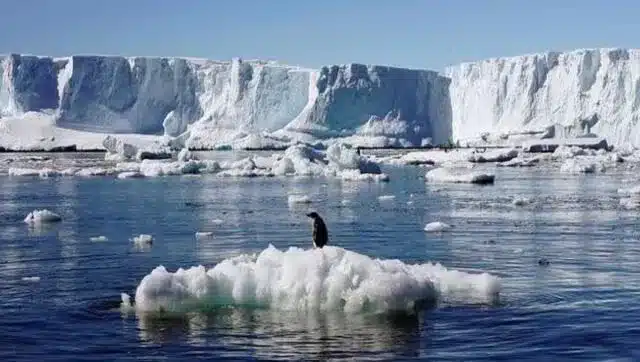
- The peninsula’s Antarctic tundra features mountainous landscapes, glaciers and ice shelfs.
- The west coast of the peninsula, the area most commonly explored, has the mildest weather in all of Antarctica, where the warmest month is January with an average temperature of 1 to 2 °C.
Key Findings of the Study on Antarctic Peninsula:
- Rapid increase in vegetation:
- Research published in Nature Geoscience reveals that vegetation, mainly consisting of mosses and lichen, has expanded significantly.
- In 1986, plant life covered less than 1 square kilometer, but by 2021, it had grown to nearly 12 square kilometers.
- This is a remarkable fourteen-fold increase over just 35 years, with more than 30% of this growth occurring between 2016 and 2021.
- Climate change:
- The Antarctic Peninsula is warming at an alarming rate – five times faster than the global average. The average temperature has risen nearly 3 degrees Celsius since 1950.
- This rapid warming is linked to extreme weather events, including record-breaking heatwaves.
- For example, in July 2023, some areas experienced temperatures around 10 degrees Celsius higher than usual.
What are the Impacts of Increased Vegetation?
- Soil and ecosystem changes:
- Mosses can help create soil in an otherwise barren landscape.
- This soil formation could make the region more hospitable for invasive species, which may threaten local flora and fauna.
- The changing landscape is a clear sign of human-induced climate change, even in such a remote area.
- Alteration in Albedo effect:
- More vegetation could also alter the Antarctic Peninsula’s albedo effect, which refers to the ability of surfaces to reflect sunlight.
- This change can create a feedback loop, further accelerating warming and impacting global climate patterns.
What are the Implications of Rising Temperatures?
- Ice loss:
- A study from 2019 indicated that the continent has lost 280% more ice mass in the 2000s and 2010s compared to the previous decades.
- The 2024 sea ice extent was reported to be the second smallest on record, only slightly more than the record low set in 2023.
- As greenhouse gas emissions continue to rise, the situation is expected to worsen, leading to more vegetation growth and additional ice loss.
- Rising global sea levels: The loss of ice in Antarctica contributes to rising global sea levels, which poses risks for coastal communities worldwide.
Recommendations to Preserve the Integrity of the Antarctica:
- The changes occurring in the Antarctic Peninsula serve as a stark reminder of the impacts of climate change.
- As temperatures rise and vegetation increases, the delicate balance of this unique ecosystem is at risk.
- The consequences of these transformations could have far-reaching effects, not only for Antarctica but for the entire planet.
- Addressing climate change is crucial to mitigate these impacts and preserve the integrity of this remote wilderness.
Q.1. What is the tundra biome?
The tundra is a biome characterised by cold temperatures, short growing seasons, and little to no trees. The tundra biome covers about 10% of Earth’s surface. There are three types of tundra: Arctic tundra, alpine tundra, and Antarctic tundra.
Q.2. What is the significance of the Albedo effect?
The albedo effect is a key concept in climate science that explains how the Earth’s surface reflects sunlight and how this affects the planet’s temperature. It’s important because it helps scientists calculate the Earth’s energy budget and predict climate change.
Source: As green patch spreads in Antarctica, here’s what is worrying scientists | DTE

 Last updated on March, 2026
→ UPSC Final Result 2025 is now out.
→ UPSC has released UPSC Toppers List 2025 with the Civil Services final result on its official website.
→ Anuj Agnihotri secured AIR 1 in the UPSC Civil Services Examination 2025.
→ UPSC Marksheet 2025 is now out.
→ UPSC Notification 2026 & UPSC IFoS Notification 2026 is now out on the official website at upsconline.nic.in.
→ UPSC Calendar 2026 has been released.
→ Check out the latest UPSC Syllabus 2026 here.
→ UPSC Prelims 2026 will be conducted on 24th May, 2026 & UPSC Mains 2026 will be conducted on 21st August 2026.
→ The UPSC Selection Process is of 3 stages-Prelims, Mains and Interview.
→ Prepare effectively with Vajiram & Ravi’s UPSC Prelims Test Series 2026 featuring full-length mock tests, detailed solutions, and performance analysis.
→ Enroll in Vajiram & Ravi’s UPSC Mains Test Series 2026 for structured answer writing practice, expert evaluation, and exam-oriented feedback.
→ Join Vajiram & Ravi’s Best UPSC Mentorship Program for personalized guidance, strategy planning, and one-to-one support from experienced mentors.
→ Shakti Dubey secures AIR 1 in UPSC CSE Exam 2024.
→ Also check Best UPSC Coaching in India