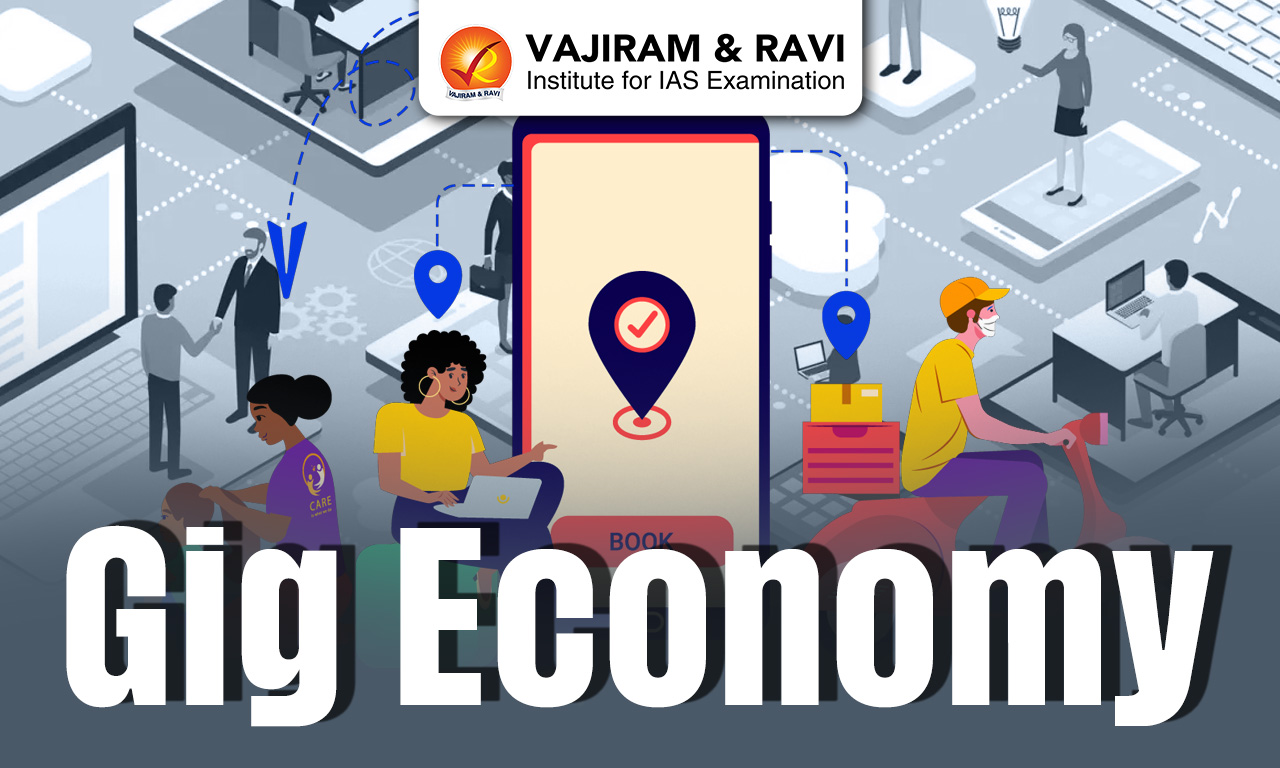
Gig Economy in India has emerged as one of the most important transformations in the country’s labor market. With the rapid growth of digital platforms, urbanization, and changing work preferences, millions of Indians are now engaged in flexible, short-term, and task-based jobs instead of traditional full-time employment. This shift has significantly impacted economic growth, employment patterns, and social security systems.
What is the Gig Economy?
The gig economy refers to a labor market where individuals work on a temporary, flexible, or freelance basis, often through digital platforms or contracts rather than permanent jobs. Workers are usually paid per task, project, or assignment. This system allows workers to choose when and how much they want to work, offering flexibility and independence.
In India, gig workers include:
- App-based drivers
- Food delivery agents
- Freelancers (writers, designers, coders)
- Home service providers (electricians, plumbers)
Types of Gig Workers in India
Gig Workers in India can be broadly classified based on the nature of work, skill level, and the platforms through which they operate.
- Platform-Based Workers: These workers depend on digital platforms or mobile apps to find work, such as ride-sharing drivers, food delivery agents, and logistics personnel. Their work is managed through algorithms, ratings, and customer feedback.
- Freelancers (Independent Professionals): Individuals who offer specialized services like content writing, graphic designing, software development, and consulting. They usually work on projects for multiple clients without long-term commitments.
- Contractual Gig Workers: These workers are hired for a specific duration or project by companies. They may work in roles such as marketing, HR, IT support, or research, often with defined deliverables and timelines.
- On-Demand Service Providers: Workers who provide services like home cleaning, plumbing, beauty services, or repair work when requested. They often operate through service-based apps or local networks.
- Creative Gig Workers: Individuals involved in creative fields such as photography, music, filmmaking, and digital content creation. They earn through projects, collaborations, or online platforms.
- High-Skilled Gig Workers: Professionals with advanced expertise in fields like data science, artificial intelligence, finance, or legal consulting. They typically earn higher incomes and work with global clients.
- Low-Skilled Gig Workers: Workers engaged in tasks requiring minimal formal education, such as delivery, warehouse handling, or basic services. They form a large share of the gig workforce in India.
- Crowdworkers (Micro-task Workers): These workers perform small online tasks like data entry, content moderation, or surveys through global platforms. The work is usually repetitive and paid per task.
- Part-Time Gig Workers: Individuals such as students or salaried employees who take up gig work alongside their primary occupation to earn extra income.
- Self-Employed Gig Workers: Workers who independently offer services without relying entirely on platforms, often using personal networks, social media, or local contacts to find gigs.


Government Initiatives Supporting Gig Economy in India
Government Initiatives Supporting Gig Economy in India aim to provide social security, legal recognition, and welfare benefits to gig and platform workers.
- Code on Social Security, 2020: For the first time, gig and platform workers are legally recognized under labor laws, enabling access to benefits like life insurance, health coverage, maternity benefits, and old-age protection, along with the creation of a Social Security Fund.
- e-Shram Portal (2021): A national database for unorganized workers that provides a Universal Account Number (UAN), helping gig workers access welfare schemes, job opportunities, and social security benefits.
- Mandatory Registration of Gig Workers: The government has directed platform companies to register gig workers on e-Shram to ensure better policy planning, identification, and delivery of benefits.
- Ayushman Bharat (PM-JAY) Coverage: Gig workers are being included under public health insurance schemes, providing free medical treatment up to ₹5 lakh per family annually.
- Union Budget 2025–26 Initiatives: Announcements include identity cards for gig workers, nationwide registration drives, and expansion of social security coverage through digital integration of databases.
- Aggregator Module for Platforms: Introduced to onboard companies like ride-hailing and delivery apps, ensuring that platforms contribute to worker welfare and maintain proper records.
- Labour Codes (2025 Implementation): The four new labor codes modernize labor laws and aim to extend protections such as wages, safety, and social security to gig workers.
- Social Security Fund for Gig Workers: The government plans to create a fund supported by contributions from central/state governments and digital platforms to finance welfare schemes.
- Skill Development and Employment Support: Gig workers registered on e-Shram are linked with skill development programs and employment opportunities under national initiatives.
Challenges Faced by Gig Workers
Challenges Faced by Gig Workers arise due to the informal and flexible nature of gig employment, where workers often lack the protections and benefits available in traditional jobs.
- Lack of Job Security: Gig workers do not have permanent contracts, and work availability depends on demand, leading to uncertainty in employment.
- Absence of Social Security: Most gig workers do not receive benefits such as health insurance, pension, paid leave, or maternity benefits.
- Irregular and Unstable Income: Earnings vary based on the number of tasks completed, demand fluctuations, and platform policies, making income unpredictable.
- Long and Uncertain Working Hours: To earn sufficient income, many workers have to work extended hours, often without fixed schedules.
- No Legal Protection: Gig workers are usually classified as independent contractors, limiting their access to labor rights and legal safeguards.
- Algorithmic Control and Ratings Pressure: Work allocation, incentives, and earnings are controlled by digital algorithms, and poor ratings can reduce job opportunities.
- High Competition: Increasing number of workers on platforms leads to intense competition, reducing earnings per worker.
- Lack of Skill Development Opportunities: Many gig jobs, especially low-skilled ones, offer limited scope for career growth or skill enhancement.
- Workplace Risks and Safety Issues: Delivery agents and drivers face risks such as road accidents, harassment, and unsafe working conditions.
- Delayed or Unfair Payments: Payment disputes, deductions, or delays can occur due to platform policies or technical issues.
- Digital Dependency: Workers are heavily dependent on apps and internet access, and any technical failure can disrupt their livelihood.
Measures to Strengthen India’s Gig Economy
- Implement Social Security Benefits: Launch schemes for health insurance, accident cover, and pensions; ensure universal registration through e-Shram for benefit access and portability.
- Fix Minimum Pay Standards: Set legally binding minimum earnings (per hour/per km + waiting time) with regular revision based on inflation and fuel costs.
- Ensure Fair Deactivation Rules: Mandate prior notice, written reasons, and an appeal system before worker account suspension or termination.
- Mandate Algorithm Transparency: Require platforms to disclose rules for ratings, incentives, and job allocation; allow workers access to data for dispute resolution.
- Set National Framework with State Execution: Define uniform standards on wages, safety, and welfare at the national level; implement through state welfare boards and funds.
- Improve Safety and Working Conditions: Provide mandatory insurance, safety gear, regulated working hours, and safer delivery infrastructure.
- Strengthen Grievance Redressal Systems: Create formal mechanisms and tripartite bodies (government–platform–workers) for dispute resolution and policy input.

 Last updated on Oct, 2026
→ UPSC 2027 Notification will be released on 13 January 2027 at upsconline.nic.in.
→ Check Nobel Prize 2026 Winners List here.
→ Download PIB PRiSM Monthly Magazine 2026 here.
→ Check UPSC Monthly Current Affairs Magazine The Recitals here.
→ Check out the latest UPSC Syllabus here.
→ Download UPSC Model Answers for Mains 2026
→ UPSC Mains Question Paper 2026 is out now for Essay & GS Paper 1, 2, 3 & 4.
→ UPSC Calendar 2027 has been released.
→ Enroll in Vajiram & Ravi’s UPSC Mains Test Series 2027 for structured answer writing practice, expert evaluation, and exam-oriented feedback.
→ Join Vajiram & Ravi’s UPSC Mentorship Program 2027 for personalized guidance, strategy planning, and one-to-one support from experienced mentors.
→ Go through the UPSC Mains Previous Year Papers to enhance your preparation.
→ UPSC has released UPSC Toppers List 2025 with the Civil Services final result on its official website.
→ Also check Best UPSC Coaching in India
Gig Economy in India FAQs
Q1. What is the gig economy in India?+
Q2. Who are gig workers?+
Q3. Is the gig economy growing in India?+
Q4. What are the main challenges in the gig economy?+
Q5. What steps has the government taken to transform the Gig Economy?+
Tags: economy economy notes gig economy