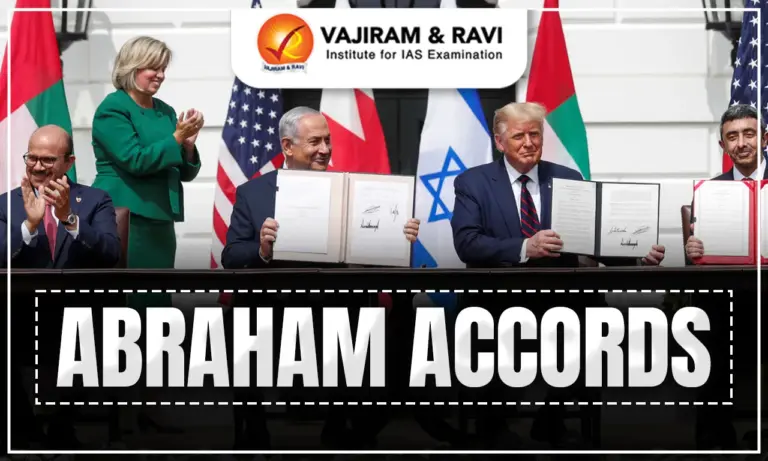
The Abraham Accords represent a historic agreement between Israel, the United States, and the United Arab Emirates, first announced on August 13, 2020. The term also covers the subsequent agreements involving Bahrain, alongside Israel and the UAE, aimed at normalising diplomatic relations.
The official signing took place on September 15, 2020, with UAE Foreign Minister Abdullah bin Zayed Al Nahyan, Bahrain’s Foreign Minister Abdullatif bin Rashid Al Zayani, and Israeli Prime Minister Benjamin Netanyahu as signatories. Following this, the UAE appointed its first ambassador to Israel, Mohammed Al Khaja, who arrived on March 1, 2021.
The name “Abraham Accords” symbolises the shared reverence for the patriarch Abraham, regarded as a prophet in both Judaism and Islam, reflecting the spirit of interfaith recognition behind the agreements.
Abraham Accords
The Abraham Accords are a landmark series of agreements signed in the second half of 2020, marking a turning point in Middle Eastern diplomacy. They established formal diplomatic and economic ties between Israel and several Arab nations, including the United Arab Emirates and Bahrain. The accords signaled a major realignment in regional politics, as Arab states moved towards open cooperation with Israel after decades of strained relations.
The accords are named after Abraham, a revered figure in Judaism, Christianity, and Islam. Often called the “Father of Many Nations,” Abraham is seen as a patriarch in all three Abrahamic religions. Since both Israel and Arab states trace religious and cultural roots back to him, the name reflects a shared heritage. It was chosen to highlight the spirit of reconciliation, mutual respect, and the possibility of lasting cooperation between the signatories.
Abraham Accords Parties Involved
The Abraham Accords are a set of diplomatic agreements signed between Israel and several Arab nations, including the United Arab Emirates (UAE), Bahrain, Sudan, and Morocco. These groundbreaking accords were brokered with the support of the United States and marked a major shift in Middle Eastern geopolitics.
The name “Abraham Accords” was chosen to honor Abraham, a central figure in Judaism, Christianity, and Islam. It symbolizes the shared cultural and spiritual heritage of the signatory nations and underscores the possibility of building cooperation and peace on that common foundation.





Abraham Accords Details
Under the Abraham Accords, the UAE and Bahrain agreed to take several key steps:
- Diplomatic exchanges: Establish embassies in each other’s countries and appoint ambassadors.
- Collaboration across sectors: Work with Israel in areas like trade, tourism, healthcare, technology, and security.
- Access to religious sites: Allow Muslims from around the world to visit historic sites in Israel and offer prayers at Jerusalem’s Al-Aqsa Mosque, the third holiest site in Islam.
Abraham Accords Significance
- The Abraham Accords highlight the readiness of Arab states to look beyond the long-standing Palestine issue and establish direct relations with Israel. This marks a strategic departure from past policies in the region.
- The agreement promotes cordial ties between Israel and Arab nations, paving the way for greater diplomatic goodwill. This shift has the potential to reduce tensions, encourage dialogue, and promote cooperation in West Asia.
Abraham Accords Impact on India
- The Abraham Accords provide India with much-needed diplomatic space to engage both Israel and Arab states without appearing tilted towards either side. This helps reduce earlier frictions in balancing ties.
- With Israel and Arab nations opening up to collaboration, India can strengthen partnerships in trade, investments, energy, defence, and technology. These accords create fresh opportunities for multi-sectoral cooperation.
- Overall, the agreements work in India’s favour by easing its diplomatic challenges in West Asia. They allow India to deepen ties with both blocs while safeguarding its strategic and economic interests in the region.
Abraham Accords Declaration
- The Abraham Accords aim to strengthen peace in the Middle East and globally, rooted in mutual understanding, coexistence, and respect for human dignity and freedom, including religious freedom.
- Efforts are encouraged to promote interfaith and intercultural dialogue, particularly among the three Abrahamic religions, Judaism, Christianity, and Islam to advance a culture of peace for all humanity.
- The Abraham Accords emphasize that cooperation and dialogue are the most effective ways to resolve challenges, while friendly relations among states contribute to lasting peace.
- They advocate for tolerance and respect for every individual, regardless of race, faith, or ethnicity, aiming for a world where everyone can live with dignity and hope.
- The signatories pledge support for science, art, medicine, and commerce as means to inspire humanity, unlock human potential, and strengthen ties between nations.
- A strong focus is placed on ending radicalization and conflict, ensuring a safer and more secure environment for future generations.
- The Abraham Accords put forward a vision of peace, security, and prosperity not only for the Middle East but also for the world at large.
Abraham Accords Challenges
- The Hamas attack on Israel has exposed the fragile foundation of the Accords. Such escalations threaten to undo the limited progress made in normalizing ties, as violence reinforces mistrust among the parties.
- Palestinians view the Accords as being tilted in Israel’s favor, sidelining their struggle for statehood. This perception weakens the legitimacy of the agreements in the wider Arab world.
- Saudi Arabia’s reaction, particularly through recent statements by Crown Prince Mohammed bin Salman, reflects the fluid stance of the Arab bloc. Any hardening of Saudi Arabia’s position can influence the future trajectory of Arab–Israel relations under the Accords.
| Also Check Other Posts | |
| Indus Water Treaty | Kartarpur Corridor |
| String of Pearls | Doklam Issue |

 Last updated on March, 2026
→ UPSC Final Result 2025 is now out.
→ UPSC has released UPSC Toppers List 2025 with the Civil Services final result on its official website.
→ Anuj Agnihotri secured AIR 1 in the UPSC Civil Services Examination 2025.
→ UPSC Marksheet 2025 is now out.
→ UPSC Notification 2026 & UPSC IFoS Notification 2026 is now out on the official website at upsconline.nic.in.
→ UPSC Calendar 2026 has been released.
→ Check out the latest UPSC Syllabus 2026 here.
→ UPSC Prelims 2026 will be conducted on 24th May, 2026 & UPSC Mains 2026 will be conducted on 21st August 2026.
→ The UPSC Selection Process is of 3 stages-Prelims, Mains and Interview.
→ Prepare effectively with Vajiram & Ravi’s UPSC Prelims Test Series 2026 featuring full-length mock tests, detailed solutions, and performance analysis.
→ Enroll in Vajiram & Ravi’s UPSC Mains Test Series 2026 for structured answer writing practice, expert evaluation, and exam-oriented feedback.
→ Join Vajiram & Ravi’s Best UPSC Mentorship Program for personalized guidance, strategy planning, and one-to-one support from experienced mentors.
→ Shakti Dubey secures AIR 1 in UPSC CSE Exam 2024.
→ Also check Best UPSC Coaching in India
Abraham Accords FAQs
Q1. What are the Abraham Accords?+
Q2. What are Abraham's accords in UPSC?+
Q3. Which Arab countries made peace with Israel?+
Q4. Are the Abraham Accords biblical? +
Q5. What are the three Abrahamic religions?+
Tags: abraham accords