ACC Battery Latest News
- India’s flagship ACC Battery Manufacturing PLI scheme has fallen significantly short of its targets due to delays in capacity creation and technology constraints.
Background: Advanced Chemistry Cells and Their Strategic Importance
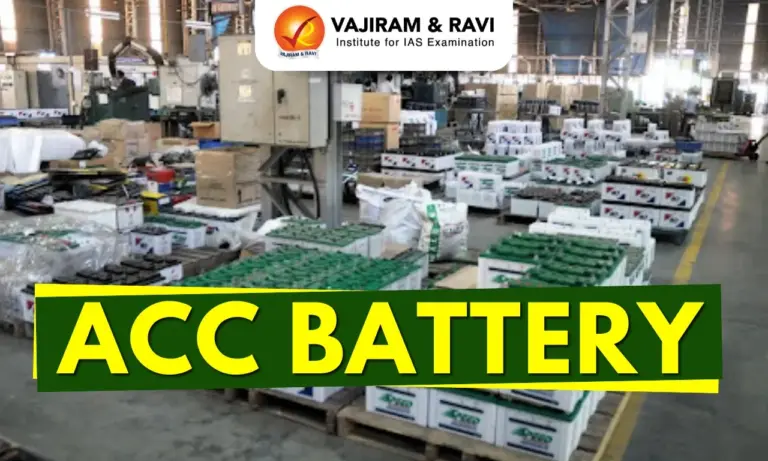
- Advanced Chemistry Cells (ACCs) are next-generation battery technologies, such as lithium-ion cells, that power electric vehicles (EVs), renewable energy storage systems, and consumer electronics.
- Unlike traditional lead-acid batteries, ACCs offer higher energy density, faster charging, and longer lifecycle performance.
- For India, domestic ACC Battery Manufacturing is strategically important for three reasons.
- First, batteries account for nearly 40% of the cost of electric vehicles, making local production critical for EV affordability.
- Second, India is heavily dependent on imports, mainly from China, for lithium-ion cells and battery components.
- Third, battery manufacturing is central to India’s clean energy transition and its commitments toward reducing carbon emissions and enhancing energy security.





The ACC Production Linked Incentive (PLI) Scheme
- The ACC-PLI scheme was launched in October 2021 by the Ministry of Heavy Industries to catalyse domestic manufacturing of next-generation battery cells.
- With a total financial outlay of Rs. 18,100 crore, the scheme aimed to establish 50 GWh of battery manufacturing capacity by 2026.
- Under the scheme, selected manufacturers were promised incentives linked to actual battery sales, with a maximum subsidy of about Rs. 2,000 per kilowatt-hour.
- Companies were required to make a minimum investment of Rs. 1,100 crore and meet phased domestic value-addition targets, 25% within two years and 60% within five years.
- Beyond capacity creation, the policy intended to develop a complete battery supply chain covering cathodes, anodes, electrolytes, and cell assembly, while also generating over one million jobs.
Current Status and Performance Gap
- Despite its ambitious design, the scheme’s on-ground performance has been weak.
- As of October 2025, only 1.4 GWh of battery cell capacity had been commissioned on time, while 8.6 GWh was under development but delayed. This is far below the original 50 GWh target.
- Although bids were invited for the entire capacity, only 30 GWh was finally allotted.
- Importantly, none of the selected firms had prior experience in large-scale battery cell manufacturing.
- As no company has begun commercial battery sales, zero incentives have been disbursed so far, against a targeted Rs. 2,900 crore payout by October 2025.
- Job creation has also been minimal, with just over 1,100 jobs generated compared to the projected 1.03 million.
Key Challenges Affecting Implementation
- One major bottleneck is the lack of a mature battery manufacturing ecosystem in India.
- Critical inputs such as lithium refining, cathode materials, and specialised machinery remain import-dependent, largely sourced from China.
- Delays in visa approvals for foreign technical experts, especially Chinese specialists needed for equipment installation, have further slowed plant commissioning.
- Additionally, strict localisation norms and aggressive installation timelines have posed challenges for companies without prior technical expertise.
Implications for Electric Mobility and Energy Transition
- The EV sector accounts for nearly 70-80% of lithium-ion battery demand in India.
- Slower progress in ACC Battery Manufacturing directly affects EV affordability, supply chain resilience, and the pace of clean mobility adoption.
- While EV sales continue to grow, the pace has been lower than earlier projections, partly reflecting supply-side constraints in battery availability and pricing.
- Continued reliance on imports also exposes India to geopolitical risks and trade disruptions.
Way Forward
- To revive momentum, India needs a more flexible and phased localisation strategy that aligns with existing industrial capabilities.
- Facilitating technology partnerships, easing skilled-visa processes, and supporting component-level manufacturing are critical.
- Policy recalibration may also be required to encourage participation by experienced manufacturers and align incentives with realistic timelines.
- Without such course correction, India’s ambition of becoming a global battery manufacturing hub may remain unfulfilled.
Source: TH

 Last updated on March, 2026
→ UPSC Final Result 2025 is now out.
→ UPSC has released UPSC Toppers List 2025 with the Civil Services final result on its official website.
→ Anuj Agnihotri secured AIR 1 in the UPSC Civil Services Examination 2025.
→ UPSC Marksheet 2025 is now out.
→ UPSC Notification 2026 & UPSC IFoS Notification 2026 is now out on the official website at upsconline.nic.in.
→ UPSC Calendar 2026 has been released.
→ Check out the latest UPSC Syllabus 2026 here.
→ UPSC Prelims 2026 will be conducted on 24th May, 2026 & UPSC Mains 2026 will be conducted on 21st August 2026.
→ The UPSC Selection Process is of 3 stages-Prelims, Mains and Interview.
→ Prepare effectively with Vajiram & Ravi’s UPSC Prelims Test Series 2026 featuring full-length mock tests, detailed solutions, and performance analysis.
→ Enroll in Vajiram & Ravi’s UPSC Mains Test Series 2026 for structured answer writing practice, expert evaluation, and exam-oriented feedback.
→ Join Vajiram & Ravi’s Best UPSC Mentorship Program for personalized guidance, strategy planning, and one-to-one support from experienced mentors.
→ Shakti Dubey secures AIR 1 in UPSC CSE Exam 2024.
→ Also check Best UPSC Coaching in India
ACC Battery FAQs
Q1. What are Advanced Chemistry Cells (ACCs)?+
Q2. What is the objective of the ACC-PLI scheme?+
Q3. How much battery capacity was targeted under the scheme?+
Q4. Why has the scheme underperformed so far?+
Q5. Why is battery manufacturing critical for India’s EV sector?+
Tags: acc battery mains articles upsc current affairs upsc mains current affairs