Acid Rain is an important environmental issue faced all over the world. It not only damages the ecosystem and biodiversity but also impacts human health, cultural heritage and infrastructure. In this article, we are going to cover acid rain, its causes, process, types and impacts.
Acid Rain
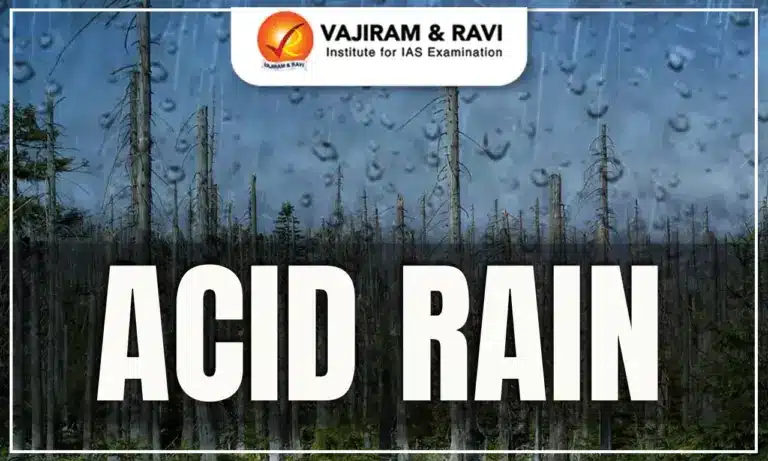
- Acid Rain is the formation of precipitation in the form of rain, fog, mist or snow that becomes acidic because of the presence of pollutants in the atmosphere.
- The pollutants responsible for acid rain are sulphur dioxide and nitrogen oxides that combine with water vapour to form sulphuric acid and nitric acid.
- These acids then return to the Earth’s surface through rain, snow, or fog, damaging soil, water, vegetation, and man-made structures.
- While normal rain is slightly acidic (pH around 5.6) due to dissolved carbon dioxide, acid rain has a pH much lower than this, often between 4.0–5.0.
Acid Rain Mechanism
The cycle of acid rain works in the following manner:
- Emission of Pollutants: Fossil fuel burning in industries, vehicles, and power plants releases SO₂ and NOₓ into the atmosphere.
- Chemical Reactions: These gases undergo oxidation and dissolve in water droplets, forming sulphuric and nitric acids.
- Deposition: The acids fall back to Earth in the form of rain, snow, fog, or dust, leading to acid deposition.





Acid Rain Sources
The sources of acid rain are:
| Compound | Natural Sources | Anthropogenic (Human) Sources |
|
Sulphur Dioxide |
Volcanoes, oceans, decomposition of organic matter |
Fossil fuel burning, coal-based power plants, industrial emissions |
|
Nitrogen Oxides |
Volcanoes, lightning, forest fires, organic decomposition |
Vehicle emissions, thermal power plants, biomass burning |
|
Formic Acid |
Forest fires |
Biomass burning |
|
Carbon Dioxide |
Respiration, decomposition |
Fossil fuels, industrial processes |
|
Carbon Monoxide |
Plant emissions (isoprene) |
Biomass burning, industries |
Acid Rain Chemistry
Acid rain causes the following reactions:
- Sulphur Cycle:
- SO₂ + H₂O → H₂SO₃ (Sulphurous Acid)
- H₂SO₃ + O₂ → H₂SO₄ (Sulphuric Acid)
- Nitrogen Cycle:
- 2NO₂ + H₂O → HNO₂ (Nitrous Acid) + HNO₃ (Nitric Acid)
These acids mix with rainwater and fall as acid rain.
Acid Rain Causes
Acid Rain is caused by the following factors:
- Burning fossil fuels in power plants, industries, and vehicles.
- Volcanic eruptions and wildfires releasing natural SO₂ and NOₓ.
- Industrial emissions from refineries, cement plants, and chemical factories.
- Biomass burning and agricultural practices.
Types of Acid Deposition
Acid Rain causes the depositions of following types:
- Wet Deposition
- Occurs when acidic pollutants combine with rain, snow, mist, or fog.
- Common in humid regions with high precipitation.
- Example: Acid rains in Scandinavia caused by industrial emissions in Britain.
- Dry Deposition
- Occurs when acidic gases and particles settle on surfaces without precipitation.
- Later washed off by rain, causing delayed environmental damage.
- Common in arid or semi-arid regions with less rainfall.
Acid Rain Impacts
Following are the impacts of acid rain:
- On Soil
- Leaching of essential nutrients like calcium, magnesium, and potassium, making soil infertile.
- Reduced microbial activity and decomposition rates.
- Acidic soils affect crop productivity and forest health.
- On Vegetation
- Reduced photosynthesis and growth rates.
- Symptoms: Leaf discolouration, premature ageing, stunted growth, and tree death.
- Weakens plants, making them more vulnerable to disease and pests.
- On Microorganisms
- Disrupts soil microbial balance and reduces bacteria and protozoa, favours fungi.
- Alters decomposition rates and nutrient cycling.
- Increases susceptibility to plant and soil-borne fungal diseases.
- On Aquatic Life
- Acidic waters lower pH below tolerance levels for fish and amphibians.
- Kills eggs, sperm, and larvae of aquatic organisms.
- Reduces plankton populations, collapsing aquatic food chains.
- Example: Fishless lakes in Canada and Scandinavia due to acidification.
- On Terrestrial Life
- Indirect effect via food chain disruption.
- Herbivores suffer due to damaged vegetation, cascading impacts on predators.
- On Humans
- Not directly harmful to touch, but indirectly impacts health.
- SO₂ and NOₓ cause respiratory diseases like asthma, bronchitis, and lung cancer.
- Eye, skin, and throat irritation.
- Contributes to ground-level ozone formation, worsening air pollution.
- On Buildings & Monuments
- Acid rain reacts with limestone and marble, causing structural damage.
- Famous example: Taj Mahal (Agra) turning yellow due to acid rain and pollution.
- Damages heritage structures, statues, and buildings worldwide.
Acid Rain Controlling Measures
Acid rain can be controlled by the following measures:
- Cleaner Fuels: Use low-sulphur coal, natural gas, or renewable energy and promote solar, wind, and hydropower.
- Scrubbers: Installs flue-gas desulfurization units in power plants and can remove 90–95% of sulphur dioxide emissions.
- Catalytic Converters: Fit into vehicles to reduce NOₓ and SO₂ emissions.
- Neutralization: Add lime to acidic lakes and soils to restore pH balance.
- Policy Measures: Stricter emission standards for industries and vehicles and promotes energy efficiency and public awareness campaigns.
- International Cooperation: Since acid rain crosses borders, global treaties like the 1979 Geneva Convention on Long-Range Transboundary Air Pollution are crucial.

 Last updated on March, 2026
→ UPSC Final Result 2025 is now out.
→ UPSC has released UPSC Toppers List 2025 with the Civil Services final result on its official website.
→ Anuj Agnihotri secured AIR 1 in the UPSC Civil Services Examination 2025.
→ UPSC Marksheet 2025 is now out.
→ UPSC Notification 2026 & UPSC IFoS Notification 2026 is now out on the official website at upsconline.nic.in.
→ UPSC Calendar 2026 has been released.
→ Check out the latest UPSC Syllabus 2026 here.
→ UPSC Prelims 2026 will be conducted on 24th May, 2026 & UPSC Mains 2026 will be conducted on 21st August 2026.
→ The UPSC Selection Process is of 3 stages-Prelims, Mains and Interview.
→ Prepare effectively with Vajiram & Ravi’s UPSC Prelims Test Series 2026 featuring full-length mock tests, detailed solutions, and performance analysis.
→ Enroll in Vajiram & Ravi’s UPSC Mains Test Series 2026 for structured answer writing practice, expert evaluation, and exam-oriented feedback.
→ Join Vajiram & Ravi’s Best UPSC Mentorship Program for personalized guidance, strategy planning, and one-to-one support from experienced mentors.
→ Shakti Dubey secures AIR 1 in UPSC CSE Exam 2024.
→ Also check Best UPSC Coaching in India
Acid Rain FAQs
Q1. What is acid rain?+
Q2. What is the concept of acid rain?+
Q3. What are three causes of acid rain?+
Q4. What is the impact of acid rain?+
Q5. What are the pollutants of acid rain?+
Tags: acid rain