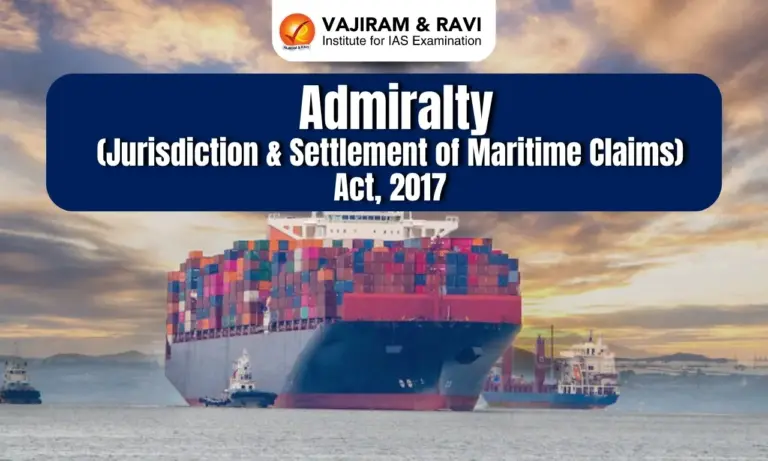
Admiralty (Jurisdiction & Settlement of Maritime Claims) Act, 2017 Latest News
The Kerala High Court recently ordered the conditional “arrest” of Liberian container ship MSC Akiteta II, after the Kerala government filed an admiralty suit in the court under Section 4 of the Admiralty (Jurisdiction and Settlement of Maritime Claims) Act, 2017.
About Admiralty (Jurisdiction & Settlement of Maritime Claims) Act, 2017
- The Act consolidates the existing laws relating to the admiralty jurisdiction, legal proceedings in connection with the vessels, arrest, detention and sale of the vessel and other matters that are connected or incidental to the admiralty jurisdiction.
- The Act repeals the following British-era admiralty laws on civil matters:
- The Admiralty Court Act, 1861;
- The Colonial Courts of Admiralty Act, 1890;
- The Colonial Courts of Admiralty (India) Act, 1891; and
- The provisions of the Letters Patent, 1865, insofar as it applies to the admiralty jurisdiction of the Bombay, Calcutta, and Madras High Courts.





Applicability of the Act
- The Act applies to every vessel, irrespective of the place of residence or domicile of the owner.
- Exception to the Applicability: The Act shall not apply to the following vessels-
- Inland vessel defined in clause (a) of sub-section (1) of section 2 of the Inland Vessels Act, 1917;
- A vessel under construction that has not been launched unless it is notified by the Central Government to be a vessel for the purposes of the Act;
- A warship, naval auxiliary, or other vessel owned or operated by the Central or a State Government and used for any non-commercial purpose; and
- Foreign vessel which is used for any non-commercial purpose as may be notified by the Central Government.
Admiralty Jurisdiction
- The Act conferred admiralty jurisdiction to eight High including the High Court of Calcutta, Bombay, Madras, Karnataka, Gujarat, Orissa, Kerala and Hyderabad.
- The jurisdiction of the High Courts in respect of all maritime claims be exercisable over the waters up to and including the territorial waters of their respective jurisdictions.
Maritime Claims
- The High Court having admiralty jurisdiction is empowered to determine any question against any vessel relating to a maritime claim arising out of any
- dispute regarding possession or ownership of a vessel;
- loss or damage caused by the operation of a vessel;
- loss of life or personal injury occurring whether on land or on water, in direct connection with the operation of a vessel;
- loss or damage to or in connection with any goods;
- agreement relating to the carriage of goods or passengers on board a vessel, whether contained in a charter party or otherwise;
- agreement relating to the use or hire of the vessel, whether contained in a charter party or otherwise, etc.
Jurisdiction over Vessels (Arrest of Vessels) and Persons
- Courts with admiralty jurisdiction exercise their authority over both vessels within their territorial waters (jurisdiction in rem) and persons within their territory (jurisdiction in personam).
- The usual practice followed by the courts having admiralty jurisdiction to secure the maritime claim is to arrest the vessel.
- The main purpose for the arrest of the vessel is to obtain the security for the satisfaction of the judgment.
- Thus, the High Court having admiralty jurisdiction may order arrest of any vessel if the High Court is satisfied that
- the owner of the vessel at the time when maritime claim arose is liable for the claim;
- the claim is based on a mortgage or a charge of the vessel;
- the claim is related to the possession or ownership of the vessel, etc.
- Further, a claimant seeking the arrest of a vessel may be required to furnish an unconditional undertaking on the terms determined by the High Court to secure the defendant from any loss or damage that may result due to such arrest (for example, if the arrest is wrongful or unjustified).
- The Act also provides that the High Court ordering the sale of a vessel can determine any questions relating to the title to the proceeds of the sale.
Source: IE

 Last updated on April, 2026
→ UPSC Final Result 2025 is now out.
→ UPSC has released UPSC Toppers List 2025 with the Civil Services final result on its official website.
→ Anuj Agnihotri secured AIR 1 in the UPSC Civil Services Examination 2025.
→ UPSC Marksheet 2025 is now out.
→ UPSC Notification 2026 & UPSC IFoS Notification 2026 is now out on the official website at upsconline.nic.in.
→ UPSC Calendar 2026 has been released.
→ Check out the latest UPSC Syllabus 2026 here.
→ UPSC Prelims 2026 will be conducted on 24th May, 2026 & UPSC Mains 2026 will be conducted on 21st August 2026.
→ The UPSC Selection Process is of 3 stages-Prelims, Mains and Interview.
→ Prepare effectively with Vajiram & Ravi’s UPSC Prelims Test Series 2026 featuring full-length mock tests, detailed solutions, and performance analysis.
→ Enroll in Vajiram & Ravi’s UPSC Mains Test Series 2026 for structured answer writing practice, expert evaluation, and exam-oriented feedback.
→ Join Vajiram & Ravi’s Best UPSC Mentorship Program for personalized guidance, strategy planning, and one-to-one support from experienced mentors.
→ Shakti Dubey secures AIR 1 in UPSC CSE Exam 2024.
→ Also check Best UPSC Coaching in India
Admiralty (Jurisdiction & Settlement of Maritime Claims) Act, 2017 FAQs
Q1. The Admiralty (Jurisdiction & Settlement of Maritime Claims) Act, 2017 primarily deals with:+
Q2. The Admiralty jurisdiction under the Admiralty (Jurisdiction & Settlement of Maritime Claims) Act, 2017 has been conferred to how many High Courts?+
Q3. Why is the arrest of a vessel under the Admiralty (Jurisdiction & Settlement of Maritime Claims) Act, 2017, primarily done?+
Tags: admiralty (jurisdiction & settlement of maritime claims) act prelims pointers upsc current affairs upsc prelims current affairs