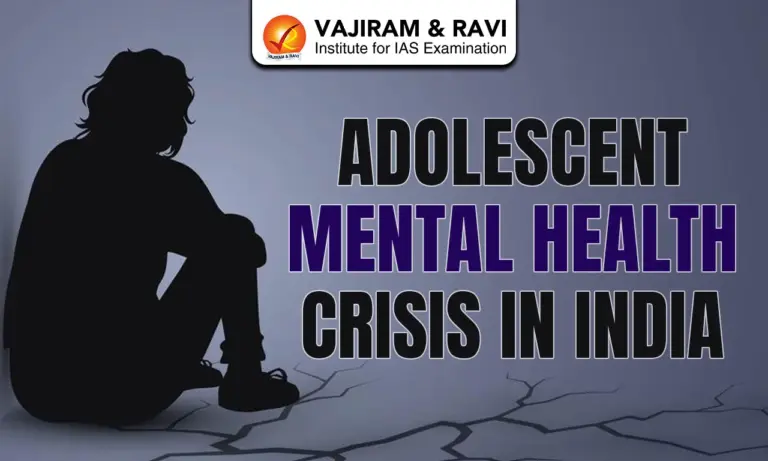
Adolescent Mental Health Crisis in India is emerging as a major public health concern. Recent incidents involving adolescent deaths, including a tragic case in Ghaziabad, have once again drawn public attention to the fragile mental health of young people in India. They reflect a deeper and largely neglected crisis in child and adolescent mental health.
Adolescent Mental Health Crisis in India
Mental Health Crisis in India is no longer limited to adults. Doctors and psychologists are increasingly observing anxiety, depression, attention disorders and behavioural problems even among younger children. Even India’s Economic Survey 2025-26 acknowledged rising mental health concerns among young people. Studies such as the National Mental Health Survey suggest that:
- Around 7-10% of Indian adolescents have diagnosable mental health conditions.
- Nearly 5-7% of school-aged children may have Attention Deficit Hyperactivity Disorder (ADHD).
- Studies suggest that nearly one in ten adolescents in India may be living with a diagnosable mental health condition.
Key Drivers of the Adolescents Mental Health Crisis in India
The adolescent mental health crisis in India is driven by multiple social, educational and technological factors. Key drivers are as follows:
- Early childhood vulnerability: Experiences such as family conflict, neglect, economic insecurity or lack of emotional warmth affect a child’s psychological development. However, early warning signs such as social withdrawal, irritability, poor concentration or sudden behavioural changes are often ignored or dismissed as “normal teenage behaviour.” As a result, many children do not receive timely support.
- Excessive digital exposure: The rapid expansion of smartphones and internet access has deeply influenced adolescent behaviour. Social media comparison, cyberbullying, online validation and constant connectivity have increased anxiety and reduced self-esteem among many young people. Excessive screen time also affects sleep, concentration and physical activity, indirectly worsening emotional health.
- Academic pressure and performance-oriented culture: The Indian education system largely revolves around marks, rankings and competitive examinations. Adolescents face continuous pressure to perform, often linking their self-worth to academic success. Fear of failure, parental expectations and peer competition contribute to stress, anxiety and depressive tendencies.
- Weak institutional support in schools: Schools focus primarily on academic outcomes while structured emotional support remains limited. Many institutions lack trained counsellors or mental health awareness programmes. Teachers are rarely trained to identify early warning signs, leading to delayed intervention.
- Shortage of mental health professionals: India faces a serious shortage of child and adolescent mental health specialists. India has fewer than 10,000 psychiatrists for a population exceeding 1.4 billion, and only a small fraction specialise in child and adolescent mental health. Access to affordable and quality care remains uneven, especially in rural and low-income settings. This treatment gap prevents early diagnosis and timely care.
- Stigma and lack of open conversation: Mental health issues continue to be surrounded by social stigma. Families often hesitate to seek help due to fear of judgement or labelling. Adolescents themselves may suppress their struggles, resulting in crisis-driven rather than preventive care.
- Rapid social and lifestyle changes: Urbanisation, nuclear families and reduced community interaction have weakened traditional support systems. Adolescents today navigate identity, relationships and aspirations in a fast-changing environment without adequate emotional guidance.
- Policy Framework and Implementation Gaps: India has programmes such as the National Mental Health Programme and school health initiatives under Ayushman Bharat, along with expanding tele-mental health services. However, implementation remains uneven. Routine mental health screening in schools is rare, teacher training is limited, and dedicated funding for child and adolescent mental health is inadequate.





Way Forward
India must adopt a preventive and community-based approach rather than a crisis-driven response.
- Strengthen existing mental health programmes: India should improve the implementation of existing systems such as the National Mental Health Programme, school health services under Ayushman Bharat Health and Wellness Centres, and tele-mental health initiatives.
- Introduce routine screening in schools: Schools should conduct regular screening to identify emotional, behavioural and learning problems early. Early identification can help prevent small problems from becoming serious mental health issues.
- Train teachers and frontline workers: Teachers, paediatricians, counsellors and other child-care workers should be trained to recognise early signs of anxiety, depression, internet addiction and behavioural changes.
- Improve referral systems: There should be clear pathways so that children who need professional help can be quickly connected to mental health specialists without delay.
- Provide dedicated support for child mental health: Budget allocation and policy attention should specifically focus on child and adolescent mental health services, especially for low- and middle-income families.
- Promote healthy digital behaviour: Schools and families should encourage balanced screen use. Guidelines on internet and social media use should be developed along with awareness programmes.
- Expand community-based counselling: Affordable counselling services should be available at community level so that families do not depend only on specialised urban hospitals.
- Encourage parent and peer support systems: Parent support groups and adolescent peer groups can help reduce isolation, share experiences and build emotional resilience.
- Reduce stigma around mental health: Open discussion about mental health in families, schools and society is necessary so that children can seek help without fear or shame.
Conclusion
Adolescents’ mental health in India is crucial for realising the country’s demographic dividend. With a large young population, protecting mental wellbeing through early intervention, school support systems, responsible digital use and reduced stigma is essential. Ensuring good adolescent mental health will help India convert its population advantage into long-term social and economic growth.

 Last updated on April, 2026
→ UPSC Final Result 2025 is now out.
→ UPSC has released UPSC Toppers List 2025 with the Civil Services final result on its official website.
→ Anuj Agnihotri secured AIR 1 in the UPSC Civil Services Examination 2025.
→ UPSC Marksheet 2025 is now out.
→ UPSC Notification 2026 & UPSC IFoS Notification 2026 is now out on the official website at upsconline.nic.in.
→ UPSC Calendar 2026 has been released.
→ Check out the latest UPSC Syllabus 2026 here.
→ UPSC Prelims 2026 will be conducted on 24th May, 2026 & UPSC Mains 2026 will be conducted on 21st August 2026.
→ The UPSC Selection Process is of 3 stages-Prelims, Mains and Interview.
→ Prepare effectively with Vajiram & Ravi’s UPSC Prelims Test Series 2026 featuring full-length mock tests, detailed solutions, and performance analysis.
→ Enroll in Vajiram & Ravi’s UPSC Mains Test Series 2026 for structured answer writing practice, expert evaluation, and exam-oriented feedback.
→ Join Vajiram & Ravi’s Best UPSC Mentorship Program for personalized guidance, strategy planning, and one-to-one support from experienced mentors.
→ Shakti Dubey secures AIR 1 in UPSC CSE Exam 2024.
→ Also check Best UPSC Coaching in India
Adolescent Mental Health Crisis in India FAQs
Q1. What is adolescents mental health in India?+
Q2. What are the main causes of adolescent mental health crisis in India?+
Q3. How common are mental health problems among Indian adolescents?+
Q4. Why is adolescent mental health important for India’s demographic dividend?+
Q5. What can be done to improve adolescent mental health in India?+
Tags: adolescent mental health crisis in india