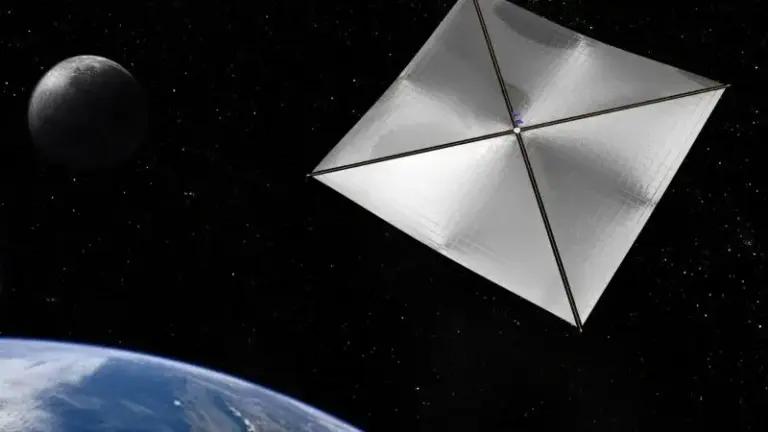
About Advanced Composite Solar Sail System (ACS3):
- It is a NASA technology demonstration mission designed to characterize solar sail structures technologies for future small spacecraft to engage in deep space missions requiring long-duration, low-thrust propulsion.
- Launched on April 23, 2024, ACS3 will deploy a sail about the size of a small apartment from a toaster oven-size spacecraft.
- At its core, ACS3 is a CubeSat, a small satellite built to standardized dimensions. It features four 7 m long deployable composite booms.
- Just as a sailboat is powered by wind in a sail, solar sails employ the pressure of sunlight for propulsion, eliminating the need for conventional rocket propellant.
- Space missions have demonstrated that small spacecraft can use solar sails to change their orbits, expanding their possible uses.
- Future solar sail missions will need bigger sails and lighter materials to maximize their performance.
- ACS3 uses lightweight carbon fiber sail booms instead of traditional metal booms.
- This will be the first test of this technology in space.
- What is solar sailing?
Light is made up of particles called photons. Photons don’t have mass, but they have momentum.
As sunlight reflects off a shiny solar sail, some of its momentum getst transferred, giving the sail a small push.
This push is slight but continuous and, over time, can impart more thrust to a spacecraft than traditional chemical rockets.
Solar sails can reach unique destinations that are difficult or impossible to access with other propulsion systems.
They may also be our best option for interstellar travel.
Q1: What are CubeSats?
CubeSats are a class of nanosatellites that use a standard size and form factor. The standard CubeSat size uses a “one unit” or “1U” measuring 10x10x10 cm and is extendable to larger sizes; 1.5, 2, 3, 6, and even 12U.
Source: NASA’s Advanced Composite Solar Sail System Launched Into Space, To Redefine Propulsion






 Last updated on March, 2026
→ UPSC Final Result 2025 is now out.
→ UPSC has released UPSC Toppers List 2025 with the Civil Services final result on its official website.
→ Anuj Agnihotri secured AIR 1 in the UPSC Civil Services Examination 2025.
→ UPSC Marksheet 2025 is now out.
→ UPSC Notification 2026 & UPSC IFoS Notification 2026 is now out on the official website at upsconline.nic.in.
→ UPSC Calendar 2026 has been released.
→ Check out the latest UPSC Syllabus 2026 here.
→ UPSC Prelims 2026 will be conducted on 24th May, 2026 & UPSC Mains 2026 will be conducted on 21st August 2026.
→ The UPSC Selection Process is of 3 stages-Prelims, Mains and Interview.
→ Prepare effectively with Vajiram & Ravi’s UPSC Prelims Test Series 2026 featuring full-length mock tests, detailed solutions, and performance analysis.
→ Enroll in Vajiram & Ravi’s UPSC Mains Test Series 2026 for structured answer writing practice, expert evaluation, and exam-oriented feedback.
→ Join Vajiram & Ravi’s Best UPSC Mentorship Program for personalized guidance, strategy planning, and one-to-one support from experienced mentors.
→ Shakti Dubey secures AIR 1 in UPSC CSE Exam 2024.
→ Also check Best UPSC Coaching in India