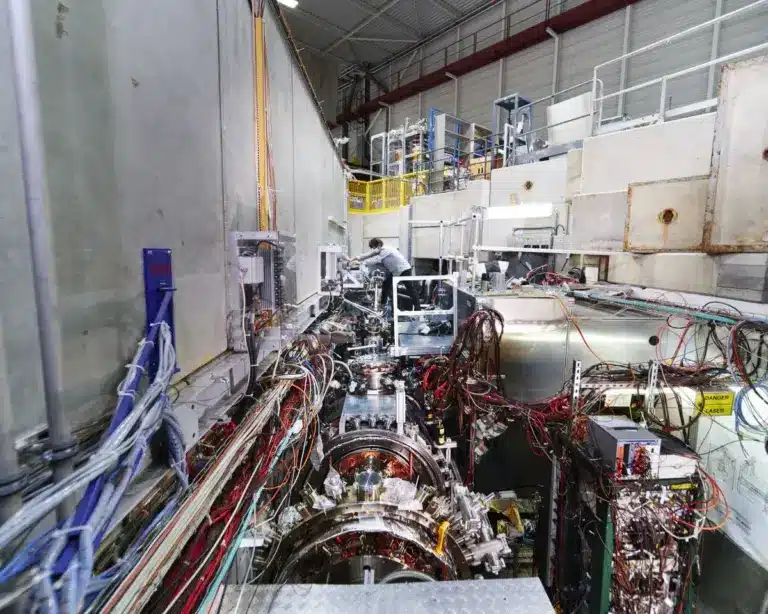
About Anti-hydrogen Experiment: Gravity, Interferometry, Spectroscopy (AEgIS)
- It is an experiment approved by CERN (European Organization for Nuclear Research) with the goal of studying antihydrogen physics.
- The primary goal of AEgIS is the direct measurement of the Earth’s gravitational acceleration, g, on antihydrogen.
- Once performed this could be the first direct test of the gravitational interaction between matter and antimatter.
- AEgIS is a collaboration of physicists from a number of countries in Europe and from India.
What is Antimatter?
- Antimatter is the same as ordinary matter except that it has the opposite electric charge.
- It is also known as “mirror” matter.
- For instance, an electron, which has a negative charge, has an antimatter partner known as a positron. A positron is a particle with the same mass as an electron but a positive charge.
- The antimatter particles corresponding to electrons, protons, and neutrons are called positrons, antiprotons, and antineutrons; collectively they are referred to as antiparticles.
- These anti-particles can combine to form anti-atoms and, in principle, could even form anti-matter regions of our universe.
- Matter and antimatter cannot coexist at close range for more than a small fraction of a second because they collide with and annihilate each other, releasing large quantities of energy in the form of gamma rays or elementary particles.
- Antimatter was created along with matter after the Big Bang.
- Humans have created antimatter particles using ultra-high-speed collisions at huge particle accelerators such as the Large Hadron Collider, which is located outside Geneva and operated by CERN (the European Organization for Nuclear Research).
- There are also naturally produced antiparticles made sporadically throughout the universe.





Key Facts about Positronium
- The matter, which forms the world around us, consists of atoms, the simplest of which is hydrogen, which is the most plentiful element in the Universe. This is made up of a positively-charged proton and a negatively-charged electron.
- Positronium, on the other hand, is a short-lived hydrogen-like atom, which consists of an electron and its antimatter equivalent, a positron (rather than an electron and a proton).
- Due to its very short life, it annihilates with a half-life of 142 nano-seconds.
- This hydrogen-like system is a great contender for attempting laser cooling and thereby performing tests of fundamental theories in physics.
- Positronium can generate huge amounts of energy. It can shed light on ‘antimatter’ which existed at the beginning of the Universe.
Q1) What is Spectroscopy?
Spectroscopy is the study of the absorption and emission of light and other radiation by matter. It involves the splitting of light (or more precisely electromagnetic radiation) into its constituent wavelengths (a spectrum), which is done in much the same way as a prism splits light into a rainbow of colours.
Source: In a first, CERN scientists carry out laser cooling of Positronium

 Last updated on March, 2026
→ UPSC Final Result 2025 is now out.
→ UPSC has released UPSC Toppers List 2025 with the Civil Services final result on its official website.
→ Anuj Agnihotri secured AIR 1 in the UPSC Civil Services Examination 2025.
→ UPSC Marksheet 2025 is now out.
→ UPSC Notification 2026 & UPSC IFoS Notification 2026 is now out on the official website at upsconline.nic.in.
→ UPSC Calendar 2026 has been released.
→ Check out the latest UPSC Syllabus 2026 here.
→ UPSC Prelims 2026 will be conducted on 24th May, 2026 & UPSC Mains 2026 will be conducted on 21st August 2026.
→ The UPSC Selection Process is of 3 stages-Prelims, Mains and Interview.
→ Prepare effectively with Vajiram & Ravi’s UPSC Prelims Test Series 2026 featuring full-length mock tests, detailed solutions, and performance analysis.
→ Enroll in Vajiram & Ravi’s UPSC Mains Test Series 2026 for structured answer writing practice, expert evaluation, and exam-oriented feedback.
→ Join Vajiram & Ravi’s Best UPSC Mentorship Program for personalized guidance, strategy planning, and one-to-one support from experienced mentors.
→ Shakti Dubey secures AIR 1 in UPSC CSE Exam 2024.
→ Also check Best UPSC Coaching in India