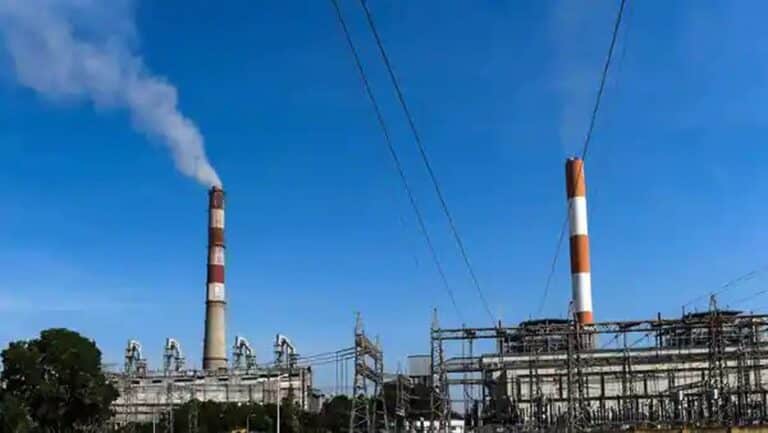
About Aerosol Pollution:
- Aerosols are fine particulates that float in the atmosphere.
- Aerosol pollution refers to particles in the air emitted by vehicles and factories that burn fossil fuels.
- High aerosol amounts include particulate matter (PM2.5 and PM10) among other pollutants as well as sea salt, dust, black and organic carbon.
- Primary aerosols like dust, soot, or sea salt, come directly from the planet’s surface. They get lifted into the atmosphere by gusty winds, shot high into the air by exploding volcanoes, or they waft away from smokestacks or flames.
- Secondary aerosols form when different things floating in the atmosphere—like organic compounds released by plants, liquid acid droplets, or other materials—crash together, culminating in a chemical or physical reaction.
Impact:
- If inhaled they can be harmful.
- This pollution contributes to asthma, bronchitis, and long-term irritation of the respiratory tract, which can lead to cancer.
- Aerosols influence climate in two primary ways:
- by changing the amount of heat that gets in or out of the atmosphere, or
- by affecting the way clouds form.
Aerosol optical depth (AOD):
- Aerosol optical depth (AOD) is the quantitative estimate of the aerosol present in the atmosphere and can be used as a proxy measurement of PM2.5.
- AOD is measured on the basis of how much light is getting attenuated due to the presence of particulate matter.
- More particulates present means more light will be absorbed and hence more will be the AOD. It is measured with the help of remote sensing using satellites.
- The values of AOD range from 0 to 1.0.
- While 0 indicates a crystal-clear sky with maximum visibility, a value of 1 indicates very hazy conditions.
- AOD values less than 0.3 fall under the green zone (safe),
- 3-0.4 is blue zone (less vulnerable),
- 4-0.5 is orange (vulnerable), and
- Over 0.5 is the red zone (highly vulnerable).
Source : The Hindu






 Last updated on April, 2026
→ UPSC Final Result 2025 is now out.
→ UPSC has released UPSC Toppers List 2025 with the Civil Services final result on its official website.
→ Anuj Agnihotri secured AIR 1 in the UPSC Civil Services Examination 2025.
→ UPSC Marksheet 2025 is now out.
→ UPSC Notification 2026 & UPSC IFoS Notification 2026 is now out on the official website at upsconline.nic.in.
→ UPSC Calendar 2026 has been released.
→ Check out the latest UPSC Syllabus 2026 here.
→ UPSC Prelims 2026 will be conducted on 24th May, 2026 & UPSC Mains 2026 will be conducted on 21st August 2026.
→ The UPSC Selection Process is of 3 stages-Prelims, Mains and Interview.
→ Prepare effectively with Vajiram & Ravi’s UPSC Prelims Test Series 2026 featuring full-length mock tests, detailed solutions, and performance analysis.
→ Enroll in Vajiram & Ravi’s UPSC Mains Test Series 2026 for structured answer writing practice, expert evaluation, and exam-oriented feedback.
→ Join Vajiram & Ravi’s Best UPSC Mentorship Program for personalized guidance, strategy planning, and one-to-one support from experienced mentors.
→ Shakti Dubey secures AIR 1 in UPSC CSE Exam 2024.
→ Also check Best UPSC Coaching in India