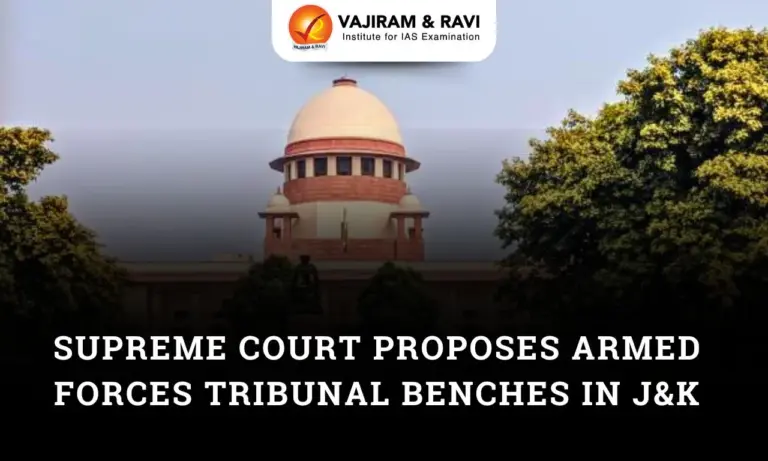
About Armed Forces Tribunal (AFT):
- AFT is a military tribunal in India established under the Armed Forces Tribunal Act, 2007.
- It is functioning under the Ministry of Defence (MoD).
- It is responsible for resolving military-related disputes, including service matters and appeals from court-martial decisions.
- Functions:
- To provide for the adjudication or trial of disputes and complaints with respect to commission, appointments, enrolment, and conditions of service in respect of persons subject to the Army Act, 1950; the Navy Act, 1957; and the Air Force Act, 1950.
- To provide for appeals arising out of orders, findings, or sentences of courts-martial held under the said Acts and for matters connected therewith or incidental thereto.
- The tribunal can also dismiss the appeal if the court martial findings are found to be justified.
- Thus, the tribunal has original jurisdiction in service matters and appellate jurisdiction in court martial matters.
- Any appeal by a person against a decision given by the tribunal can only be taken up in the Supreme Court.
- Benches: Besides the principal bench in New Delhi, AFT has regional benches at Chandigarh, Lucknow, Kolkata, Guwahati, Chennai, Kochi, Mumbai, Jabalpur, Srinagar, and Jaipur.
- Composition:
- Each Bench comprises of a Judicial Member and an Administrative Member.
- The Judicial Members are retired High Court Judges, and Administrative Members are retired Members of the Armed Forces who have held the rank of Major General/equivalent or above for a period of three years or more.
- Judge Advocate General (JAG), who has held the appointment for at least one year, are also entitled to be appointed as the Administrative Member.
- Functioning:
- The Tribunal shall transact their proceedings as per the Armed Forces Tribunal (Procedure) rules, 2008.
- All proceedings in the Tribunal will be in English.
- The Tribunal will normally follow the procedure as is practiced in the High Courts of India.
Q1: What is a Tribunal?
A tribunal is a quasi-judicial institution that deals with the resolution of disputes pertaining to administration, taxation, environment, securities, etc. Tribunals in India are adjudicatory bodies that serve as an alternative to the traditional court system. Tribunals were established to provide swift, cost-effective, and decentralized resolution of disputes across various issues.
Source: TH






 Last updated on March, 2026
→ UPSC Final Result 2025 is now out.
→ UPSC has released UPSC Toppers List 2025 with the Civil Services final result on its official website.
→ Anuj Agnihotri secured AIR 1 in the UPSC Civil Services Examination 2025.
→ UPSC Marksheet 2025 is now out.
→ UPSC Notification 2026 & UPSC IFoS Notification 2026 is now out on the official website at upsconline.nic.in.
→ UPSC Calendar 2026 has been released.
→ Check out the latest UPSC Syllabus 2026 here.
→ UPSC Prelims 2026 will be conducted on 24th May, 2026 & UPSC Mains 2026 will be conducted on 21st August 2026.
→ The UPSC Selection Process is of 3 stages-Prelims, Mains and Interview.
→ Prepare effectively with Vajiram & Ravi’s UPSC Prelims Test Series 2026 featuring full-length mock tests, detailed solutions, and performance analysis.
→ Enroll in Vajiram & Ravi’s UPSC Mains Test Series 2026 for structured answer writing practice, expert evaluation, and exam-oriented feedback.
→ Join Vajiram & Ravi’s Best UPSC Mentorship Program for personalized guidance, strategy planning, and one-to-one support from experienced mentors.
→ Shakti Dubey secures AIR 1 in UPSC CSE Exam 2024.
→ Also check Best UPSC Coaching in India