What’s in today’s article?
- Why in news?
- What does the NEP 2020 say about the minimum age to admit students in Class 1?
- What does the Right to Education (RTE) Act, 2009 say about the age of entry for Class 1?
- Opinions of academicians on this issue
- What does research say about the entry age for formal education?
- What is the age to start formal education across the world in various countries?
Why in news?
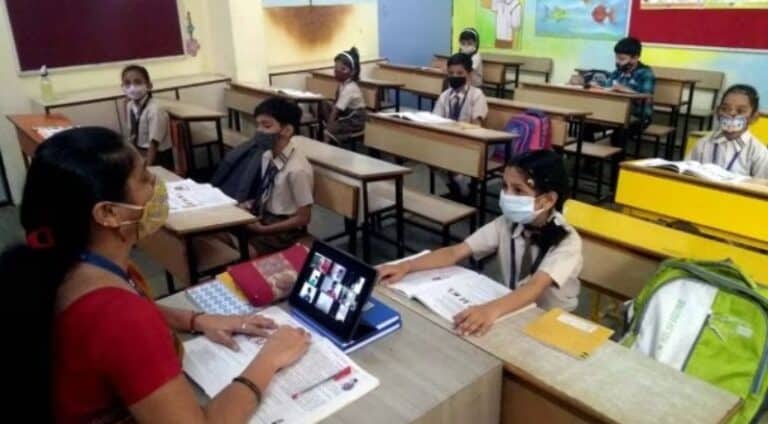
- Schools in Delhi this year will continue to admit students to Class 1 below the age of 6 years.
- This is contrary to recent letters from the Union government to all states, urging them to align the age of entry to Class 1 with the new National Education Policy 2020.
- According to a response furnished by the Union government in the Lok Sabha, there are wide variations in the age criteria among states when it comes to admission to Class 1.
- There were 14 States and Union Territories, as of March 2022, that allow Class 1 admission for children who have not completed six years.





What does the NEP 2020 say about the minimum age to admit students in Class 1?
- The new NEP pitches for a “5+3+3+4” design for formal schooling corresponding to:
- the age groups 3-8 years (foundational stage),
- 8-11 years (preparatory stage),
- 11-14 years (middle stage), and
- 14-18 years (secondary stage).
- This brings early childhood education (also known as pre-school education for children of ages 3 to 5 years) under the ambit of formal schooling.
- This effectively means that a child should be 6 years old to be eligible for admission into Class 1, after completing three years of early childhood education.
What does the Right to Education (RTE) Act, 2009 say about the age of entry for Class 1?
- The RTE Act guarantees education from the age of 6 years to 14 years.
- This means that a child is expected to begin elementary education (i.e., Class 1) at the age of 6 years.
- RTE Act had to specify the entry age for enforcement of formal compulsory education.
- This has been ignored even now by many States leading to the confusion of the actual age for admitting students grade1.
Opinions of academicians on this issue
- As per the academicians in India:
- The age of 6 years was identified considering the universal age that most countries across the world have been following, i.e., to admit a child into grade one at the age of 6 or 7.
- The age 6, which the RTE says is the age to begin Class 1, is simply a reiteration of what has already been a part of our Constitution.
- This was also the same in Gandhi’s idea of basic education.
- It was also stated in the report of the Sargent Commission (on post-war education development in India), which goes back to the 1940s.
What does research say about the entry age for formal education?
- As per the research conducted by David Whitebread, from the Faculty of Education at Cambridge University:
- the early introduction of formal learning approaches to literacy does not improve children’s reading development, and may be damaging.
- By the age of 11, there was no difference in reading ability level between the two groups.
- But the children who started at 5 developed less positive attitudes to reading and showed poorer text comprehension than those children who had started later.
- In a separate study of reading achievement in 15-year-olds across 55 countries, researchers showed that there was no significant association between reading achievement and school entry age.
What is the age to start formal education across the world in various countries?
- Six is the standard age for starting primary school across East Asia, not just in Japan.
- This age is also common in most European countries.
- It is usual (though not compulsory) for younger children in these societies to attend some sort of preschool.
- However, in the USA and the UK children generally start school at 5.
Q1) What is Sargent Commission?
The Sargent Scheme, formally known as the Report of the Sargent Commission on Post-War Education Development in India, was a 1944 memorandum prepared at the behest of the British-run Government of India that outlined the future development of literacy and education in India.
Q2) What was the aim of Gandhi’s idea of basic education?
The aim of Gandhiji’s basic education was to educate the students on crafts which would enable them to solve the problems of their livelihood and at the same time develop qualities of good citizenship.
Source: Explained: The debate over appropriate age of admission to Class 1

 Last updated on March, 2026
→ UPSC Final Result 2025 is now out.
→ UPSC has released UPSC Toppers List 2025 with the Civil Services final result on its official website.
→ Anuj Agnihotri secured AIR 1 in the UPSC Civil Services Examination 2025.
→ UPSC Marksheet 2025 is now out.
→ UPSC Notification 2026 & UPSC IFoS Notification 2026 is now out on the official website at upsconline.nic.in.
→ UPSC Calendar 2026 has been released.
→ Check out the latest UPSC Syllabus 2026 here.
→ UPSC Prelims 2026 will be conducted on 24th May, 2026 & UPSC Mains 2026 will be conducted on 21st August 2026.
→ The UPSC Selection Process is of 3 stages-Prelims, Mains and Interview.
→ Prepare effectively with Vajiram & Ravi’s UPSC Prelims Test Series 2026 featuring full-length mock tests, detailed solutions, and performance analysis.
→ Enroll in Vajiram & Ravi’s UPSC Mains Test Series 2026 for structured answer writing practice, expert evaluation, and exam-oriented feedback.
→ Join Vajiram & Ravi’s Best UPSC Mentorship Program for personalized guidance, strategy planning, and one-to-one support from experienced mentors.
→ Shakti Dubey secures AIR 1 in UPSC CSE Exam 2024.
→ Also check Best UPSC Coaching in India