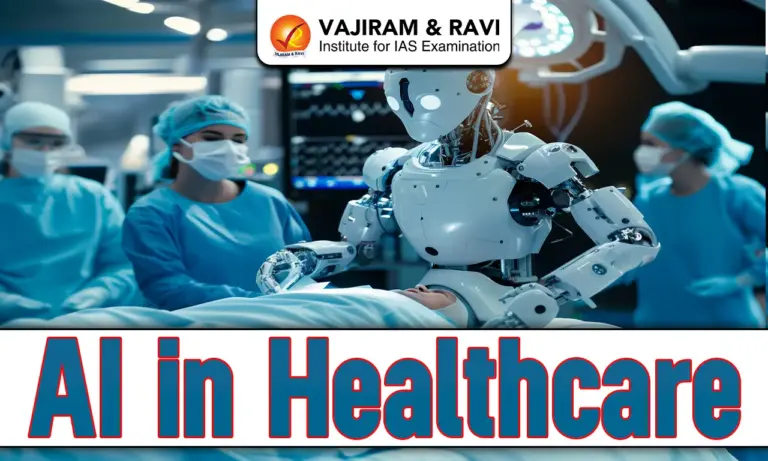
India is currently witnessing growing discussions about the role of Artificial Intelligence (AI) in healthcare. AI is often presented as a transformative solution that can solve major health system challenges. However, beyond the global excitement, it is important to examine whether AI truly addresses ground realities and whether it strengthens public health systems in a fair and ethical manner.
Promise of AI in Healthcare
The promise of AI in healthcare is reflected in its potential to improve diagnosis, increase efficiency, expand access to quality care, and strengthen overall health system functioning. Its key promises are:
- Improved Diagnosis: AI can assist doctors in early detection of diseases, especially in radiology, pathology, and screening of chronic illnesses.
- Better Efficiency: It can reduce paperwork, streamline hospital workflows, and save time for doctors and nurses.
- Support in Remote Areas: AI-powered tools can help bridge gaps in rural and underserved regions where specialist doctors are scarce.
- Data-Driven Decision Making: AI can analyse large volumes of health data to identify disease trends and support public health planning.
- Strengthening Preventive Care: It can help in early risk prediction, monitoring patients, and encouraging timely intervention.
- Improved Referral Systems: AI can assist in directing patients to appropriate levels of care, reducing overcrowding in tertiary hospitals.
- Patient Empowerment: AI systems can simplify medical information and make health records more understandable.
- Rational Drug Use: It can help monitor prescriptions and reduce misuse or overuse of medicines.
- Cost Reduction in the Long Term: If implemented properly, AI may reduce unnecessary tests and improve resource allocation.
- Research and Innovation: AI can accelerate medical research, drug discovery, and development of personalised treatment plans.
AI in Healthcare Challenges
Some major concerns regarding Artificial Intelligence (AI) in healthcare include:
- Data ownership and digital extractivism: Questions arise about who owns health data, who benefits from it, and who bears the risks. Patients should not be treated merely as sources of data.
- Right to understand: People must be able to comprehend their medical information. AI systems should simplify complex medical terms rather than create more confusion.
- Right to control and consent: Consent should not be a one-time formality. Individuals must have the option to withdraw their data and control how it is used.
- Bias and inequality: If AI systems are trained mainly on urban and privileged populations, they may reinforce caste, gender, regional, and economic inequalities. Regular audits and inclusive data are necessary.
- Impact on health workers: AI should support health workers, not replace them. There is a risk that technology may be used to justify staff reductions or increase surveillance of frontline workers.
- Commercialisation of healthcare: If AI is driven by profit-oriented corporate platforms, it may deepen corporatisation instead of strengthening public healthcare.
Another key issue is that India’s health challenges are largely structural. Chronic underinvestment in public health, shortage of trained personnel, weak regulation of private healthcare, and high out-of-pocket expenditure are systemic problems. These cannot be solved by algorithms alone. Over-reliance on AI may lead to “techno-solutionism,” where complex policy problems are treated as purely technical issues.





AI in Healthcare Way forward
- Adopt a rights-based framework: Ensure patient privacy, data protection, informed consent, and the right to withdraw data at any time.
- Strengthen public healthcare systems first: AI should complement investments in infrastructure, human resources, and primary healthcare, not replace them.
- Ensure transparency and accountability: AI algorithms used in healthcare must be explainable, regularly audited, and subject to regulatory oversight.
- Address bias and ensure inclusivity: Use diverse and representative datasets to prevent caste, gender, regional, and socio-economic discrimination.
- Keep humans in the loop: Final medical decisions must remain with trained and accountable healthcare professionals. AI should assist, not substitute, doctors and health workers.
- Protect health workers’ rights: Conduct labour impact assessments before adopting AI tools to ensure no workforce reduction, casualisation, or excessive surveillance.
- Promote local data processing and data sovereignty: Sensitive health data should be processed locally wherever possible, with strict safeguards against misuse.
- Ensure equitable access: AI-enabled services developed with public funds must be accessible and affordable within the public health system.
- Encourage ethical innovation: Public research institutions and startups should be supported to develop AI tools aligned with public interest rather than purely commercial motives.
- Avoid techno-solutionism: Recognise that AI cannot solve structural issues like underfunding, regulatory gaps, and inequality. Policy reforms and systemic improvements must remain the priority
In conclusion, AI can help improve healthcare in India by supporting diagnosis and making systems more efficient. However, it cannot replace strong public health systems and trained professionals. AI must protect patient rights and work under proper regulation. It should support doctors, not replace them, and strengthen public healthcare. Ultimately, people and human care must remain at the centre of the health system.

 Last updated on March, 2026
→ UPSC Final Result 2025 is now out.
→ UPSC has released UPSC Toppers List 2025 with the Civil Services final result on its official website.
→ Anuj Agnihotri secured AIR 1 in the UPSC Civil Services Examination 2025.
→ UPSC Marksheet 2025 is now out.
→ UPSC Notification 2026 & UPSC IFoS Notification 2026 is now out on the official website at upsconline.nic.in.
→ UPSC Calendar 2026 has been released.
→ Check out the latest UPSC Syllabus 2026 here.
→ UPSC Prelims 2026 will be conducted on 24th May, 2026 & UPSC Mains 2026 will be conducted on 21st August 2026.
→ The UPSC Selection Process is of 3 stages-Prelims, Mains and Interview.
→ Prepare effectively with Vajiram & Ravi’s UPSC Prelims Test Series 2026 featuring full-length mock tests, detailed solutions, and performance analysis.
→ Enroll in Vajiram & Ravi’s UPSC Mains Test Series 2026 for structured answer writing practice, expert evaluation, and exam-oriented feedback.
→ Join Vajiram & Ravi’s Best UPSC Mentorship Program for personalized guidance, strategy planning, and one-to-one support from experienced mentors.
→ Shakti Dubey secures AIR 1 in UPSC CSE Exam 2024.
→ Also check Best UPSC Coaching in India
AI in Healthcare FAQs
Q1. What is meant by AI in healthcare?+
Q2. How can AI improve healthcare delivery in India?+
Q3. What are the major concerns related to AI in healthcare?+
Q4. Can AI replace doctors and health workers?+
Q5. What should be the approach for adopting AI in healthcare?+
Tags: aI in healthcare