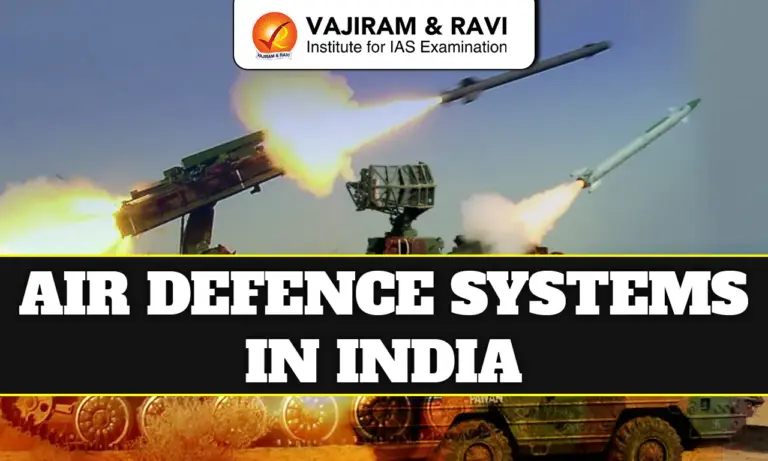
Air Defence System of India form a multi-layered security shield designed to protect national airspace from aircraft, missiles, drones, and emerging hypersonic threats. India operates one of the most complex air defence architectures in Asia, integrating indigenous missile systems, advanced radars, and foreign-origin platforms. With nearly 1750 military aircraft and close to 900 fighter jets, India ranks among the top five global air powers. The system ensures early detection, interception, and neutralisation of hostile aerial threats across varying ranges and altitudes.
Air Defence System of India
Air Defence Systems are defensive military technologies that detect, track, and destroy aerial threats such as fighter aircraft, ballistic missiles, cruise missiles, UAVs, and loitering munitions. India’s air defence framework combines surface-to-air missiles, ballistic missile defence interceptors, radar-guided guns, and integrated command-control networks. Operated jointly by the Indian Air Force, Indian Army, and Indian Navy, these systems follow a layered approach consisting of long-range, medium-range, short-range, and very short-range defences to provide comprehensive aerial security.
Air Defence System of India List
India follows a layered air defence doctrine combining imported and indigenous systems for redundancy and flexibility. The list of major Air Defence System of India are:
- Long-range systems such as S-400 Triumph and Ballistic Missile Defence interceptors
- Medium-range platforms like Akash and Barak-8
- Short-range systems including QRSAM and SPYDER
- Very short-range missile and gun-based systems for terminal defence





1. Prithvi Air Defence (PAD)
Prithvi Air Defence is the exo-atmospheric interceptor of India’s Ballistic Missile Defence Programme.
- Developed by DRDO under BMD Phase-I
- Interception altitude up to 80 km
- Engagement range between 300 and 2,000 km
- Designed to destroy incoming ballistic missiles outside the atmosphere
- Uses inertial navigation with radar guidance
- Successfully tested multiple times against simulated ballistic targets
2. S-400 Triumph
S-400 Triumph is India’s most advanced long-range air defence system, procured from Russia.
- Maximum engagement range of 400 km
- Can intercept aircraft, UAVs, cruise missiles, and ballistic missiles
- India signed a USD 5.43 billion deal for five regiments
- Known in India as “Sudarshan Chakra”
- Tracks up to 300 targets simultaneously
- Deployed along northern and western strategic sectors
3. Advanced Air Defence (AAD)
Advanced Air Defence is the endo-atmospheric interceptor of India’s BMD architecture.
- Designed to intercept missiles within the atmosphere
- Operational altitude up to 30 km
- Speed approximately Mach 4.5
- Complements PAD in two-layer missile interception
- Provides terminal phase ballistic missile defence
- Successfully tested against short and medium-range ballistic targets
4. Akash Surface-to-Air Missile System
Akash is an indigenously developed medium-range surface-to-air missile system.
- Developed by DRDO, produced by BDL and BEL
- Range up to 45 km, speed Mach 3.5
- Uses Rajendra phased-array radar
- Simultaneously tracks 64 targets
- Deployed by Indian Air Force and Indian Army
- Variants include Akash-1S and Akash-NG (70 km range)
5. SPYDER
SPYDER is a quick reaction air defence system acquired from Israel.
- Uses Python-5 and Derby missiles
- Engagement range between 20 and 50 km
- Capable of all-weather operations
- Highly mobile and rapidly deployable
- Effective against low-flying aircraft and drones
- Integrated into IAF’s low-level air defence network
6. QRSAM
Quick Reaction Surface-to-Air Missile (QRSAM) is a mobile indigenous air defence system.
- Developed by DRDO for Indian Army
- Operational range up to 30 km
- Speed approximately Mach 4.7
- Capable of firing on the move
- Designed to counter aircraft and UAVs
- Fully automated command and control system
7. 2K12 Kub (Kvadrat)
2K12 Kub is a Soviet-era medium-range air defence system still in limited service.
- Maximum range of about 24 km
- Engagement altitude up to 14,000 metres
- Radar-guided missile system
- Used for point and area defence
- Gradually being phased out
- Replaced by modern indigenous platforms
8. S-125 Pechora
S-125 Pechora is a legacy short-range surface-to-air missile system.
- Soviet-origin system
- Maximum range around 30 km
- Designed to counter low-altitude targets
- Upgraded with digital radars in India
- Used extensively during earlier decades
- Now largely replaced by Akash and Barak-8
9. Barak-8
Barak-8 is a modern medium-range air defence system jointly developed by India and Israel.
- Range up to 100 km
- Used by Army, Navy, and Air Force
- Equipped with active radar seeker
- High resistance to electronic countermeasures
- Deployed in sensitive border areas
- Effective against missiles, aircraft, and UAVs
Also Read: Air Defence Systems in the World
10. 9K33 Osa-AK
Osa-AK is a mobile short-range air defence missile system.
- Soviet-origin all-weather system
- Range approximately 15 km
- Mounted on amphibious vehicles
- Designed for frontline air defence
- Rapid reaction capability
- Gradually being replaced by newer systems
11. S-200 Angara
S-200 Angara was a long-range air defence system previously used by India.
- Engagement range exceeding 250 km
- Designed for high-altitude targets
- Large radar signature and fixed deployment
- Required extensive logistical support
- Now retired from active service
- Replaced by S-400 class systems
12. 9K35 Strela-10
Strela-10 is a very short-range infrared-guided missile system.
- Engagement range up to 5 km
- Designed for low-flying aircraft
- Mounted on tracked vehicles
- Passive infrared guidance
- Suitable for frontline troops
- Part of India’s VSHORAD layer
13. 2K22 Tunguska
Tunguska is a combined gun-missile air defence platform.
- Integrates missiles and 30 mm cannons
- Engagement range up to 10 km
- Effective against helicopters and aircraft
- Radar and optical tracking
- Mounted on tracked chassis
- Used for mobile battlefield air defence
14. ZSU-23-4 Shilka and ZU-23-2
These are gun-based air defence systems forming the last line of defence.
- ZSU-23-4 has radar-guided 23 mm guns
- ZU-23-2 is a towed twin-barrel system
- Effective against low-altitude threats
- Widely used for point defence
- High rate of fire
- Deployed near critical installations
15. Bofors 40 mm Gun & KPV HMG
Gun-based systems provide close-in air defence against low-flying threats.
Key facts:
- Bofors 40 mm effective against aircraft and drones
- High accuracy and proven reliability
- KPV Heavy Machine Gun used for short-range defence
- Effective against helicopters and UAVs
- Deployed at airbases and forward areas
- Complements missile-based systems

 Last updated on March, 2026
→ UPSC Final Result 2025 is now out.
→ UPSC has released UPSC Toppers List 2025 with the Civil Services final result on its official website.
→ Anuj Agnihotri secured AIR 1 in the UPSC Civil Services Examination 2025.
→ UPSC Marksheet 2025 is now out.
→ UPSC Notification 2026 & UPSC IFoS Notification 2026 is now out on the official website at upsconline.nic.in.
→ UPSC Calendar 2026 has been released.
→ Check out the latest UPSC Syllabus 2026 here.
→ UPSC Prelims 2026 will be conducted on 24th May, 2026 & UPSC Mains 2026 will be conducted on 21st August 2026.
→ The UPSC Selection Process is of 3 stages-Prelims, Mains and Interview.
→ Prepare effectively with Vajiram & Ravi’s UPSC Prelims Test Series 2026 featuring full-length mock tests, detailed solutions, and performance analysis.
→ Enroll in Vajiram & Ravi’s UPSC Mains Test Series 2026 for structured answer writing practice, expert evaluation, and exam-oriented feedback.
→ Join Vajiram & Ravi’s Best UPSC Mentorship Program for personalized guidance, strategy planning, and one-to-one support from experienced mentors.
→ Shakti Dubey secures AIR 1 in UPSC CSE Exam 2024.
→ Also check Best UPSC Coaching in India
Air Defence Systems of India FAQs
Q1. What is the Air Defence System of India?+
Q2. Which is the longest-range Air Defence System in India?+
Q3. What is India’s indigenous Ballistic Missile Defence system?+
Q4. Which indigenous missile forms the backbone of medium-range Air Defence Systems in India?+
Q5. How does India ensure last-layer air defence?+
Tags: air defence system of india