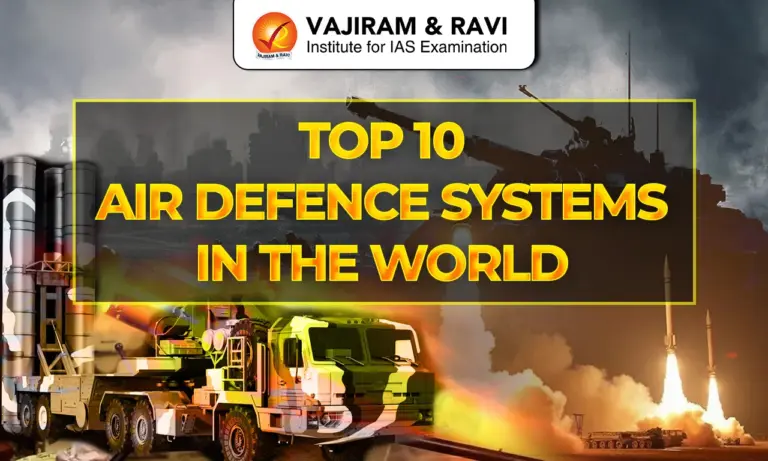
The Top 10 Air Defence Systems in the World reflect a strategic shift toward layered, networked, and high-speed interception capabilities. Modern warfare is increasingly dominated by aerial threats such as ballistic missiles, hypersonic glide vehicles, armed drones, and stealth aircraft. To counter these threats, nations rely on advanced air defence systems that integrate radars, interceptor missiles, command-and-control networks, and real-time surveillance. With rising geopolitical conflicts and missile proliferation, air defence systems now play a crucial role in protecting airspace, strategic assets, and civilian infrastructure worldwide.
Air Defence Systems
Air defence systems are military technologies designed to detect, track, intercept, and destroy hostile aerial objects including aircraft, cruise missiles, ballistic missiles, and unmanned aerial vehicles. These systems combine long-range surveillance radars, fire control radars, interceptor missiles, and battle management systems into Integrated Air Defence Systems (IADS). As per global defence market estimates, the air defence systems market was valued at USD 46.55 billion in 2024 and is projected to reach USD 81.92 billion by 2035 (market projected to grow at a CAGR of 5.27% between 2025 and 2035), driven by hypersonic threats, drone warfare, and missile modernisation.
Top 10 Air Defence Systems in the World List
The Top 10 Air Defence Systems in the World are ranked based on operational range, interception altitude, target spectrum, combat performance, and technological sophistication.
- S-500 Prometheus- Russia
- S-400 Triumph- Russia
- THAAD- United States
- David’s Sling- Israel/USA
- Patriot PAC-3- United States
- S-300VM/ Antey-2500- Russia
- Aster 30 SAMP/T- France/ Italy
- HQ-9- China
- Barak-8- India/Israel
- Iron Dome- Israel





1. S-500 Prometheus
The S-500 Prometheus is Russia’s most advanced strategic air and missile defence system, designed for next-generation warfare.
- Maximum interception range of up to 600 km for ballistic targets and 500 km for aerial targets
- Capable of intercepting targets at altitudes up to 180-200 km, including low Earth orbit threats
- Interceptor missile speed reaches Mach 20, enabling hypersonic interception
- Can simultaneously engage 10 hypersonic targets travelling at 7 km per second
- Designed to counter ballistic missiles, hypersonic weapons, UAVs, and satellites
2. S-400 Triumph
The S-400 Triumph is a long-range, multi-target air defence system widely deployed globally.
- Maximum engagement range of 400 km with altitude coverage of 30-56 km
- Tracks and engages up to 36 targets simultaneously
- Uses multiple interceptor missiles including 40N6, 48N6, and 9M96 variants
- Effective against aircraft, cruise missiles, ballistic missiles, and UAVs
- Operational in Russia, India, China, Turkey, and other countries
3. THAAD (Terminal High Altitude Area Defense)
THAAD is a high-altitude ballistic missile defence system developed by the United States.
- Engagement range of approximately 200 km
- Interception altitude up to 150 km, enabling exo-atmospheric kills
- Uses hit-to-kill kinetic interceptors without explosives
- Interceptor speed exceeds Mach 8
- Deployed in South Korea, UAE, and integrated with Patriot and Aegis systems
4. David’s Sling
David’s Sling is a medium-to-long range missile defence system jointly developed by Israel and the United States.
- Effective range up to 300 km
- Designed to intercept tactical ballistic missiles, cruise missiles, drones, and aircraft
- Uses Stunner interceptor missile with dual seeker technology
- Interceptor speed exceeds Mach 7
- Forms a key layer between Iron Dome and Arrow systems in Israel’s defence architecture
5. Patriot PAC-3
Patriot PAC-3 is a combat-proven air and missile defence system manufactured by Raytheon.
- Engagement range of 160-170 km
- Effective interception altitude up to 24 km
- PAC-3 variant uses hit-to-kill technology
- Widely deployed in over 17 countries, including Japan, Germany, Saudi Arabia
- Integrated into multi-layered missile defence networks alongside THAAD
6. S-300VM/ Antey-2500
The S-300VM is a mobile long-range air and missile defence system developed by Russia.
- Maximum engagement range of 250 km
- Effective interception altitude up to 30 km
- Capable of engaging aircraft, cruise missiles, and intermediate-range ballistic missiles
- Interceptor missile speed exceeds Mach 7
- Deployed in countries such as Egypt and Venezuela
7. Aster 30 SAMP/T
Aster 30 SAMP/T is a European air defence system developed jointly by France and Italy.
- Operational range between 120-150 km
- Interception altitude up to 25 km
- Uses Aster 30 missile with active radar homing
- Capable of engaging short-range ballistic missiles and cruise missiles
- Deployed by France, Italy, and Singapore
8. HQ-9
HQ-9 is China’s long-range surface-to-air missile system.
- Maximum engagement range of 200 km
- Effective altitude of approximately 27 km
- Incorporates phased-array radar technology
- Designed to counter aircraft, cruise missiles, and ballistic missiles
- Advanced variants include HQ-9B and HQ-9C
9. Barak-8
Barak-8 is a joint India-Israel air defence system designed for land and naval operations.
- Engagement range of 70-100 km
- Interception altitude up to 20 km
- Uses active radar seeker missiles
- Effective against aircraft, UAVs, cruise missiles, and anti-ship missiles
- Deployed by Indian Navy, Indian Air Force, and Israeli Defence Forces
10. Iron Dome
Iron Dome is a short-range air defence system developed by Israel for rocket interception.
- Effective range up to 70 km
- Interception altitude around 10 km
- Uses Tamir interceptor missiles
- Achieved a combat success rate of over 90%
- Designed to neutralise rockets, artillery shells, and mortars in real time

 Last updated on March, 2026
→ UPSC Final Result 2025 is now out.
→ UPSC has released UPSC Toppers List 2025 with the Civil Services final result on its official website.
→ Anuj Agnihotri secured AIR 1 in the UPSC Civil Services Examination 2025.
→ UPSC Marksheet 2025 is now out.
→ UPSC Notification 2026 & UPSC IFoS Notification 2026 is now out on the official website at upsconline.nic.in.
→ UPSC Calendar 2026 has been released.
→ Check out the latest UPSC Syllabus 2026 here.
→ UPSC Prelims 2026 will be conducted on 24th May, 2026 & UPSC Mains 2026 will be conducted on 21st August 2026.
→ The UPSC Selection Process is of 3 stages-Prelims, Mains and Interview.
→ Prepare effectively with Vajiram & Ravi’s UPSC Prelims Test Series 2026 featuring full-length mock tests, detailed solutions, and performance analysis.
→ Enroll in Vajiram & Ravi’s UPSC Mains Test Series 2026 for structured answer writing practice, expert evaluation, and exam-oriented feedback.
→ Join Vajiram & Ravi’s Best UPSC Mentorship Program for personalized guidance, strategy planning, and one-to-one support from experienced mentors.
→ Shakti Dubey secures AIR 1 in UPSC CSE Exam 2024.
→ Also check Best UPSC Coaching in India
Top 10 Air Defence Systems in the World FAQs
Q1. What are Top 10 Air Defence Systems in the World used for?+
Q2. Which is the most advanced among Top 10 Air Defence Systems in the World?+
Q3. Which has the highest combat success rate among Top 10 Air Defence Systems in the World?+
Q4. Which air defence system is jointly developed by India and Israel?+
Q5. Why are air defence systems gaining global importance?+
Tags: top 10 air defence systems in the world