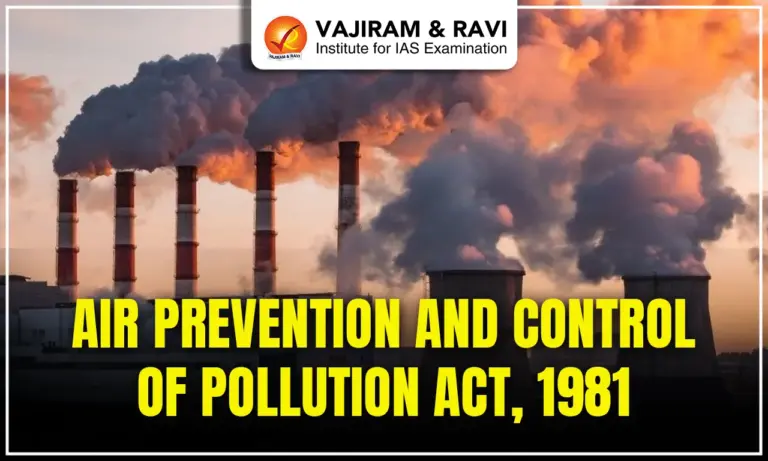
Air pollution poses a serious threat to human health, ecosystems, and climate. To regulate emissions and protect air quality, the Government of India enacted the Air (Prevention and Control of Pollution) Act, 1981, which provides a legal framework to prevent, control, and abate air pollution across the country.
Air Prevention and Control of Pollution Act 1981
The Air (Prevention and Control of Pollution) Act, 1981, formally Act No. 14 of 1981, was enacted by the Indian Parliament on 29 March 1981 and came into force on the date notified by the Central Government. It extends to the entire territory of India. The purpose of the Act is to provide for the prevention, control and abatement of air pollution, and to establish Boards with powers and functions to enforce this regime.
Air Prevention and Control of Pollution Act 1981 Objectives
The primary objectives of the Air Prevention and Control of Pollution Act 1981 are:
- To prevent and reduce air pollution so as to protect public health and the environment.
- To provide statutory bodies (Boards)- Central and State, with powers to monitor, regulate, and enforce air quality norms.
- To coordinate national and state-level programmes for the abatement of air pollution.
- To lay down standards for emissions from sources such as automobiles and industrial plants.
- To support research, training, technical assistance, and public awareness on air pollution.




Air Prevention and Control of Pollution Act 1981 Need
There were several compelling reasons for enacting Air Prevention and Control of Pollution Act in 1981:
- Rising Industrialization: Rapid industrial growth was increasing emissions from factories, power plants, and manufacturing units.
- Vehicular Emissions: The expansion of road transport contributed significantly to air pollution via exhaust gases.
- International Commitment: India had participated in the 1972 United Nations Conference on the Human Environment in Stockholm, where the need to control air pollution was emphasized.
- Lack of Regulatory Framework: Before this Act, there was no unified legal mechanism specifically targeting air pollution (though the Water Act of 1974 existed for water pollution).
- Public Health Risks: Air pollutants such as particulate matter, gases, and noise posed serious risks to human health, agriculture, and ecosystems.
- Environmental Degradation: Without regulation, unchecked emissions could degrade the quality of life, damage property, and harm biodiversity.
Air Prevention and Control of Pollution Act 1981 Provisions
The Air Prevention and Control of Pollution Act 1981 contains a range of provisions to ensure effective control of air pollution:
- Definitions (Section 2): Defines key terms such as “air pollutant” (including noise), “air pollution,” “approved appliance,” “approved fuel,” “automobile,” etc.
- Boards (Sections 3-5):
- Central Board: The Central Pollution Control Board (CPCB), already constituted under the Water Act, performs functions under this Air Act as well.
- State Boards: State Pollution Control Boards are constituted (or designated) for air pollution control.
- Powers of Boards (Sections 16-18):
- The Central Board has powers to advise the Central Government; plan national pollution abatement programmes; coordinate State Boards; conduct research; train personnel; monitor; lay down air quality norms; and more.
- The State Boards have the responsibility to inspect industrial premises, ensure compliance, fix industrial emission standards, and regulate fuel and appliance usage.
- Declaration of Pollution Control Areas (Section 19): State Governments, after consulting the Board, can notify any area as an “air pollution control area” where special restrictions apply (e.g., on fuel types, appliances, burning of material).
- Automobile Emission Regulation (Section 20): State Governments, in consultation with the boards, may direct vehicle registration authorities to ensure that vehicles comply with emission standards.
- Industrial Consent Regime (Section 21): No person may establish or operate an industrial plant in a declared pollution control area without prior “consent” of the State Board.
- Laboratory, Funds, Accounts (Sections 33-36): Boards must maintain funds, keep proper accounts, set up/recognize laboratories, produce annual reports.
- Enforcement: The Act empowers Boards to issue directions, grant or withdraw consents, and inspect premises to ensure compliance.
- Offences and Penalties (Sections 37-39): The Act provides for imprisonment, fines, and other punitive measures for violations.
Air Prevention and Control of Pollution Act 1981 Amendments
The Air Prevention and Control of Pollution Act 1981 was amended by the Air (Prevention and Control of Pollution) Amendment Act, 1987 (Act No. 47 of 1987). Major changes included:
- Definition Expansion: The 1987 amendment explicitly included “noise” as an air pollutant under the definition.
- New Section 19: Empowered State Governments (with Boards’ advice) to declare “air pollution control areas” and impose restrictions on fuel, appliances, and burning practices.
- Stricter Penalties: The amendment increased the severity of penalties for violation.
- Clarification of Consent Regime: It laid down clearer provisions for prior consent by State Boards before establishing or operating industrial plants in declared areas.
Also Read: Forest Rights Act
Air Prevention and Control of Pollution Act 1981 Organizations
Under the Air Prevention and Control of Pollution Act 1981, the institutional structure is composed of:
- Central Pollution Control Board (CPCB):
- Already established under the Water (Prevention and Control of Pollution) Act, 1974. Under the Air Act, it performs additional tasks related to air pollution.
- Functions include advising government, coordinating State Boards, research, setting air standards, and public awareness.
- It may also delegate its functions and set up laboratories.
- State Pollution Control Boards (SPCBs):
- Each State has an SPCB that implements Air Act provisions at the state level, enforces standards, grants or denies consent for industrial plants, inspects, monitors, and takes action.
- Committees & Technical Bodies: Boards may set up committees for specific roles (e.g., training, research), and associate experts temporarily for special tasks.
Air Prevention and Control of Pollution Act 1981 Challenges
Air Prevention and Control of Pollution Act 1981 faces several implementation challenges. To strengthen the Air Prevention and Control of Pollution Act 1981, steps that could be taken are discussed below.
Challenges:
- Limited enforcement capacity at State Pollution Control Boards.
- Inadequate coverage of monitoring infrastructure in many regions.
- Delays in granting or renewing industrial consents.
- Weak public awareness and involvement in enforcement.
- Non-compliance by industries, especially in unorganized sectors.
- Pollution control areas not declared timely or enforced strictly.
- Poor inter-state coordination among State Boards.
- Insufficient research and technical capacity for air quality management.
- Penalties sometimes not deter violations effectively.
- Lack of integration with other environmental laws and climate goals.
Way Forward:
- Enhance capacity building and staffing of SPCBs for better enforcement.
- Expand and modernize air quality monitoring networks across all states.
- Simplify and fast-track the consent process for industries, with transparency.
- Promote public participation via citizen monitoring and grievance redressal.
- Target non-compliant and informal sectors with stricter inspections and audits.
- Declare more pollution control areas and enforce fuel/appliance restrictions.
- Foster better coordination among State Boards for transboundary pollution control.
- Invest in research labs, training, and technical support for pollution control strategies.
- Review and raise penalty provisions so they act as a strong deterrent.
- Align the Act’s implementation with national climate and sustainable development policies.
Air Prevention and Control of Pollution Act 1981 Penalties
Penalties under the Air Prevention and Control of Pollution Act 1981 ensure that industries, individuals and authorities follow air pollution rules.
- Failure to follow emission rules can lead to 1.5 to 6 years imprisonment, along with fines, and 5000 rupees daily fine if violation continues after conviction.
- If the violation goes beyond one year after conviction, imprisonment increases to 2 to 7 years with additional fines.
- Damaging Board property, stopping officials, or giving false information can lead to 3 months jail or 10,000-rupee fine.
- Any violation without a specific penalty can also attract 3 months jail or 10,000-rupee fine, with 5000 rupees daily for continuing offences.
- Companies and government departments are liable when offences occur, and responsible officers can also be punished unless they prove due diligence.
Air Prevention and Control of Pollution Act 1981 Achievements
Since its enactment, the Air Prevention and Control of Pollution Act 1981 has achieved several important milestones:
- Institutional Framework: It established the Central and State Pollution Control Boards, which are now central to India’s air quality governance.
- Standards and Regulation: It enabled the formulation and enforcement of emission standards for industries and automobiles.
- Consent Regime: The mechanism of “consent to operate” has made air-polluting industries accountable.
- Research & Data Generation: Through its mandate, CPCB has collected and published large amounts of air-quality data, guiding policy and public awareness.
- Preventive Measures: The power to declare “air pollution control areas” has allowed states to restrict use of unapproved fuels and appliances.
- Public Awareness: Boards organize training programmes and use mass media to educate people about air pollution prevention.
- Laboratory Network: Establishment and recognition of laboratories help in monitoring, testing, and research.
Air Prevention and Control of Pollution Act 1981 Recent Developments
In recent years, some notable developments relating to the Air Prevention and Control of Pollution Act 1981 include:
- The Central Pollution Control Board (CPCB) continues to update its functions; as of 2025, it advises the government, plans national programmes, resolves inter-state issues, and enforces pollution standards.
- Grants and Rules: New guidelines have been issued for grant, refusal, or cancellation of consent under the Act. For example, the CPCB’s website shows recent updates on air-pollution control rules.
- Judicial Oversight: Environmental cases often cite the Air Act in court, emphasizing its continuing relevance in legal enforcement.
- Technological Monitoring: Researchers are now using satellite imagery and machine-learning tools to detect non-compliant sources (like brick kilns), highlighting gaps in enforcement and compliance.
- Policy Integration: The Act’s implementation is being aligned more closely with national air quality programmes and climate change policy goals.
Also Read: Biodiversity Act
Air Prevention and Control of Pollution Act 1981 UPSC
The Air (Prevention and Control of Pollution) Act, 1981 represents India’s foundational legal instrument to fight air pollution. By establishing institutional mechanisms, defining standards, enabling consent-based regulation, and setting penalties, the Act provides a robust framework for protecting air quality. However, persistent challenges such as enforcement gaps, resource constraints, and evolving pollution sources demand consistent policy updates and stronger implementation. Strengthening monitoring, enhancing public participation, and leveraging technology are critical for the Act’s long-term effectiveness.
The Act also plays a crucial role in addressing Delhi Pollution, as it provides the primary legal framework for regulating emissions from industries, vehicles, construction activities, and waste burning in the National Capital Region. Under this Act, the Delhi Pollution Control Committee (DPCC), functioning as the State Board for Delhi, issues consent to operate, monitors air quality, enforces emission norms, and restricts polluting activities during severe pollution episodes.

 Last updated on March, 2026
→ UPSC Final Result 2025 is now out.
→ UPSC has released UPSC Toppers List 2025 with the Civil Services final result on its official website.
→ Anuj Agnihotri secured AIR 1 in the UPSC Civil Services Examination 2025.
→ UPSC Marksheet 2025 Will be out soon.
→ UPSC Notification 2026 & UPSC IFoS Notification 2026 is now out on the official website at upsconline.nic.in.
→ UPSC Calendar 2026 has been released.
→ Check out the latest UPSC Syllabus 2026 here.
→ UPSC Prelims 2026 will be conducted on 24th May, 2026 & UPSC Mains 2026 will be conducted on 21st August 2026.
→ The UPSC Selection Process is of 3 stages-Prelims, Mains and Interview.
→ Prepare effectively with Vajiram & Ravi’s UPSC Prelims Test Series 2026 featuring full-length mock tests, detailed solutions, and performance analysis.
→ Enroll in Vajiram & Ravi’s UPSC Mains Test Series 2026 for structured answer writing practice, expert evaluation, and exam-oriented feedback.
→ Join Vajiram & Ravi’s Best UPSC Mentorship Program for personalized guidance, strategy planning, and one-to-one support from experienced mentors.
→ Shakti Dubey secures AIR 1 in UPSC CSE Exam 2024.
→ Also check Best UPSC Coaching in India
Air Prevention and Control of Pollution Act 1981 FAQs
Q1. What is the Air Prevention and Control of Pollution Act 1981?+
Q2. What are the key objectives of the Air Prevention and Control of Pollution Act 1981?+
Q3. Who enforces the Air Prevention and Control of Pollution Act 1981?+
Q4. What happens if someone violates the Air Prevention and Control of Pollution Act 1981?+
Q5. How has the Air Prevention and Control of Pollution Act 1981 been amended?+
Tags: air prevention and control of pollution act 1981