Airport Privatisation Latest News
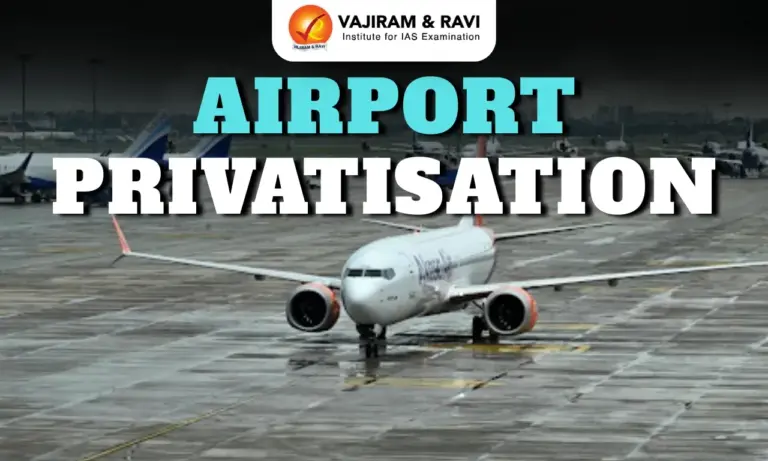
- The Union government has moved forward with the third round of airport privatisation by proposing the leasing of 11 Airports Authority of India facilities to private operators under the PPP model.
Background: Airport Privatisation in India
- Airport privatisation in India is part of a broader strategy to improve infrastructure efficiency, mobilise private capital, and reduce the financial burden on the public exchequer.
- Airports in India are largely owned and operated by the Airports Authority of India (AAI), which manages both aeronautical services (runways, terminals) and non-aeronautical assets (retail, parking, real estate).
- The process began in the early 2000s with the privatisation of Delhi and Mumbai airports, followed by greenfield PPP airports such as Bengaluru and Hyderabad.
- In 2019, six more airports were privatised, marking a shift from a revenue-share model to a per-passenger fee model.
- The current round represents a new phase, as it introduces the bundling of metro and non-metro airports for the first time.





Objectives of Airport Privatisation
- The core objectives of airport privatisation include improving service quality, modernising infrastructure, and increasing operational efficiency.
- Private operators are expected to bring in investment, adopt global best practices, and expand non-aeronautical revenue streams to cross-subsidise passenger costs.
- Airport privatisation is also linked to India’s long-term aviation growth strategy.
- With only about 6% of Indians currently using air travel, there is significant untapped demand.
- Expanding airport capacity and improving connectivity are seen as essential for economic growth, regional integration, and tourism.
Third Round of Airport Privatisation
- The third round of privatisation covers 11 airports, grouped into five bundled packages.
- These airports are drawn from AAI facilities handling 0.1 to 1 million passengers annually, selected based on traffic potential, future growth projections, and geographical proximity.
- Once approved by the Public Private Partnership Appraisal Committee (PPPAC) and the Union Cabinet, bids are expected to be invited, with the tender process likely to begin in 2026.
- This round is also aligned with the National Monetisation Pipeline (NMP), which seeks to monetise brownfield infrastructure to fund new public assets.
- Under the NMP, airport privatisation of 25 airports was projected to generate over Rs. 20,000 crore.
- However, the aviation sector has lagged behind roads and railways in achieving monetisation targets, prompting renewed policy focus.
Revenue Models and Regulatory Framework
- A major issue in airport privatisation is the shift from revenue-sharing to per-passenger fee models.
- Under this system, private operators pay AAI a fixed amount per passenger, indexed annually.
- While this provides revenue certainty to AAI, it raises concerns about higher user charges.
- Airport tariffs are regulated by the Airport Economic Regulatory Authority (AERA), which approves user development fees, landing charges, and other tariffs.
- Non-aeronautical revenues are intended to offset passenger costs, but disputes have arisen over the under-reporting of such revenues by private operators.
Emerging Concerns and Criticisms
- One of the biggest concerns is market concentration.
- Over the past few years, a single corporate group has acquired control over a large number of major airports, raising fears of monopoly or duopoly in the aviation ecosystem.
- This weakens the bargaining power of airlines and leaves passengers with limited choices.
- There are also concerns over rising costs for passengers. In some privatised airports, user development fees and ancillary charges have increased significantly after tariff revisions.
- Additional issues reported by passengers include congestion, high taxi charges, limited accessibility services, and declining service quality.
- To address this, the regulator has begun moving towards service-linked tariff regulation, proposing penalties for airports that fail to meet benchmarks such as security wait times, check-in duration, and passenger assistance.
Way Forward
- India’s aviation market is expected to grow rapidly, with airport capacity projected to increase from about 550 million passengers per annum to nearly 850 million in the next five years.
- Meeting this demand will require not just new airports but also effective regulation, competition safeguards, and consumer protection.
- Balancing private investment with public interest will be critical.
- Transparent bidding, caps on concentration, robust regulatory oversight, and accountability on service quality will determine whether airport privatisation delivers inclusive and affordable air travel.
Source: TH

 Last updated on March, 2026
→ UPSC Final Result 2025 is now out.
→ UPSC has released UPSC Toppers List 2025 with the Civil Services final result on its official website.
→ Anuj Agnihotri secured AIR 1 in the UPSC Civil Services Examination 2025.
→ UPSC Marksheet 2025 is now out.
→ UPSC Notification 2026 & UPSC IFoS Notification 2026 is now out on the official website at upsconline.nic.in.
→ UPSC Calendar 2026 has been released.
→ Check out the latest UPSC Syllabus 2026 here.
→ UPSC Prelims 2026 will be conducted on 24th May, 2026 & UPSC Mains 2026 will be conducted on 21st August 2026.
→ The UPSC Selection Process is of 3 stages-Prelims, Mains and Interview.
→ Prepare effectively with Vajiram & Ravi’s UPSC Prelims Test Series 2026 featuring full-length mock tests, detailed solutions, and performance analysis.
→ Enroll in Vajiram & Ravi’s UPSC Mains Test Series 2026 for structured answer writing practice, expert evaluation, and exam-oriented feedback.
→ Join Vajiram & Ravi’s Best UPSC Mentorship Program for personalized guidance, strategy planning, and one-to-one support from experienced mentors.
→ Shakti Dubey secures AIR 1 in UPSC CSE Exam 2024.
→ Also check Best UPSC Coaching in India
Airport Privatisation FAQs
Q1. What is airport privatisation in India?+
Q2. Why is the government privatising airports?+
Q3. What is new in the third round of airport privatisation?+
Q4. Who regulates airport tariffs after privatisation?+
Q5. What are the main concerns with airport privatisation?+
Tags: airport privatisation mains articles upsc current affairs upsc mains current affairs