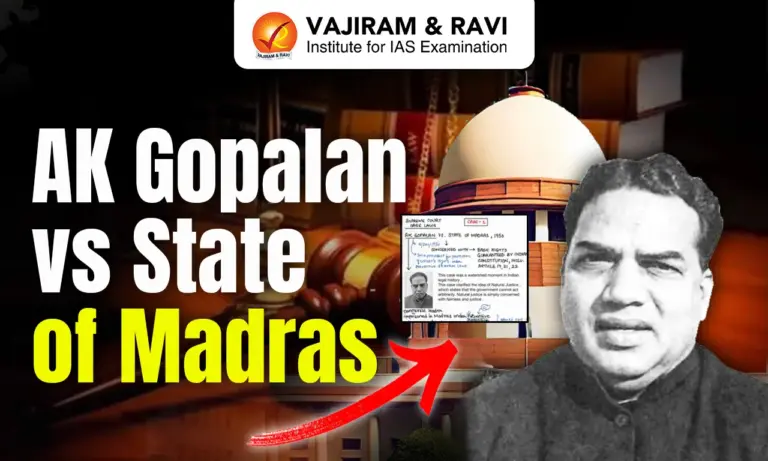
AK Gopalan vs State of Madras and Union of India (1950) is one of the earliest and most influential constitutional law judgments delivered by the Supreme Court of India. It interpreted Article 21 and defined the meaning of “Procedure Established by Law” in post-independence India. The case examined Preventive Detention, Personal Liberty, and the scope of fundamental rights under Articles 19, 21, and 22. Though it upheld the Preventive Detention Act 1950, the judgment shaped constitutional interpretation for decades.
AK Gopalan vs State of Madras Issue
The AK Gopalan vs State of Madras case began with AK Gopalan’s challenge to his preventive detention and raised crucial questions on personal liberty.
- A.K. Gopalan, a Communist leader and MP, had been under continuous detention since December 1947 under several preventive detention laws.
- He was first detained under the Madras Maintenance of Public Order Act, 1947, and later under the Preventive Detention Act, 1950.
- A fresh detention order under Section 3(1)(a)(i) was issued by the Madras Government on 20 February 1950 for one year.
- The grounds for detention, communicated on 25 February 1950, alleged activities prejudicial to public order.
- His separate conviction under criminal law was set aside, but his detention continued under preventive detention laws.
- On 6 March 1950, he filed a writ petition under Article 32 seeking a writ of habeas corpus against the detention order.
- He claimed violation of his fundamental rights under Articles 19, 21, and 22.
- He challenged several sections of the Preventive Detention Act as unconstitutional for violating safeguards in Article 22.
- The petition alleged mala fide exercise of power and breach of procedural fairness.
- The case was placed before a Constitution Bench due to its major constitutional implications.
- Key Issues highlighted under this case were:
- Whether Article 21 required “due process of law” or only “procedure established by law.”
- Whether the Preventive Detention Act violated Articles 19, 21, and 22.
- Whether Articles 19 and 21 were interrelated or functioned independently.
- Whether Sections 7, 8, 11, 12, and 14 of the Preventive Detention Act were constitutional.
- Whether principles of natural justice applied to preventive detention.
- Whether the detention law violated the equality guarantee under Article 14.
AK Gopalan vs State of Madras Judgment
The Supreme Court delivered its judgment with a 4:1 majority, shaping the early interpretation of personal liberty in India.
- The majority led by Chief Justice Kania held that Article 21 only requires “procedure established by law,” not “due process of law.” If a law exists and is followed, Article 21 is satisfied even if the procedure is unfair.
- The Court adopted compartmentalization of fundamental rights, holding that each Article is independent. Articles 19 and 21 cannot be read together.
- “Personal liberty” under Article 21 was given a narrow meaning, limited to physical freedom, not broader freedoms under Article 19.
- The Preventive Detention Act 1950 was largely upheld as constitutional and fell within the powers granted under Article 22.
- Section 14 of the Act was struck down for violating Article 22(5) since it blocked disclosure of grounds of detention before courts.
- The Court held that natural justice principles did not apply because preventive detention was administrative, not judicial, in nature.
- Justice Fazl Ali dissented, arguing that Article 21 inherently includes fairness, natural justice, and must be read with other fundamental rights.
- He advocated a broad, liberal interpretation of personal liberty, criticizing the restrictive majority approach.
- Fazl Ali stressed that fundamental rights should work harmoniously, not in isolation, to protect citizens effectively.
- The Court confirmed Parliament’s power to enact preventive detention laws under the Seventh Schedule.
- It viewed preventive detention as necessary for national security and public order in the early years after independence.
- The judgment influenced decades of constitutional jurisprudence until it was overruled by the Maneka Gandhi Case (1978), which introduced the due-process-oriented interpretation of Article 21.





What is the Procedure Established by Law?
Procedure established by law means that the State can deprive a person of life or personal liberty as long as there is an existing law that prescribes a procedure and the State follows that procedure. The Court in AK Gopalan Case held that Article 21 does not require the procedure to be fair, reasonable, or just. This narrow interpretation was later replaced by a more expansive, rights-protective approach in Maneka Gandhi Case (1978).

 Last updated on March, 2026
→ UPSC Final Result 2025 is now out.
→ UPSC has released UPSC Toppers List 2025 with the Civil Services final result on its official website.
→ Anuj Agnihotri secured AIR 1 in the UPSC Civil Services Examination 2025.
→ UPSC Marksheet 2025 is now out.
→ UPSC Notification 2026 & UPSC IFoS Notification 2026 is now out on the official website at upsconline.nic.in.
→ UPSC Calendar 2026 has been released.
→ Check out the latest UPSC Syllabus 2026 here.
→ UPSC Prelims 2026 will be conducted on 24th May, 2026 & UPSC Mains 2026 will be conducted on 21st August 2026.
→ The UPSC Selection Process is of 3 stages-Prelims, Mains and Interview.
→ Prepare effectively with Vajiram & Ravi’s UPSC Prelims Test Series 2026 featuring full-length mock tests, detailed solutions, and performance analysis.
→ Enroll in Vajiram & Ravi’s UPSC Mains Test Series 2026 for structured answer writing practice, expert evaluation, and exam-oriented feedback.
→ Join Vajiram & Ravi’s Best UPSC Mentorship Program for personalized guidance, strategy planning, and one-to-one support from experienced mentors.
→ Shakti Dubey secures AIR 1 in UPSC CSE Exam 2024.
→ Also check Best UPSC Coaching in India
AK Gopalan vs State of Madras FAQs
Q1. What was the main issue in AK Gopalan vs State of Madras?+
Q2. Why was AK Gopalan detained?+
Q3. What did the Supreme Court decide in the AK Gopalan vs State of Madras case?+
Q4. What was Justice Fazl Ali’s dissent in AK Gopalan vs State of Madras Case?+
Q5. Why is AK Gopalan vs State of Madras Case law significant?+
Tags: ak gopalan vs state of madras