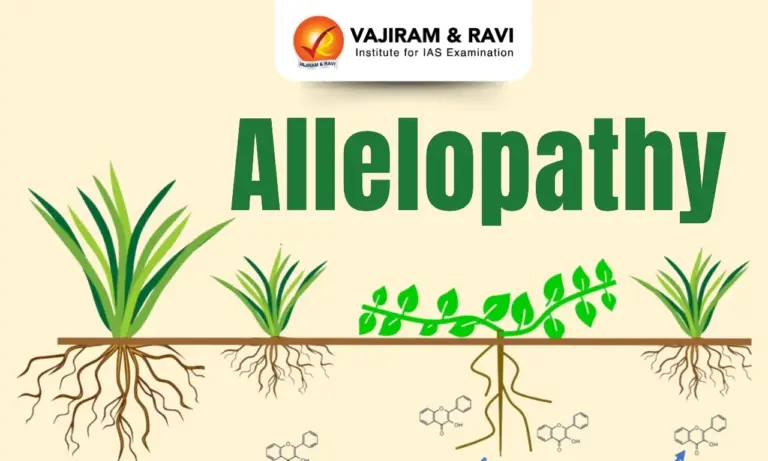
Allelopathy is a biological phenomenon in which one plant releases certain chemicals into the environment that influence the growth, survival, reproduction, or development of other plants and organisms nearby. These chemicals, known as allelochemicals, may have positive or negative effects on neighboring plants.
The term “allelopathy” was first introduced by Austrian scientist Hans Molisch in 1937. It is derived from two Greek words: “allelon” meaning “mutual” and “pathos” meaning “suffering” or “effect.”
Allelopathy Types
Allelopathy is broadly classified into two main types based on the effect that allelochemicals have on neighboring plants and organisms.
1. Positive Allelopathy
Positive allelopathy occurs when chemicals released by a plant stimulate or enhance the growth, germination, survival, or productivity of nearby plants.
- Promotes seed germination and plant growth.
- Improves nutrient availability in the soil.
- Encourages beneficial microbial activity.
- Enhances soil fertility and productivity.
- Supports healthy plant interactions within ecosystems.
- Contributes to sustainable agricultural practices.
- May increase crop yield and plant vigor.
Example: Leguminous plants improve soil nitrogen levels, benefiting neighboring crops.
2. Negative Allelopathy
Negative allelopathy occurs when chemicals released by a plant inhibit the germination, growth, reproduction, or survival of surrounding plants.
- Suppresses seed germination of nearby plants.
- Inhibits root and shoot development.
- Reduces nutrient uptake by competing plants.
- Controls weed growth naturally.
- Decreases competition for water, nutrients, and sunlight.
- Influences plant distribution in ecosystems.
- Can reduce biodiversity if dominant species suppress native vegetation.
Examples:
- Eucalyptus suppresses the growth of understory plants.
- Black Walnut releases juglone, which inhibits several crop species.
- Parthenium (Congress Grass) suppresses the growth of native plants.
Allelopathy in Agriculture
Allelopathy plays an important role in agriculture by influencing crop growth, weed management, soil health, and farming productivity through the release of natural chemical compounds by plants.
- Natural Weed Control: Certain crops release allelochemicals that suppress the germination and growth of weeds, reducing competition for nutrients, water, and sunlight.
- Reduced Dependence on Herbicides: The use of allelopathic crops can decrease the need for synthetic herbicides, making farming more environmentally sustainable.
- Improved Crop Productivity: By limiting weed infestation, crops can utilize available resources more efficiently, resulting in better growth and higher yields.
- Sustainable Farming Practices: Allelopathy supports eco-friendly agricultural systems by promoting natural methods of pest and weed management.
- Use of Cover Crops: Cover crops such as rye and mustard release allelochemicals that suppress weeds and improve field conditions before the main crop is planted.
- Crop Rotation Benefits: Including allelopathic plants in crop rotation systems can help reduce weed populations and improve soil fertility over time.
- Soil Health Enhancement: Decomposing plant residues contribute organic matter to the soil and influence beneficial microbial activity.
- Bioherbicide Development: Scientists are studying allelochemicals to develop natural bioherbicides as alternatives to chemical weed killers.
- Reduced Production Costs: Lower herbicide usage and improved weed control can help farmers reduce cultivation expenses.
- Integrated Weed Management: Allelopathy is increasingly being incorporated into integrated weed management strategies alongside mechanical and biological control methods.
Examples of Allelopathic Crops in Agriculture
- Rice: Some rice varieties suppress the growth of weeds in paddy fields.
- Sorghum: Produces compounds such as sorgoleone that inhibit weed growth.
- Sunflower: Its residues help reduce weed emergence in agricultural fields.
- Mustard: Releases natural compounds that suppress certain weeds and soil-borne pathogens.
- Rye: Commonly used as a cover crop for effective weed control.


Importance of Allelopathy
Allelopathy is an important ecological and agricultural phenomenon that influences plant interactions, regulates biodiversity, and supports sustainable farming through natural chemical processes.
- Natural Weed Management: Allelopathic plants suppress weed growth naturally, reducing competition for nutrients, water, and sunlight.
- Promotes Sustainable Agriculture: It helps farmers adopt eco-friendly farming practices by reducing dependence on synthetic herbicides.
- Reduces Environmental Pollution: Lower use of chemical herbicides decreases soil and water contamination and protects non-target organisms.
- Enhances Crop Productivity: By controlling weeds and reducing resource competition, allelopathy can contribute to higher crop yields.
- Supports Integrated Pest and Weed Management: Allelopathic crops can be integrated with other biological and cultural practices for effective farm management.
- Maintains Ecological Balance: It regulates plant populations and prevents the dominance of certain species, helping maintain ecosystem stability.
- Influences Plant Distribution: Allelopathic interactions determine which plant species can grow together in a particular habitat.
- Aids Forest Regeneration and Succession: In forest ecosystems, allelopathy influences species composition and the process of ecological succession.
- Helps Control Invasive Species: Understanding allelopathic mechanisms can assist in managing invasive plants that threaten native biodiversity.
- Improves Soil Health: Plant residues from allelopathic species can contribute organic matter and influence beneficial soil microorganisms.
Difference Between Allelopathy and Competition
Allelopathy and competition are two important ecological interactions among plants, but while allelopathy involves the release of chemical substances that affect neighboring plants, competition occurs when plants struggle for limited resources such as water, nutrients, sunlight, and space.
| Difference Between Allelopathy and Competition | ||
|
Basis of Difference |
Allelopathy |
Competition |
|
Meaning |
A biological phenomenon where one plant releases chemicals that influence the growth of another plant. |
A process in which organisms compete for limited resources available in the environment. |
|
Nature of Interaction |
Chemical interaction. |
Resource-based interaction. |
|
Cause |
Release of allelochemicals into the environment. |
Scarcity of essential resources such as water, light, nutrients, and space. |
|
Mechanism |
Direct biochemical effects on neighboring plants. |
Indirect effects due to resource sharing and depletion. |
|
Requirement of Resource Limitation |
Can occur even when resources are abundant. |
Occurs mainly when resources are limited. |
|
Effect on Plants |
May inhibit or stimulate germination, growth, and reproduction. |
Reduces growth and survival due to resource shortage. |
|
Source of Influence |
Chemicals released from roots, leaves, stems, or decomposing residues. |
Utilization of common environmental resources by multiple organisms. |
|
Type of Impact |
Can be positive or negative. |
Generally negative for competing organisms. |
|
Role in Agriculture |
Used for natural weed control and sustainable farming. |
Often reduces crop yield due to competition from weeds. |
|
Ecological Importance |
Regulates plant distribution and species composition through chemical interactions. |
Determines population density and resource allocation within ecosystems. |
|
Example |
Eucalyptus suppressing nearby vegetation through chemical release. |
Crops and weeds competing for sunlight, water, and nutrients in a field. |

 Last updated on Oct, 2026
→ UPSC 2027 Notification will be released on 13 January 2027 at upsconline.nic.in.
→ Check Nobel Prize 2026 Winners List here.
→ Download PIB PRiSM Monthly Magazine 2026 here.
→ Check UPSC Monthly Current Affairs Magazine The Recitals here.
→ Check out the latest UPSC Syllabus here.
→ Download UPSC Model Answers for Mains 2026
→ UPSC Mains Question Paper 2026 is out now for Essay & GS Paper 1, 2, 3 & 4.
→ UPSC Calendar 2027 has been released.
→ Enroll in Vajiram & Ravi’s UPSC Mains Test Series 2027 for structured answer writing practice, expert evaluation, and exam-oriented feedback.
→ Join Vajiram & Ravi’s UPSC Mentorship Program 2027 for personalized guidance, strategy planning, and one-to-one support from experienced mentors.
→ Go through the UPSC Mains Previous Year Papers to enhance your preparation.
→ UPSC has released UPSC Toppers List 2025 with the Civil Services final result on its official website.
→ Also check Best UPSC Coaching in India
Allelopathy FAQs
Q1. What is allelopathy?+
Q2. Who coined the term allelopathy?+
Q3. What are allelochemicals?+
Q4. What is the difference between allelopathy and competition?+
Q5. How does allelopathy help in agriculture?+
Tags: agriculture allelopathy biology