Carbon is a unique non-metal element that exhibits an exceptional ability to form multiple structural forms known as allotropes. These allotropes differ in atomic arrangement, bonding, and physical properties, leading to wide variations in hardness, conductivity, and applications. The allotropes of carbon range from naturally occurring substances like diamond and coal to advanced nanomaterials such as graphene and carbon nanotubes. Due to their scientific, industrial, and technological significance, carbon allotropes hold an important place in chemistry.
What are Allotropes?
Allotropes are different physical forms of the same element that exist in the same physical state but have distinct atomic structures. Although they are made of the same element, allotropes show different physical and chemical properties due to variations in bonding and arrangement of atoms. Carbon shows allotropy mainly because of its tetravalency and strong covalent bonding ability. The phenomenon of allotropy explains why carbon can exist as both the hardest natural substance and a soft, slippery material.
Classification of Carbon Allotropes
Carbon allotropes are classified based on the degree of atomic order present in their structure. Some allotropes have a regular and repeating arrangement of atoms, while others have a random arrangement. On this basis, carbon allotropes are divided into crystalline and amorphous forms. This classification helps in understanding their properties and industrial uses.
Crystalline Allotropes of Carbon
Crystalline Allotropes of Carbon have atoms arranged in a well-ordered, repeating three-dimensional structure. This regular arrangement gives them unique mechanical, thermal, and electrical properties, making them highly valuable in industry and technology.
- Well-ordered Structure: Atoms are arranged in a regular, repeating three-dimensional lattice.
- Definite Geometry: Each allotrope has a fixed geometric shape (tetrahedral in diamond, planar in graphite).
- High Melting and Boiling Points: Strong covalent bonding gives them very high thermal stability.
- Hardness Variation: Hardness varies widely (diamond is extremely hard, graphite is soft).
- Electrical Conductivity: Some conduct electricity (graphite, graphene, carbon nanotubes), while others do not (diamond).
- Good Thermal Conductivity: Most crystalline forms conduct heat efficiently.
- Distinct Physical Appearance: Diamond is transparent, graphite is opaque and flaky.
- High Strength: Strong covalent bonding makes them mechanically strong (diamond and nanotubes).
- Chemical Stability: Resistant to chemical attack under normal conditions.
- Industrial and Technological Applications: Used in cutting tools, lubricants, electronics, nanotechnology, and more.
1. Diamond
Diamond is the hardest naturally occurring allotrope of carbon, with each carbon atom covalently bonded to four others in a tetrahedral structure.
- Structure: Each carbon atom is sp³ hybridized, forming a strong 3D tetrahedral lattice.
- Hardness: Hardest known natural material, resistant to scratching.
- Electrical Conductivity: Poor conductor of electricity due to absence of free electrons.
- Thermal Conductivity: Excellent conductor of heat.
- Uses: Cutting and drilling tools, jewelry, high-precision instruments, and heat sinks.
2. Graphite
Graphite is a soft, slippery allotrope of carbon with carbon atoms arranged in hexagonal layers. Its layers are held together by weak van der Waals forces, allowing them to slide over each other easily.
- Structure: Each carbon atom is sp² hybridized, forming planar hexagonal sheets.
- Electrical Conductivity: Good conductor due to delocalized electrons within layers.
- Lubricating Property: Soft and slippery; used as a dry lubricant.
- Thermal Stability: High melting point and can withstand high temperatures.
- Uses: Pencil leads, electrodes in batteries, lubricants, and nuclear reactor moderators.
3. Graphene
Graphene is a single layer of carbon atoms arranged in a two-dimensional hexagonal lattice. It is extremely strong, lightweight, and has exceptional electrical and thermal conductivity.
- Structure: One-atom-thick planar sheet of sp²-hybridized carbon atoms.
- Strength: Extremely strong and flexible; over 100 times stronger than steel by weight.
- Electrical & Thermal Conductivity: Excellent conductor of electricity and heat.
- Transparency: Almost transparent, allowing light to pass through.
- Uses: Flexible electronics, sensors, energy storage devices, and advanced composites.
4. Fullerenes
Fullerenes are carbon molecules arranged in hollow spherical, ellipsoidal, or tubular structures. The most common is C₆₀, known as Buckminsterfullerene, resembling a soccer ball.
- Structure: Cage-like, hollow molecule made of carbon atoms in pentagons and hexagons.
- Stability: Lightweight and chemically stable structure.
- Unique Properties: Distinct electrical and chemical reactivity.
- Electrical Conductivity: Can behave as semiconductors or superconductors in certain conditions.
- Uses: Drug delivery systems, superconductors, lubricants, and catalysts in chemical reactions.
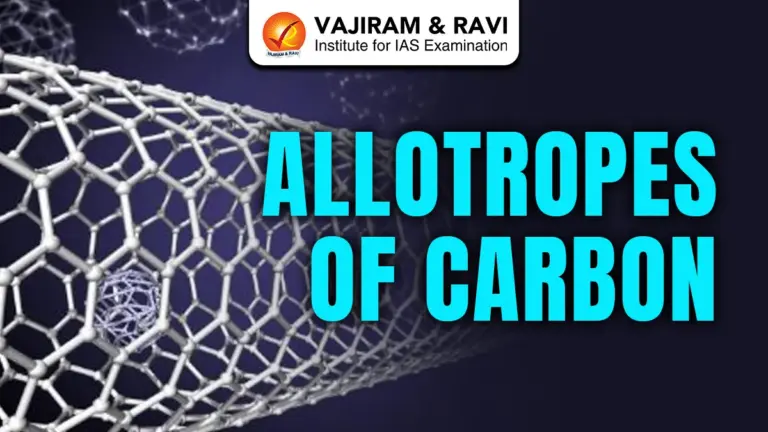
5. Carbon Nanotubes
Carbon nanotubes are cylindrical structures formed by rolling graphene sheets into seamless tubes. They exhibit extraordinary strength, lightweight nature, and exceptional electrical and thermal conductivity, making them important nanomaterials.
- Structure: Cylindrical tubes of carbon atoms arranged in a hexagonal lattice; can be single-walled (SWCNT) or multi-walled (MWCNT).
- Strength: Extremely high tensile strength, stronger than steel by weight.
- Electrical Conductivity: Excellent conductor of electricity; can also act as semiconductors.
- Thermal Conductivity: Excellent heat conductors along the tube axis.
Uses: Nanoelectronics, aerospace materials, drug delivery, reinforced composites, and energy storage devices.
Amorphous Allotropes of Carbon
Amorphous allotropes of carbon lack a regular crystalline structure and have carbon atoms arranged randomly. They are usually softer, porous, and contain impurities, unlike crystalline forms. These allotropes are primarily used as fuels, adsorbents, and industrial materials. Common examples include coal, coke, charcoal, and carbon black.
- Irregular Structure: Lack long-range crystalline order; carbon atoms are randomly arranged.
- Variable Hardness: Softer than crystalline allotropes; texture ranges from brittle (charcoal) to hard (coke).
- Porous and High Surface Area: Makes them excellent adsorbents (e.g., activated charcoal).
- Contains Impurities: Often includes hydrogen, oxygen, nitrogen, or sulfur from source material.
- Combustible and Less Dense: Burns easily and generally lighter than crystalline forms.
- Industrial Uses: Used as fuel, pigments, lubricants, purification agents, and in metallurgy.
1. Coal
Coal is a natural amorphous carbon formed from the remains of ancient plants over millions of years. It contains carbon along with hydrogen, oxygen, nitrogen, and sulfur, which influence its properties and combustion behavior.
- Composition: Contains 60–90% carbon, along with hydrogen, oxygen, sulfur, and nitrogen.
- Appearance: Black, brittle, and solid.
- Combustibility: Burns easily, releasing energy.
- Density & Structure: Irregular, porous, lower density than crystalline carbon.
- Uses: Fuel in thermal power plants, steel and cement production, and precursor for coke.
2. Coke
Coke is a nearly pure form of carbon obtained by destructive distillation of coal in the absence of air. It is harder and more porous than coal and widely used in metallurgy.
- Composition: Almost pure carbon with very low impurities.
- Structure: Porous and hard, irregular amorphous structure.
- Combustibility: Burns at high temperature; used as fuel.
- Chemical Role: Acts as a reducing agent in metallurgy.
- Uses: Fuel in blast furnaces, steel production, and chemical industries.
3. Charcoal
Charcoal is produced by heating wood or other organic matter in limited oxygen, a process called pyrolysis. It is lightweight, porous, and a good adsorbent.
- Composition: Mainly carbon with small amounts of volatile compounds.
- Appearance: Black, brittle, porous material.
- Combustibility: Burns easily and provides steady heat.
- Adsorption: Excellent for purifying water, gases, and medicinal applications.
- Uses: Fuel, water purification, gas masks, medicinal purposes, and art supplies.
4. Carbon Black
Carbon black is produced by incomplete combustion of heavy petroleum products. It is a fine black powder with high surface area, widely used in industry.
- Composition: Almost pure carbon in finely divided form.
- Appearance: Fine black powder, highly porous.
- Conductivity: Slightly conductive due to surface carbon particles.
- Industrial Use: Reinforcing agent in rubber and plastics, pigment in inks and paints.
- Special Applications: Used in batteries, tires, and as a conductive filler.





Allotropes of Carbon Applications
Carbon allotropes have a wide range of applications due to their diverse structures, bonding, and properties. From industry and electronics to medicine and nanotechnology, these allotropes are indispensable in modern science and technology.
- Industrial Uses: Carbon allotropes like diamond and graphite are extensively used in industries. Diamond is used in cutting, drilling, and grinding tools, while graphite is used in electrodes, crucibles, and lubricants.
- Energy Production: Coal and coke serve as primary fuels in thermal power plants, steel production, and cement industries. Amorphous carbon forms are also used for gasification and chemical energy sources.
- Electronics and Nanotechnology: Graphene, carbon nanotubes, and fullerenes are used in flexible electronics, sensors, conductive films, and nano-devices due to their excellent electrical and thermal conductivity.
- Medical and Pharmaceutical Applications: Fullerenes and carbon nanotubes are used in drug delivery systems, biomedical imaging, and controlled release of medications. Activated charcoal is used to treat poisoning and purify water.
- Environmental Applications: Charcoal and activated carbon are used in water and air purification, gas masks, and removal of pollutants due to their high adsorption capacity.
- Materials and Composites: Graphene, carbon nanotubes, and diamond are used in advanced composite materials for aerospace, defense, automotive, and construction industries due to their strength and lightweight properties.
- Jewelry and Ornamentation: Diamond is highly valued in jewelry for its brilliance, transparency, and hardness.
- Lubricants and Additives: Graphite and carbon black are used as dry lubricants, reinforcing agents in rubber and plastics, and pigments in paints, inks, and coatings.
- Research and Scientific Applications: Diamond is used in high-pressure experiments, graphene in photonics and optoelectronics, and carbon nanomaterials in superconductivity and advanced nanoscience research.
Energy Storage: Graphene, carbon nanotubes, and carbon black are widely used in batteries, ultracapacitors, and hydrogen storage devices for renewable and efficient energy solutions.
UPSC Prelims PYQs
Q.With reference to carbon nanotubes, consider the following statements: (2020)
- They can be used as carriers of drugs and antigens in the human body.
- They can be made into artificial blood capillaries for an injured part of human body.
- They can be used in biochemical sensors.
- Carbon nanotubes are biodegradable.
Which of the statements given above are correct?
(a) 1 and 2 only
(b) 2, 3 and 4 only
(c) 1, 3 and 4 only
(d) 1, 2, 3 and 4
Ans: (c)
- Graphene is frequently in news recently. What is its importance? (2012)
- It is a two-dimensional material and has good electrical conductivity.
- It is one of the thinnest but strongest materials tested so far.
- It is entirely made of silicon and has high optical transparency
- It can be used as ‘conducting electrodes’ required for touch screens, LCDs and organic LEDs.
Which of the statements given above are correct?
(a) 1 and 2 only
(b) 3 and 4 only
(c) 1, 2 and 4 only
(d) 1, 2, 3 and 4
Ans: (c)

 Last updated on March, 2026
→ UPSC Final Result 2025 is now out.
→ UPSC has released UPSC Toppers List 2025 with the Civil Services final result on its official website.
→ Anuj Agnihotri secured AIR 1 in the UPSC Civil Services Examination 2025.
→ UPSC Marksheet 2025 is now out.
→ UPSC Notification 2026 & UPSC IFoS Notification 2026 is now out on the official website at upsconline.nic.in.
→ UPSC Calendar 2026 has been released.
→ Check out the latest UPSC Syllabus 2026 here.
→ UPSC Prelims 2026 will be conducted on 24th May, 2026 & UPSC Mains 2026 will be conducted on 21st August 2026.
→ The UPSC Selection Process is of 3 stages-Prelims, Mains and Interview.
→ Prepare effectively with Vajiram & Ravi’s UPSC Prelims Test Series 2026 featuring full-length mock tests, detailed solutions, and performance analysis.
→ Enroll in Vajiram & Ravi’s UPSC Mains Test Series 2026 for structured answer writing practice, expert evaluation, and exam-oriented feedback.
→ Join Vajiram & Ravi’s Best UPSC Mentorship Program for personalized guidance, strategy planning, and one-to-one support from experienced mentors.
→ Shakti Dubey secures AIR 1 in UPSC CSE Exam 2024.
→ Also check Best UPSC Coaching in India
Allotropes of Carbon FAQs
Q1. Why does carbon show allotropy?+
Q2. Which allotrope of carbon is hardest?+
Q3. Why is graphite used as a lubricant?+
Q4. What is the difference between graphene and graphite?+
Q5. Name three amorphous allotropes of carbon.+
Tags: allotropes of carbon