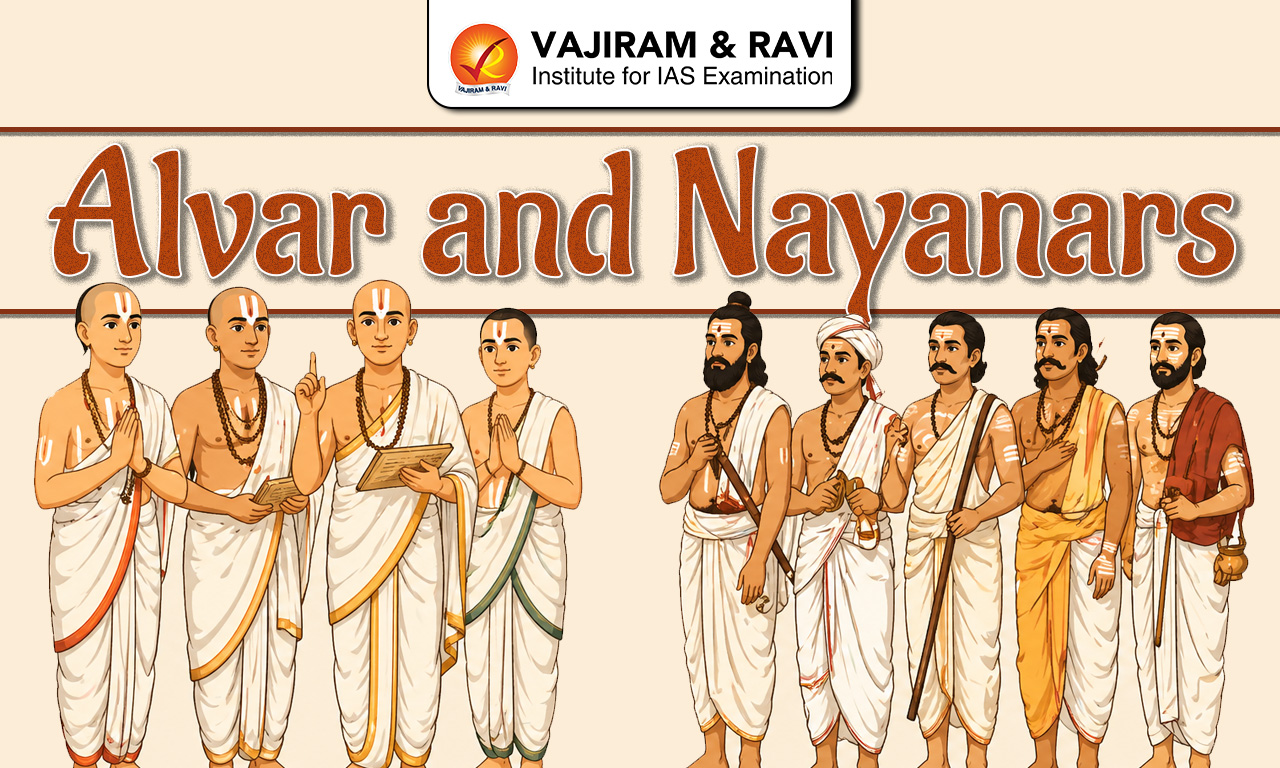
The Alvars and Nayanars were important saint-poets of South India who played a key role in the growth of the Bhakti Movement. The Alvars were devoted to Lord Vishnu, while the Nayanars worshipped Lord Shiva. They spread the message of love, devotion, and faith in God through simple songs and hymns in local languages, making spiritual ideas easy for everyone to understand. Their teachings focused on personal devotion rather than rituals and encouraged equality and emotional connection with God. Overall, the Alvars and Nayanars helped shape devotional traditions in India and made religion more accessible and meaningful for common people.
About Alvars and Nayanars
- The Bhakti Movement started in South India around the 7th century, mainly in present-day Tamil Nadu and Kerala, and later spread to other parts of India, reaching its peak between the 15th and 17th centuries.
- The Alvars were devotees of Lord Vishnu, while the Nayanars were devotees of Lord Shiva. Both were saint-poets who spread the message of love, devotion, and faith in God through simple songs in the Tamil language.
- They made religion easy and accessible for common people by focusing on personal devotion (bhakti) instead of complex rituals and practices.
- Both groups also worked against caste discrimination and Brahmanical dominance, as their followers came from different social backgrounds, including lower castes. They believed that anyone could reach God through true devotion, regardless of birth or status.
- The Nayanars were a group of 63 Shaiva saints who dedicated their lives to the worship of Lord Shiva and helped spread Shaivism in South India. Sundarar is believed to have compiled their list.
- The Alvars were Tamil poet-saints who lived between the 5th and 10th centuries CE and were devoted to Lord Vishnu and Krishna. Their devotional hymns, full of love and emotion, were later compiled into the Divya Prabandham.
Difference Between Alvars and Nayanars
The Nayanars and Alvars were two important groups of saint-poets of South India who played a key role in the Bhakti Movement. While both emphasized devotion and equality, they followed different traditions and worshipped different deities. Their key differences in beliefs, practices, and contributions are discussed below.
| Difference Between Nayanars and Alvars | ||
|
Basis |
Nayanars |
Alvars |
|
Main Deity |
The Nayanars were devoted to Lord Shiva and expressed their devotion through intense love, service, and dedication to Shaivism. |
The Alvars were devoted to Lord Vishnu and his avatars like Krishna, showing deep emotional devotion and surrender. |
|
Time Period |
They mainly lived between the 6th and 8th centuries CE, during the early phase of the Bhakti movement in South India. |
They are believed to have lived between the 5th and 10th centuries CE, slightly earlier and overlapping with the Nayanars. |
|
Region |
Their activities were centered in Tamil Nadu, where they helped spread Shaiva traditions. |
They were also mainly from Tamil Nadu and contributed to the growth of Vaishnavism in the region. |
|
Number of Saints |
There were 63 Nayanars, who are considered important Shaiva saints. |
There were 12 Alvars, known as great Vaishnava saint-poets. |
|
Literary Contributions |
Their devotional hymns were later compiled into the Tirumurai by Nambiyandar Nambi during the time of Raja Raja Chola I. |
Their devotional hymns were collected into the Divya Prabandham, an important Vaishnava text. |
|
Social Background |
The Nayanars came from different social groups, including Brahmins, peasants, artisans, and even lower castes, showing inclusiveness. |
The Alvars also belonged to diverse backgrounds, breaking social barriers and promoting equality through devotion. |
|
Teachings and Message |
They emphasized personal devotion, service to God, and rejection of caste discrimination, focusing on love for Shiva. |
They taught complete surrender (prapatti), love, and devotion to Vishnu, considering bhakti as the path to salvation. |
|
Famous Saints |
Important Nayanars include Tiru Neelakanta, Viralminda, Meiporul, Amaraneedi, Eripathar, and Yenathinathar |
Important Alvars include Sri Andal, Thiruppan Alvar, Nammalwar, Thirumazhisai Alvar, Kulasekara Alwar |
|
Role in Bhakti Movement |
The Nayanars played a major role in spreading Shaiva Bhakti and strengthening devotion to Shiva in South India. |
The Alvars helped in the spread of Vaishnava Bhakti and enriched devotional literature with emotional hymns. |


Significance of Nayanars and Alvars
- They made religion simple and accessible by using local languages instead of Sanskrit, helping common people understand spiritual ideas easily.
- They emphasized devotion (bhakti) over rituals, teaching that love and faith in God are more important than complex practices.
- They worked against caste discrimination, showing that people from all social backgrounds could attain spiritual growth.
- They encouraged a personal and emotional connection with God, making religion more meaningful and relatable in daily life.
- Their hymns and songs enriched devotional literature, many of which are still sung in temples today.
- They played a major role in strengthening the Bhakti Movement and spreading it to different parts of India.
- They helped in the growth of Shaivism and Vaishnavism, shaping religious traditions in South India.
- Their teachings promoted values like love, equality, humility, and surrender, which continue to influence Indian society and culture.

 Last updated on Oct, 2026
→ UPSC 2027 Notification will be released on 13 January 2027 at upsconline.nic.in.
→ Check Nobel Prize 2026 Winners List here.
→ Download PIB PRiSM Monthly Magazine 2026 here.
→ Check UPSC Monthly Current Affairs Magazine The Recitals here.
→ Check out the latest UPSC Syllabus here.
→ Download UPSC Model Answers for Mains 2026
→ UPSC Mains Question Paper 2026 is out now for Essay & GS Paper 1, 2, 3 & 4.
→ UPSC Calendar 2027 has been released.
→ Enroll in Vajiram & Ravi’s UPSC Mains Test Series 2027 for structured answer writing practice, expert evaluation, and exam-oriented feedback.
→ Join Vajiram & Ravi’s UPSC Mentorship Program 2027 for personalized guidance, strategy planning, and one-to-one support from experienced mentors.
→ Go through the UPSC Mains Previous Year Papers to enhance your preparation.
→ UPSC has released UPSC Toppers List 2025 with the Civil Services final result on its official website.
→ Also check Best UPSC Coaching in India
Alvars and Nayanars FAQs
Q1. Who were the Alvars and Nayanars?+
Q2. What is the main difference between Alvars and Nayanars?+
Q3. When did the Alvars and Nayanars live?+
Q4. What was the role of Alvars and Nayanars in the Bhakti Movement?+
Q5. What are the main texts of Alvars and Nayanars?+
Tags: alvar and nayanars art and culture art and culture notes