

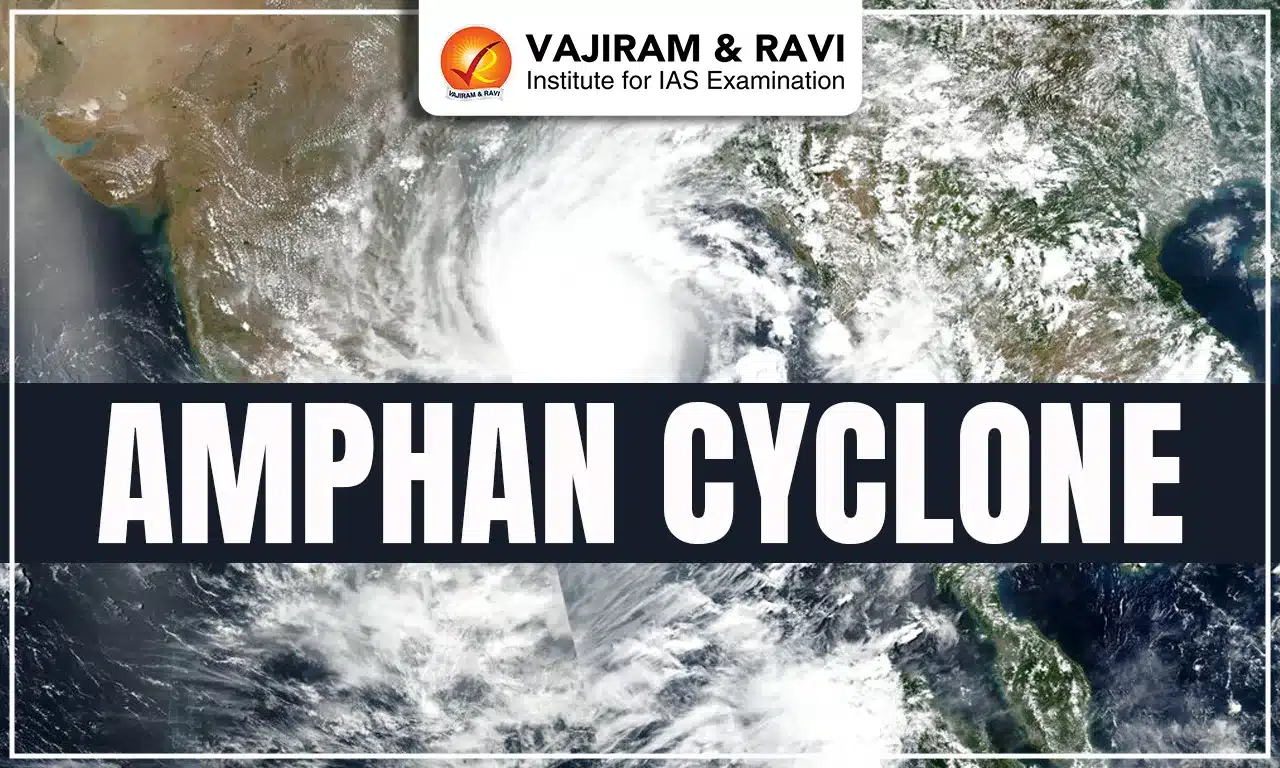
Amphan Cyclone was one of the most destructive natural disasters ever recorded in the North Indian Ocean. It hit parts of Eastern India and Bangladesh in May 2020 and caused massive destruction to life, property and environment. As a super cyclonic storm, it brought extremely strong winds, heavy rainfall and flooding across coastal districts. This cyclone is remembered for its speed, intensity and the challenges it created during the COVID-19 pandemic. It became the costliest cyclone in the region’s history and affected millions of people living near the Bay of Bengal.
Amphan Cyclone
Amphan Cyclone 2020 was declared a Super Cyclonic Storm by the India Meteorological Department (IMD). It developed over the Bay of Bengal and reached peak intensity on 18 May 2020, with Amphan Cyclone Speed of Winds touching 240 km/h. Amphan was the first super cyclone in the Bay of Bengal since 1999 and was the strongest storm to hit the Ganges Delta. The cyclone caused widespread damage in West Bengal, Odisha and Bangladesh. Its impact included uprooted trees, damaged crops, severe flooding and destruction of homes. Amphan also caused heavy losses in mango-producing regions of Bangladesh.
Amphan Cyclone Formation
Amphan Cyclone formed from a low-pressure area that appeared over the Southeast Bay of Bengal on 13 May 2020. The system developed quickly because the sea surface temperature was very warm, between 32 and 34°C, and wind conditions were favourable for growth. By 15–16 May, the disturbance became a depression and then a cyclonic storm. On 17 May, Amphan strengthened rapidly because of strong outflow and low wind shear. Within hours, it transformed into an extremely severe cyclonic storm. On 18 May, it became a super cyclone with a well-defined eye.





Amphan Cyclone Location
Amphan mainly developed over the Bay of Bengal and affected coastal regions of India and Bangladesh. The areas most affected in India were West Bengal, Odisha, and the Andaman and Nicobar Islands. In Bangladesh, the cyclone caused damage in Khulna, Barisal, Satkhira, and several coastal districts. The cyclone also influenced weather conditions in Sri Lanka, Bhutan, and Thailand. Its pathway remained close to the eastern coastline before making landfall near Bakkhali in West Bengal on 20 May 2020.
Amphan Cyclone History
Amphan Cyclone occurred during the 2020 North Indian Ocean cyclone season. It was the first cyclone of that season and one of the strongest in history. After forming on 16 May, it intensified rapidly and became a super cyclone within two days. The highest wind speed recorded by IMD was 240 km/h, while JTWC estimated 270 km/h. Amphan was compared to major historical cyclones, including the 1999 Odisha super cyclone. After crossing the coast on 20 May, it weakened quickly and dissipated on 21 May 2020 over Bangladesh.
Amphan Cyclone Pathway
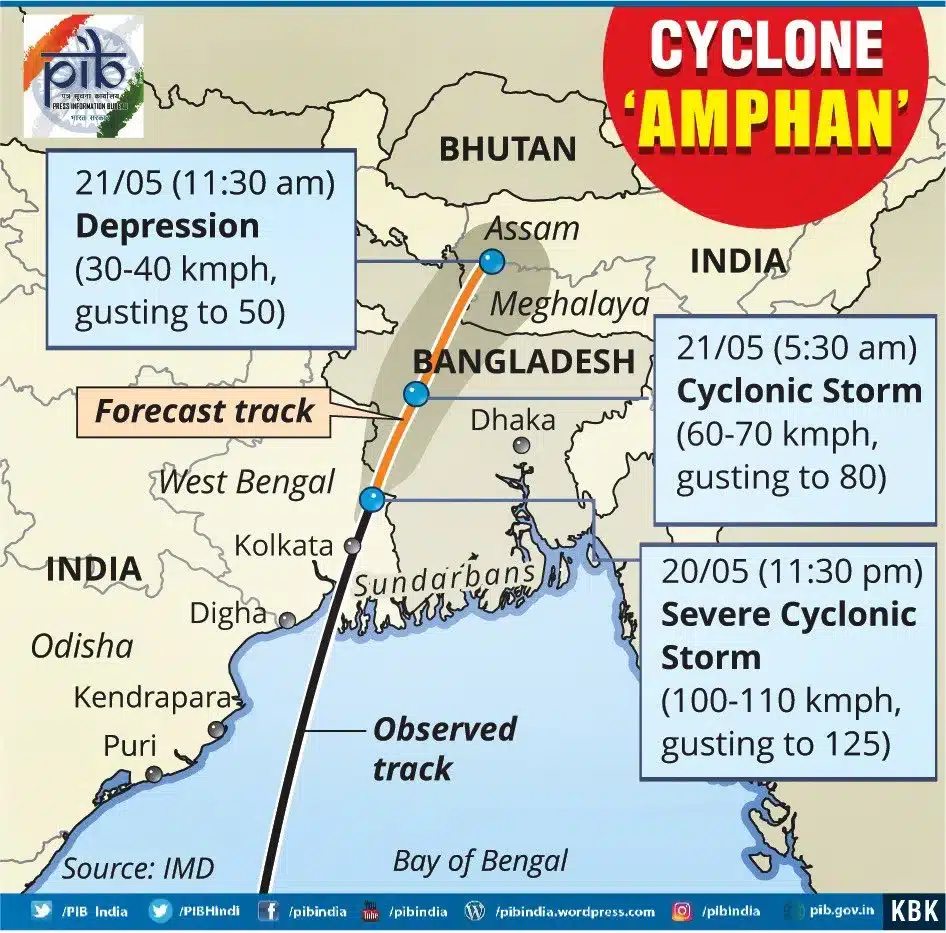
The cyclone started southeast of Sri Lanka, moved northward and then northeastward across the Bay of Bengal. As it intensified, it travelled parallel to the eastern coast of India. On 20 May, around 2:30 PM IST, Amphan made landfall near Bakkhali, close to the Sundarbans in West Bengal. The storm then moved inland across North and South 24 Parganas, Kolkata, Howrah and Hooghly. After crossing into Bangladesh, it weakened but continued to cause heavy rainfall in Rajshahi, Rangpur and nearby regions. Finally, it weakened into a low-pressure area on 21 May.
Amphan Cyclone Naming
The name Amphan was suggested by Thailand. The word means “sky” in the Thai language. Each country in the North Indian Ocean region contributes cyclone names to a common list used by meteorological agencies. Amphan’s name was selected long before the cyclone developed. Since the storm was extremely destructive, the name “Amphan” was retired and will not be used for future cyclones in the region.
Amphan Cyclone Causes
Several natural factors helped Amphan Cyclone grow into a very strong storm. These combined factors made Amphan intensify faster than normal cyclones in the Bay of Bengal.
- Very warm sea surface temperatures (32-34°C), the main energy source for cyclones.
- Low vertical wind shear, which allowed the system to remain stable.
- Strong outflow at upper levels, helping clouds expand and intensify.
- High moisture in the atmosphere, supporting rapid intensification.
- Favourable monsoon winds, which added strength to the developing system.
Amphan Cyclone Preparation
Governments of India and Bangladesh took large-scale steps to reduce casualties. A total of 4.2 million people were evacuated from vulnerable areas of both countries. Shelters were prepared with social-distancing measures because of the COVID-19 pandemic. Fishing activities were suspended across the coast, and ports were closed. Trains and flights were cancelled.
Rescue teams from NDRF, Navy, Coast Guard and state disaster forces were deployed. Myanmar, Sri Lanka and Thailand also issued alerts. Thousands of relief volunteers helped prepare shelters, supply kits and medical support.
Amphan Cyclone Impact
Amphan Cyclone caused massive destruction in India and Bangladesh. Key impacts include:
- 133 total deaths, mostly from electrocution and collapsed structures.
- US$15.5 billion in total damage, making it the costliest cyclone in the North Indian Ocean.
- West Bengal suffered ₹1.02 trillion in losses, with 70 percent population affected.
- Over 88,000 hectares of farmland were damaged.
- Kolkata experienced winds of 110-130 km/h and heavy rainfall of about 236 mm.
- Large sections of the Sundarbans were flooded after embankments broke.
- Bangladesh lost more than 220,000 homes, and thousands of families were displaced.
Amphan Cyclone Aftermath
After the cyclone passed, millions were left without electricity, drinking water and shelter. Restoring power in Kolkata and nearby districts took several days. Thousands of trees blocked roads, delaying rescue work. Agricultural losses were severe, especially in rice fields, vegetable farms and mango orchards.
Both India and Bangladesh started massive relief operations to provide food, medicine and temporary housing. International agencies like the United Nations and Red Crescent also supported rehabilitation. The coastal ecosystem, especially the Sundarbans mangrove forest, faced long-term damage.
Amphan Cyclone UPSC
Cyclone Amphan was an exceptionally powerful tropical cyclone in the Bay of Bengal that caused severe destruction across India and Bangladesh.
- Strongest Cyclone in Bay of Bengal Since 1999: Amphan became the first Super Cyclonic Storm in the Bay of Bengal since the 1999 Odisha Super Cyclone, reaching Category-5 intensity with wind speeds touching 240-260 km/h over the sea.
- Rapid Intensification Recorded by IMD and NASA: It underwent rapid intensification within 24 hours, transforming from a severe cyclonic storm to a super cyclone due to warm sea surface temperatures of above 30°C and high ocean heat content.
- Landfall and Affected Regions: Amphan made landfall on 20 May 2020 near Sagar Island (West Bengal) and Hatiya Island (Bangladesh), causing extensive flooding, embankment breaches, and infrastructure damage in South 24 Parganas, North 24 Parganas, Kolkata, and coastal Bangladesh.
- Human and Economic Losses: It caused over 90 deaths in India and displaced millions in coastal districts. West Bengal alone reported losses of around USD 13 billion, making it one of the costliest cyclones in the North Indian Ocean.
- Evacuation and Disaster Management Measures: The Indian government and NDRF conducted one of India’s largest cyclone evacuations, shifting over 3 lakh people to cyclone shelters while maintaining COVID-19 protocols. International agencies praised India’s early-warning systems and coordinated response.
Last updated on January, 2026
→ Check out the latest UPSC Syllabus 2026 here.
→ Join Vajiram & Ravi’s Interview Guidance Programme for expert help to crack your final UPSC stage.
→ UPSC Mains Result 2025 is now out.
→ UPSC Notification 2026 is scheduled to be released on January 14, 2026.
→ UPSC Calendar 2026 is released on 15th May, 2025.
→ UPSC Prelims 2026 will be conducted on 24th May, 2026 & UPSC Mains 2026 will be conducted on 21st August 2026.
→ The UPSC Selection Process is of 3 stages-Prelims, Mains and Interview.
→ UPSC Result 2024 is released with latest UPSC Marksheet 2024. Check Now!
→ UPSC Toppers List 2024 is released now. Shakti Dubey is UPSC AIR 1 2024 Topper.
→ Also check Best IAS Coaching in Delhi
Amphan Cyclone FAQs
Q1. What was Amphan Cyclone? +
Q2. Amphan Cyclone Name was given by which Country? +
Q3. Which areas were affected the most by Amphan Cyclone? +
Q4. Why did Amphan Cyclone intensify so quickly? +
Q5. How much damage did Amphan Cyclone cause? +
Tags: amphan cyclone