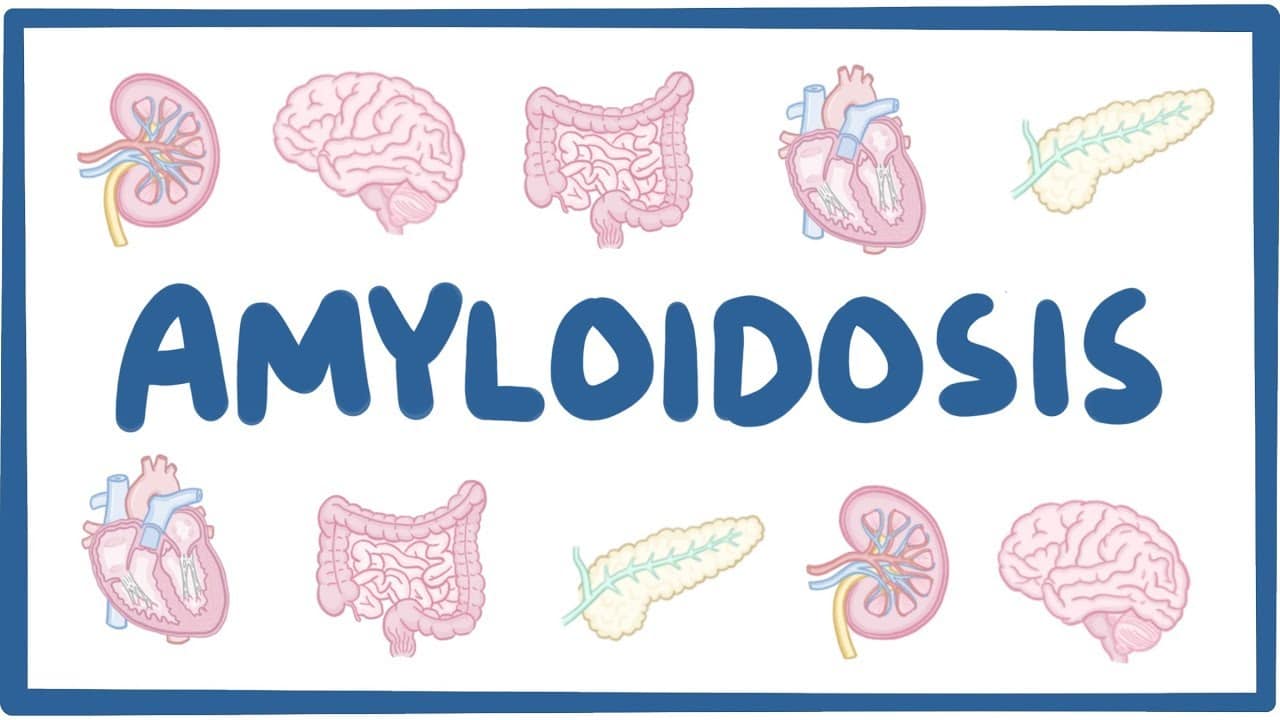
About Amyloidosis
- It is a rare disease that occurs when an abnormal protein, called amyloid, builds up in one’s organs, affecting their shape and functioning.
- Amyloid deposits can build up in the heart, brain, kidneys, spleen and other parts of the body, leading to life-threatening conditions like organ failure.
- Some varieties of amyloidosis occur in association with other diseases.
- These types may improve with treatment of the underlying disease. Some varieties of amyloidosis may lead to life-threatening organ failure.
- The general signs or symptoms would include: Severe fatigue, Loss of weight,Swelling in the belly, legs, ankles or feet, Numbness, pain or tingling in hands or feet and changes in skin colour.
- Different amyloidosis that are prevalent
- Light-chain (AL) amyloidosis: People with conditions such as multiple myeloma or a bone marrow illness are more likely to have AL amyloidosis.
- A amyloidosis: Previously known as secondary amyloidosis, this condition is the result of another chronic infectious or inflammatory disease, such as rheumatoid arthritis, Crohn’s disease, or ulcerative colitis.
What is Lysozyme?
- It is a protein present in mucosal secretions and a principal component of airway fluid.


Key points about the research
- They have assembled lysozyme molecules as a 2D monolayer at the interface of pure aqueous subphase.
- Researchers used the 2D protein monolayer to understand the behaviour of lysozyme molecules at air-water as well as at air-solid interface with the help of a technique called Langmuir-Blodgett (LB) technique.
- The physical properties of lysozyme molecules at air-water interface were investigated under the variation of surface pressure and subphase pH conditions in the study.
- The compressible behaviour of lysozyme monolayers were correlated to the stripe-like domains formed with increase in surface pressure.
- Lysozyme molecules at the air-water interface and their structural or conformational changes in variable pH conditions can be considered as a model system to study Amyloidosis disease, which occurs because of the misfolding and agglomeration of lysozyme molecules.
Q1) What is Protein?
Proteins are large, complex molecules that play many critical roles in the body. They do most of the work in cells and are required for the structure, function, and regulation of the body’s tissues and organs.
Source: Scientists fabricate a 2D protein monolayer that can help study diseases like Amyloidosis

 Last updated on Oct, 2026
→ UPSC 2027 Notification will be released on 13 January 2027 at upsconline.nic.in.
→ Check Nobel Prize 2026 Winners List here.
→ Download PIB PRiSM Monthly Magazine 2026 here.
→ Check UPSC Monthly Current Affairs Magazine The Recitals here.
→ Check out the latest UPSC Syllabus here.
→ Download UPSC Model Answers for Mains 2026
→ UPSC Mains Question Paper 2026 is out now for Essay & GS Paper 1, 2, 3 & 4.
→ UPSC Calendar 2027 has been released.
→ Enroll in Vajiram & Ravi’s UPSC Mains Test Series 2027 for structured answer writing practice, expert evaluation, and exam-oriented feedback.
→ Join Vajiram & Ravi’s UPSC Mentorship Program 2027 for personalized guidance, strategy planning, and one-to-one support from experienced mentors.
→ Go through the UPSC Mains Previous Year Papers to enhance your preparation.
→ UPSC has released UPSC Toppers List 2025 with the Civil Services final result on its official website.
→ Also check Best UPSC Coaching in India