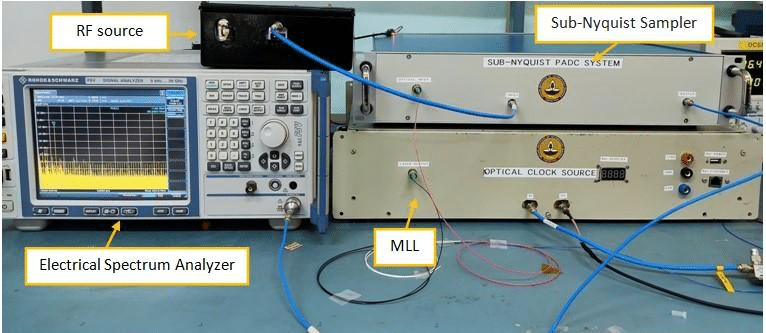
Key points:
- Analog-to-digital converters (ADCs) are critical components for developing the next generation of advanced digital receivers.
- The limitation of electronic ADCs (EADCs) is that their vertical resolution is compromised at high bandwidths.
- There are two possible approaches to solve this problem through Photonics.
- Radio frequency, when modulated on a spectrally rich optical pulsed source, can be stretched in the optical domain through a dispersive medium, thus converting high-frequency RF signals into effectively low-frequency signals.
- This reduces the input bandwidth requirements of the back-end ADC as many times as the stretch factor of the optical pulse.
- The other Photonic approach is to use an optical clock whose fluctuations in timing (timing jitter) is much smaller than an electronic clock; which is possible with a short pulsed laser.
- High bandwidth RF signals, when sampled with stable optical clocks, can provide a much higher effective number of bits (ENOB) compared to electronic clocks.
- It has time-stretched photonic ADC with effective bandwidth 12 times higher than EADC, which enables digitisation of signals with a much larger precision.
- A newly designed prototypes in the Next-Generation Photonic Analog-to-Digital Converters (NG-PADC) project which can carry out instantaneous frequency measurement, generation and transport of Radio Frequency (RF) through optical methods.
- Its effective bandwidth is 12 times higher than a corresponding EADC
- This could revolutionize various sectors, enabling faster digital communication, improved satellite communication, better medical imaging, and Photonic radars.
Q1) What is Photonic radar?
Photonic radars, also known as photonic-based radar systems are advanced radar systems that utilize photonic (light-based) technologies to enhance radar performance and capabilities. Traditional radar systems use radio frequency (RF) waves for detection and ranging, while photonic radars employ optical signals to achieve similar objectives.






 Last updated on March, 2026
→ UPSC Final Result 2025 is now out.
→ UPSC has released UPSC Toppers List 2025 with the Civil Services final result on its official website.
→ Anuj Agnihotri secured AIR 1 in the UPSC Civil Services Examination 2025.
→ UPSC Marksheet 2025 is now out.
→ UPSC Notification 2026 & UPSC IFoS Notification 2026 is now out on the official website at upsconline.nic.in.
→ UPSC Calendar 2026 has been released.
→ Check out the latest UPSC Syllabus 2026 here.
→ UPSC Prelims 2026 will be conducted on 24th May, 2026 & UPSC Mains 2026 will be conducted on 21st August 2026.
→ The UPSC Selection Process is of 3 stages-Prelims, Mains and Interview.
→ Prepare effectively with Vajiram & Ravi’s UPSC Prelims Test Series 2026 featuring full-length mock tests, detailed solutions, and performance analysis.
→ Enroll in Vajiram & Ravi’s UPSC Mains Test Series 2026 for structured answer writing practice, expert evaluation, and exam-oriented feedback.
→ Join Vajiram & Ravi’s Best UPSC Mentorship Program for personalized guidance, strategy planning, and one-to-one support from experienced mentors.
→ Shakti Dubey secures AIR 1 in UPSC CSE Exam 2024.
→ Also check Best UPSC Coaching in India