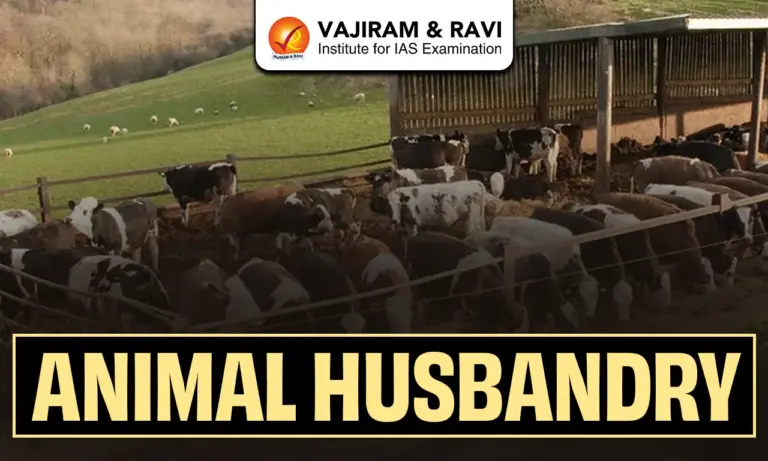
Animal Husbandry in India is one of the most important pillars of the agricultural economy. It includes the scientific breeding, feeding, healthcare, and management of livestock such as cattle, buffaloes, goats, sheep, pigs, and poultry. The sector provides milk, meat, eggs, wool, hides, manure, and draft power, supporting rural livelihoods and national food security.
Animal husbandry is a crucial pillar of the Indian economy, contributing nearly 5.5% to the country’s total Gross Value Added (GVA) and accounting for more than 30% of the GVA within the agriculture and allied sectors during 2022-23.
Dairy Sector In India
The dairy sector is one of the most important components of Animal Husbandry in India. India is the largest milk-producing country in the world, with steady growth in production over the last decade. The Dairy Sector In India provides daily income to millions of rural households and plays a key role in nutritional security and women empowerment.
- Contribution to Economy: The dairy sector contributes a significant share to agricultural GVA and supports more than 80 million rural households directly or indirectly.
- Per Capita Availability: Per capita milk availability in India has increased to around 470-500 grams per day, improving protein intake and nutritional standards.
- White Revolution: The success of the dairy sector is largely credited to Operation Flood, implemented by the National Dairy Development Board, which expanded cooperative dairy networks across the country.
- Major Milk Producing States: Uttar Pradesh, Rajasthan, Madhya Pradesh, Gujarat, and Maharashtra are among the top milk-producing states in India.
- Role of Cooperatives: Dairy cooperatives collect milk from farmers, ensure fair pricing, and provide veterinary and feed support services. Example Amul.
- Employment Generation: Dairy farming creates year-round employment, especially for women and small farmers.
- Value-Added Dairy Products: Growth in processing industries has increased production of cheese, butter, paneer, yogurt, and other dairy products.
- Government Support: Schemes like Dairy Processing and Infrastructure Development Fund help modernize dairy infrastructure and increase milk processing capacity.
Poultry Sector in India
The Poultry Sector in India is one of the fastest-growing segments of animal husbandry and plays a crucial role in meeting the country’s protein demand. It includes both egg production (layer farming) and meat production (broiler farming).
- Rapid Growth Rate: The poultry sector has been growing at an average annual rate of around 8-10%, making it one of the most dynamic livestock industries in India.
- Egg Production: India produces more than 140 billion eggs annually, ranking among the top egg-producing countries in the world. Per capita egg availability has crossed 100 eggs per person per year.
- Meat Production: Poultry contributes the largest share to India’s total meat production, which is around 9–10 million tonnes annually. Broiler farming has expanded significantly due to rising demand for affordable protein.
- Poultry Population: As per livestock census data, India has over 850 million poultry birds, including both backyard and commercial farms.
- Major Poultry Producing States: Andhra Pradesh, Tamil Nadu, Telangana, West Bengal, and Maharashtra are among the leading egg and poultry meat producing states.
- Employment Generation: The poultry industry provides direct and indirect employment to millions of farmers, traders, feed manufacturers, and transport workers.
- Low Investment, Quick Returns: Poultry farming requires relatively lower initial investment compared to dairy and offers faster returns due to a short production cycle.
- Technological Advancements: Modern poultry farms use automated feeding systems, climate-controlled sheds, vaccination schedules, and scientific breeding techniques to improve productivity.
- Government Support: The government promotes poultry farming under schemes like the National Livestock Mission, which supports entrepreneurship and infrastructure development in the livestock sector.
Also Read: Pink Revolution





Livestock in India
Livestock in India refers to domesticated animals raised for economic purposes such as milk, meat, eggs, wool, hides, and draft power. India has one of the largest livestock populations in the world, making it a global leader in dairy and a major contributor to meat and poultry production. Livestock forms the backbone of rural livelihoods and supports millions of small and marginal farmers across the country.
1. Total Livestock Population
- India has over 535 million livestock as per the latest livestock census.
- It has the largest cattle population in the world.
- Poultry population exceeds 850 million birds.
- Livestock numbers have steadily increased over the years.
2. Major Types of Livestock
- Cattle – Primarily used for milk production and agricultural draft power.
- Buffaloes – Major contributors to India’s total milk production and buffalo meat exports.
- Goats – Known as the “poor man’s cow” and widely reared for meat and milk.
- Sheep – Raised for wool and mutton, especially in Rajasthan and Telangana.
- Pigs – Important in northeastern states for meat consumption.
- Poultry – Includes layers (egg production) and broilers (meat production).
3. Economic Importance
- Livestock contributes more than 30% of agricultural Gross Value Added (GVA).
- It provides employment to over 80 million rural households.
- Offers regular income unlike seasonal crop farming.
4. Nutritional Contribution
- Supplies protein-rich foods such as milk, eggs, and meat.
- Improves food security and dietary diversity in rural and urban areas.
5. Regional Distribution
- Cattle and buffaloes are widely distributed across northern and western India.
- Sheep are concentrated in Rajasthan, Jammu & Kashmir, and Telangana.
- Goats are common in Uttar Pradesh, Bihar, and West Bengal.
- Poultry farming is highly developed in Andhra Pradesh, Tamil Nadu, and Telangana.
6. Indigenous Breeds
India is home to several famous indigenous breeds such as:
- Gir cattle
- Sahiwal cattle
- Murrah buffalo
Major Government Schemes for Animal Husbandry
The Government of India has launched several schemes and programs to promote livestock development, improve breed quality, increase productivity, and enhance farmers’ income. These schemes are mainly implemented by the Department of Animal Husbandry and Dairying under the Ministry of Fisheries, Animal Husbandry and Dairying.
1. Rashtriya Gokul Mission
- Launched to conserve and develop indigenous cattle and buffalo breeds.
- Promotes artificial insemination and genetic improvement.
- Establishment of Gokul Grams for scientific breeding.
- Aims to enhance milk productivity and preserve native breeds like Gir and Sahiwal.
2. National Livestock Mission
- Focuses on overall development of livestock sector excluding dairy.
- Encourages entrepreneurship in sheep, goat, pig, and poultry farming.
- Supports feed and fodder development programs.
- Provides financial assistance for setting up livestock units.
3. Dairy Processing and Infrastructure Development Fund
- Aims to modernize dairy processing plants.
- Expands milk chilling and storage capacity.
- Strengthens dairy cooperatives and producer companies.
- Enhances value addition in dairy products.
Also Read: India’s Dairy Model
4. Livestock Health and Disease Control Programme
- Focuses on vaccination against major animal diseases like Foot and Mouth Disease (FMD) and Brucellosis.
- Improves veterinary infrastructure and diagnostic labs.
- Reduces livestock mortality and economic losses.
5. Animal Husbandry Infrastructure Development Fund
- Encourages private sector investment in dairy and meat processing.
- Supports cold chain and value-added product units.
- Provides interest subvention and credit guarantee support.
6. National Animal Disease Control Programme
- Aims to control and eradicate Foot and Mouth Disease (FMD) and Brucellosis.
- Conducts mass vaccination drives across the country.
- Strengthens disease surveillance and monitoring systems.
7. Kisan Credit Card
- Provides affordable credit to livestock farmers.
- Covers dairy, poultry, and fisheries farmers.
- Ensures easy access to working capital.
Role of Women in Animal Husbandry
Women make up nearly 70% of the workforce in India’s animal husbandry sector and are central to its growth and sustainability. They handle essential daily activities such as feeding animals, collecting fodder, providing water, cleaning sheds, and milking, thereby strengthening food security and the rural economy. Women are also actively involved in rearing small livestock like goats and poultry and in processing dairy products at the household level.
Animal Husbandry in India Challenges
- Genetic Improvement of Breeds: Promote artificial insemination, embryo transfer technology, and conservation of high-yielding indigenous breeds to increase productivity per animal.
- Strengthening Fodder Security: Expand fodder cultivation, promote silage making, and encourage use of balanced cattle feed to address feed shortages.
- Improved Veterinary Infrastructure: Establish more veterinary hospitals, mobile clinics, and diagnostic labs in rural areas for timely disease control.
- Mass Vaccination and Disease Surveillance: Strengthen nationwide vaccination drives and digital disease monitoring systems to reduce livestock mortality.
- Promotion of Modern Technology: Encourage use of automated milking machines, climate-controlled poultry sheds, and digital livestock tracking systems.
- Enhancing Credit and Insurance Coverage: Provide easy access to institutional credit, expand livestock insurance schemes, and simplify loan procedures for small farmers.
Way Forward
- Boost Breed Productivity: Expand artificial insemination coverage, strengthen indigenous breed improvement, and promote scientific selection to raise milk and meat yields.
- Ensure Fodder & Feed Security: Increase fodder cultivation, support silage and hay-making, and promote balanced feed and mineral supplementation.
- Upgrade Veterinary Services: Add rural veterinary clinics, mobile units, tele-veterinary services, and modern diagnostic labs for timely disease control.
- Scale Up Vaccination & Surveillance: Intensify mass vaccination against FMD and Brucellosis and use digital disease tracking to prevent outbreaks.
- Invest in Infrastructure: Build milk chilling centers, cold chains, meat processing units, and quality testing labs to reduce post-harvest losses.
- Improve Access to Credit & Insurance: Expand affordable loans, interest subvention, and livestock insurance coverage for small and marginal farmers.
- Promote Technology Adoption: Encourage automated milking, climate-controlled poultry sheds, RFID tagging, and data-driven farm management.
- Strengthen Market Linkages: Develop farmer producer organizations (FPOs), e-market platforms, and direct procurement models to improve price realization.

 Last updated on April, 2026
→ UPSC Final Result 2025 is now out.
→ UPSC has released UPSC Toppers List 2025 with the Civil Services final result on its official website.
→ Anuj Agnihotri secured AIR 1 in the UPSC Civil Services Examination 2025.
→ UPSC Marksheet 2025 is now out.
→ UPSC Notification 2026 & UPSC IFoS Notification 2026 is now out on the official website at upsconline.nic.in.
→ UPSC Calendar 2026 has been released.
→ Check out the latest UPSC Syllabus 2026 here.
→ UPSC Prelims 2026 will be conducted on 24th May, 2026 & UPSC Mains 2026 will be conducted on 21st August 2026.
→ The UPSC Selection Process is of 3 stages-Prelims, Mains and Interview.
→ Prepare effectively with Vajiram & Ravi’s UPSC Prelims Test Series 2026 featuring full-length mock tests, detailed solutions, and performance analysis.
→ Enroll in Vajiram & Ravi’s UPSC Mains Test Series 2026 for structured answer writing practice, expert evaluation, and exam-oriented feedback.
→ Join Vajiram & Ravi’s Best UPSC Mentorship Program for personalized guidance, strategy planning, and one-to-one support from experienced mentors.
→ Shakti Dubey secures AIR 1 in UPSC CSE Exam 2024.
→ Also check Best UPSC Coaching in India
Animal Husbandry FAQs
Q1. What is Animal Husbandry?+
Q2. Why is Animal Husbandry important in India?+
Q3. Which ministry looks after Animal Husbandry in India?+
Q4. What is the contribution of Animal Husbandry to India’s economy?+
Q5. Which country is the largest milk producer in the world?+
Tags: agriculture science animal husbandry