What’s in today’s article?
- About the Anti-Maritime Piracy Bill 2019
Why in News?
- The Lok Sabha recently witnessed a rare display of unity between the government and opposition benches as the Anti-Maritime Piracy Bill 2019 was passed almost unanimously.
Background of the Anti-Maritime Piracy Bill 2019
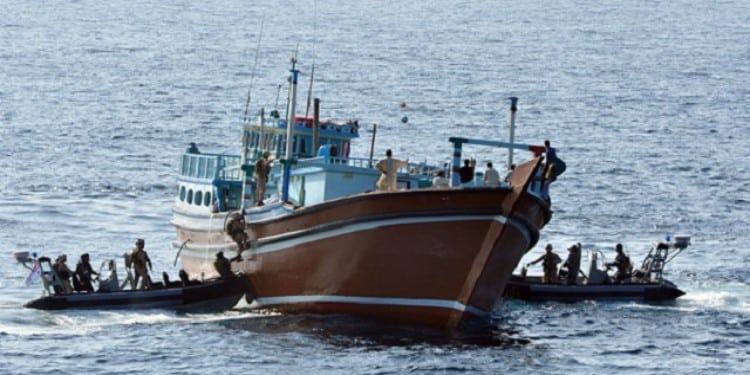
- The 1982 UNCLOS defines piracy to include any acts of violence, detention or destruction committed for private ends against persons or property on board a ship on the high seas or outside the jurisdiction of any state.
- Acts of piracy threaten maritime security by endangering the welfare of people travelling by sea and the security of navigation and commerce.
- As per the International Maritime Organisation, during 2018 and 2019, 84 acts of piracy were reported globally.
- Currently, India does not have a domestic legislation on maritime piracy and the Indian Penal Code, 1860 (IPC) pertaining to armed robbery and the admiralty jurisdiction of certain courts have been invoked to prosecute pirates.
- However, the sovereignty of India extends only up to the territorial waters of India (12 nautical miles from the coastline) and the piratical acts by a foreigner committed outside the territorial waters of India do not constitute an offence under the IPC.
- In 1995, India ratified the UNCLOS, which gives a uniform international legal framework for combating piracy and consequently the Anti-Maritime Piracy Bill, 2019 was introduced and has been referred to the Standing Committee on External Affairs.





Highlights of the Anti-Maritime Piracy Bill 2019:
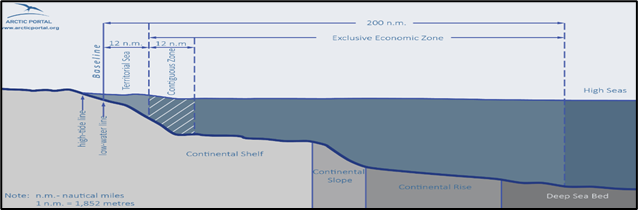
Image Caption: Illustration of Exclusive Economic Zone
- It enables Indian authorities to take action against piracy in the high seas, beyond the Exclusive Economic Zone (EEZ), i.e., beyond 200 nautical miles from India’s coastline.
- It defines piracy as any illegal act of violence, detention or destruction against a ship, aircraft, person or property, for private purposes, by the crew or passengers of a private ship or aircraft.
- Piracy also includes inciting and intentionally facilitating such acts of violence, and voluntarily participating in the operation of a pirate ship or aircraft.
- Committing an act of piracy will be punishable with –
- Up to 14 years of imprisonment and a fine, for participating, organising, aiding, and directing others to participate in an act of piracy.
- Life imprisonment or death, if the act of piracy causes or seeks to cause death.
Key issues and analysis of the bill:
- A mandatory death penalty
- Under the Bill, if a person, while committing an act of piracy causes or seeks to cause death, he will be punished with death. This implies a mandatory death penalty for such offences.
- The Supreme Court has held that mandatory death penalty for any offence is unconstitutional as it violates Articles 14 and 21 of the Constitution.
- Overlapping circumstances
- The Bill provides for imprisonment of up to 14 years if a person participates in an act of piracy.
- Committing an act of piracy (which includes voluntarily participating in the operation of a pirate ship or aircraft) is punishable with life imprisonment.
- As these circumstances may overlap, it is unclear how the punishment would be determined in such cases.
Q1) What are high seas?
The high seas are defined by international law as all parts of the ocean that aren’t included in the exclusive economic zone, the territorial sea, or the internal waters of a country, or in the archipelagic waters of an archipelagic country.
Q2) What is the purpose of exclusive economic zone?
The concept of an EEZ was adopted through the 1982 UNCLOS. It gives sovereign rights for the purpose of exploring, exploiting, conserving, and managing natural resources of the seabed, subsoil, and waters above it. Jurisdiction as provided for in international law with regard to the establishment and use of artificial islands, installations, and structures; marine scientific research; and the protection and preservation of the marine environment.
Source: Explained | What is the Anti-Maritime Piracy Bill, 2019?

 Last updated on March, 2026
→ UPSC Final Result 2025 is now out.
→ UPSC has released UPSC Toppers List 2025 with the Civil Services final result on its official website.
→ Anuj Agnihotri secured AIR 1 in the UPSC Civil Services Examination 2025.
→ UPSC Marksheet 2025 is now out.
→ UPSC Notification 2026 & UPSC IFoS Notification 2026 is now out on the official website at upsconline.nic.in.
→ UPSC Calendar 2026 has been released.
→ Check out the latest UPSC Syllabus 2026 here.
→ UPSC Prelims 2026 will be conducted on 24th May, 2026 & UPSC Mains 2026 will be conducted on 21st August 2026.
→ The UPSC Selection Process is of 3 stages-Prelims, Mains and Interview.
→ Prepare effectively with Vajiram & Ravi’s UPSC Prelims Test Series 2026 featuring full-length mock tests, detailed solutions, and performance analysis.
→ Enroll in Vajiram & Ravi’s UPSC Mains Test Series 2026 for structured answer writing practice, expert evaluation, and exam-oriented feedback.
→ Join Vajiram & Ravi’s Best UPSC Mentorship Program for personalized guidance, strategy planning, and one-to-one support from experienced mentors.
→ Shakti Dubey secures AIR 1 in UPSC CSE Exam 2024.
→ Also check Best UPSC Coaching in India