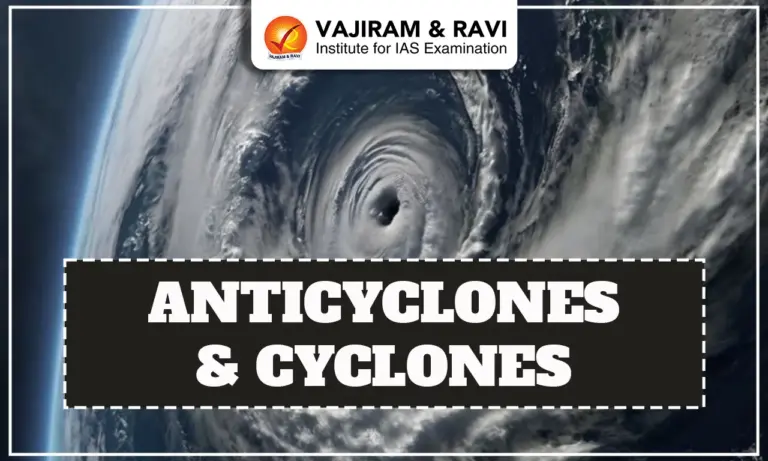
Anticyclones are large-scale high-pressure systems where air is descending, creating stable and calm weather conditions. Unlike cyclones, which are low-pressure systems with rising air, anticyclones bring dry, warm, and gentle winds. Their rotation is influenced by the Earth’s spin: clockwise in the Northern Hemisphere and counter-clockwise in the Southern Hemisphere. These systems can persist for days or weeks and often block or redirect storms, earning them the nickname “Blocking Highs.”
Anticyclones & Cyclones
Anticyclones are high-pressure systems characterized by a central area of high pressure surrounded by closed isobars, with pressure decreasing outward. Air flows outward from the centre, rotating clockwise in the Northern Hemisphere and anticlockwise in the Southern Hemisphere. This circular motion occurs because winds are deflected by the Coriolis force to the right in the Northern Hemisphere and to the left in the Southern Hemisphere.
The pressure difference between the centre and periphery of an anticyclone is usually 10-20 mb, though it can be higher. Anticyclones are larger than temperate cyclones, often about 75% wider, covering a much larger area.
Temperate anticyclones are particularly expansive, sometimes covering nearly half of the United States. They can shift direction frequently and may remain in one location for up to four days, moving at an average speed of 30-50 km/h.
Anticyclones form when either cold polar air or warm tropical air sinks from the upper atmosphere to the lower atmosphere. These systems are most commonly found in subtropical and polar regions and are almost never present near the equator.
Anticyclones Formation
As Cyclones move away, an active Anticyclone often develops over the affected area in the cold air zone behind it. This type of system is called a cold anticyclone, forming before the arrival of the next cyclone.
In an Anticyclone, the descending air compresses as it moves downward. This compression causes the air to warm gradually. When this process occurs at altitudes of 2 to 5 km (1 to 3 miles) above the ground, the initially cold anticyclone transforms into a warm anticyclone.
Warm Anticyclones can persist for a week or longer. Some of these, called blocking Anticyclones, are strong enough to alter the course of an entire season by diverting or slowing weather systems.
Blocking or sun-blocking Anticyclones are commonly observed over Europe, the eastern Atlantic, and Alaska, where they can significantly affect seasonal weather patterns.





Anticyclones Characteristics
Anticyclones are high-pressure systems where air descends and diverges at the surface, leading to generally clear skies and stable weather. Their characteristics vary with seasons, influencing temperature, wind, and local weather phenomena. Understanding these seasonal traits is crucial for weather prediction and climate studies.
| Anticyclones Characteristics | ||||
|
Season |
Sky Conditions |
Temperature |
Wind |
Other Effects |
|
Summer |
Few or no clouds; strong sunshine |
Hot weather |
Light winds |
Morning mist; rising warm, moist air may cause thunderstorms |
|
Winter |
Clear, cloudless skies |
Cold days; very cold nights |
Light and stable |
Fog and frost formation at night |
Anticyclones Types
Anticyclones are high-pressure systems characterized by descending air that generally produces clear and stable weather. They are classified into different types based on their formation region, temperature, and influence on weather patterns. Understanding these types helps in predicting seasonal weather and climate behavior.
| Anticyclones Types | ||||
|
Type of Anticyclone |
Other Name |
Formation Region |
Characteristics |
Examples/Regions |
|
Cold Anticyclone |
Thermal Anticyclone |
Polar regions |
Formed by sinking polar air; moves east and southeast; brings very cold, stable weather |
Polar areas; Arctic and Antarctic regions |
|
Warm Anticyclone |
Dynamic Anticyclone |
Warm subtropical regions |
Air sinks from upper to lower atmosphere; spreads outward; causes clear skies and dry weather |
Subtropical belts; parts of North Africa, Middle East |
|
Blocking Anticyclone |
– |
Mid-latitudes |
Blocks movement of temperate cyclones; brings steady, clear, and dry conditions |
Canada, USA, northern Eurasia |
Anticyclones Significance
- Dry Weather – When combined with blocking highs, anticyclones can lead to prolonged periods of little or no rainfall, lasting from days to weeks.
- Groundwater Recharge – By influencing weather patterns, they indirectly aid in the replenishment of aquifers.
- Ocean Temperature Regulation – Anticyclones help in stabilizing sea surface temperatures by affecting wind and evaporation patterns.
- Nutrient Transport to Seas – Increased river and stream flows during anticyclonic conditions can carry organic matter and nutrients into the oceans, supporting marine ecosystems.
Difference Between Anticyclones & Cyclones
Anticyclones & Cyclones are two contrasting atmospheric systems that influence global and regional weather patterns. While cyclones are associated with low-pressure conditions, storms, and heavy rainfall, anticyclones bring high-pressure conditions, calm weather, and clear skies. The table below highlights the key Difference Between Anticyclones & Cyclones:
| Difference Between Anticyclones & Cyclones | |
|
Cyclones |
Anticyclones |
|
Low pressure at the centre, surrounded by high pressure on all sides. |
High pressure at the centre, surrounded by low pressure on all sides. |
|
Winds blow towards the centre. |
Winds radiate outward from the centre. |
|
Winds are violent and destructive. |
Winds are mild and generally harmless. |
|
In the Northern Hemisphere, winds blow anti-clockwise; in the Southern Hemisphere, they blow clockwise. |
In the Northern Hemisphere, winds blow clockwise; in the Southern Hemisphere, they blow anti-clockwise. |
|
Associated with cloudy weather, thunderstorms, lightning, and heavy rainfall. |
Associated with calm, dry, and clear weather. |

 Last updated on March, 2026
→ UPSC Final Result 2025 is now out.
→ UPSC has released UPSC Toppers List 2025 with the Civil Services final result on its official website.
→ Anuj Agnihotri secured AIR 1 in the UPSC Civil Services Examination 2025.
→ UPSC Marksheet 2025 is now out.
→ UPSC Notification 2026 & UPSC IFoS Notification 2026 is now out on the official website at upsconline.nic.in.
→ UPSC Calendar 2026 has been released.
→ Check out the latest UPSC Syllabus 2026 here.
→ UPSC Prelims 2026 will be conducted on 24th May, 2026 & UPSC Mains 2026 will be conducted on 21st August 2026.
→ The UPSC Selection Process is of 3 stages-Prelims, Mains and Interview.
→ Prepare effectively with Vajiram & Ravi’s UPSC Prelims Test Series 2026 featuring full-length mock tests, detailed solutions, and performance analysis.
→ Enroll in Vajiram & Ravi’s UPSC Mains Test Series 2026 for structured answer writing practice, expert evaluation, and exam-oriented feedback.
→ Join Vajiram & Ravi’s Best UPSC Mentorship Program for personalized guidance, strategy planning, and one-to-one support from experienced mentors.
→ Shakti Dubey secures AIR 1 in UPSC CSE Exam 2024.
→ Also check Best UPSC Coaching in India
Anticyclones & Cyclones FAQs
Q1. What is the difference between an anticyclone and a temperate cyclone?+
Q2. What are anticyclones?+
Q3. What are the causes and effects of cyclones and anticyclones?+
Q4. Where are cyclones and anticyclones found?+
Q5. What are the three differences between cyclones and anticyclones?+
Tags: anticyclones & cyclones