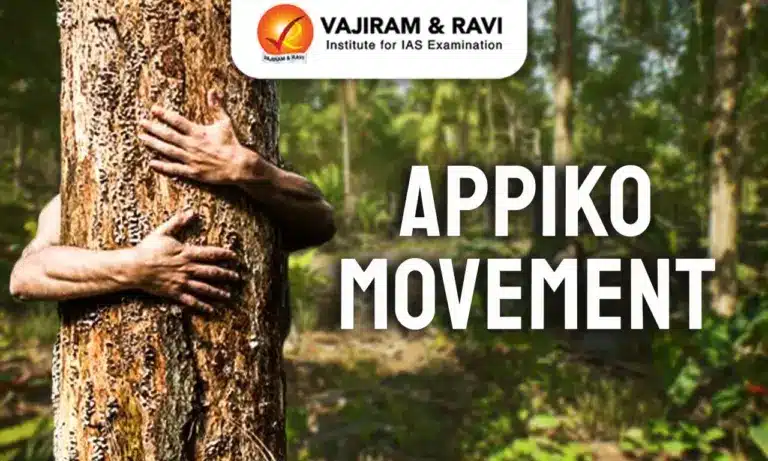
Appiko means “to embrace” in Kannada, similar movement started in the Southern India in the similar way of the famous Chipko Movement in North India. In 1983, villagers from Salkani village in Uttara Kannada, Karnataka, hugged trees and refused to let them be felled. Leading this southern “hug the trees” movement was environmentalist Panduranga Hegde. Over the next months, their grassroots campaign protected crucial parts of the Western Ghats, reversed deforestation policies, and promoted a broader ecological awakening.
Appiko Movement
The Appiko Movement took place in 1983, when men, women, and children gathered to prevent loggers from cutting trees in the Kalase forest near Salkani in the state of Karnataka. It was a peaceful, culturally rooted protest. This movement succeeded in protecting tree felling through nonviolent, direct action and community resolve. The Movement was initiated by Panduranga Hegde, a local environmentalist trained in Delhi and inspired by the Chipko Movement. On 8 September 1983, hundreds from Sirsi Taluk marched 8 km into Kalase forest and began surrounding trees to stop the loggers from cutting them. The practice of hugging trees took on a uniquely Kannada life as Appiko Chaluvali. This movement was the response to the destruction of forests which reduced the forested area from 81% in 1950 to 25% in 1980.
Appiko Movement Historical Background
The Historical Timeline and Evolution of the Appiko Movement is detailed below:
- 1950: the forests of Uttara Kannada covered over 81% of its land. Over the decades, this rich forest was cleared to make way for pulp and paper mills, plywood factories, and hydropower projects, industries that removed both trees and livelihoods.
- 1980: less than 25% of original natural forests remained. Farmers suffered too: spice cultivation depended on leaf manure, dam projects displaced local communities, and bamboo were disappearing.
- September 1980: People recognized the link between environmental degradation and poverty. Development has become similar to exploitation which resulted in villagers initiating a Chipko-style resistance, demanding a stop to green‑tree felling.
- Till 1985: The movement gained a great achievement by plantation of about 1.2 million Saplings in the Sirsi Region.





Appiko Movement Leaders
The major leaders involved in the initiation and organization of the Appiko Movement were Panduranga Hegde and Sundarlal Bahuguna:
- Panduranga Hegde: He was the movement leader and environmentalist whose leadership, research, and mobilizing skills brought clarity, discipline, and direction.
- Sunderlal Bahuguna: He was a Chipko Movement veteran who visited Karnataka in 1979, supported Appiko’s philosophy and helped it gain national momentum. His partnership with Hegde led to a 1989 ban on green felling in Western Ghats forests.
Appiko Movement Objectives
The major objectives and aim of the Appiko Movement were as highlighted below:
- Built around the incentives to Ulisu, Belasu, Balasu (“Save, Grow, Use rationally”)
- Protecting existing forest cover
- Promoting natural regeneration of indigenous species
- Ensuring sustainable use of non-timber forest resources such as bamboo and medicinal plants.
- Through cultural performances, educational slideshows, marches, street theatre in forests and villages.
- Planting fast-yielding native saplings of the “Five F’s”: Fruit, Fodder, Fuelwood, Fertilizer (leaf litter), Fiber.
Appiko Movement Methods
The Appiko Movement involves a range of innovative, community driven methods and Strategies to protect forests and promote environmental awareness. The following table highlights key Appiko Movement Methods and Strategies and their descriptions that was impactful and unique in India’s environmental history.
- Tree-Hugging: Nonviolent resistance by forming human chains around trees marked for felling
- Padayatras & Cultural Outreach: Awareness through village walks, street plays, folk performances, and festivals to connect with locals
- Educational Campaigns: Use of slideshows and exhibits in forest interiors to explain ecological importance scientifically
- Tree-Growing Schemes: Community-led afforestation, e.g., 1.2 million saplings planted in Sirsi (1984-85)
- Policy Engagement: Hegde’s collaboration with forest departments and DFID led to Karnataka’s green-felling ban in 1990.
Appiko Movement Impact
The results and achievements of the Appiko Movement as seen later years of 1990s are highlighted below:
- Karnataka responded in 1990 with a ban on green‑tree cutting in its evergreen forests which was a win for Appiko.
- The emphasis on traditional sapling planting fruitful, fodder-yielding, fiber-producing reconnected livelihoods with conservation.
- Saving bamboo, medicinal species, and forest fruits secured jobs and incomes for local artisans and farmers.
- Appiko sparked campaigns in Karnataka, Goa, Eastern Tamil Nadu, and also inspired similar movements elsewhere, reinforcing the power of decentralized people’s movements.
- It helped communities reclaim rights over forest resources, prompted forest policy reforms, and shaped national discourse on sustainable development.
| Related Articles | |
| Silent Valley Movement | Chipko Movement |
| Bishnoi Movement | Human Environment Interaction |

 Last updated on March, 2026
→ UPSC Final Result 2025 is now out.
→ UPSC has released UPSC Toppers List 2025 with the Civil Services final result on its official website.
→ Anuj Agnihotri secured AIR 1 in the UPSC Civil Services Examination 2025.
→ UPSC Marksheet 2025 is now out.
→ UPSC Notification 2026 & UPSC IFoS Notification 2026 is now out on the official website at upsconline.nic.in.
→ UPSC Calendar 2026 has been released.
→ Check out the latest UPSC Syllabus 2026 here.
→ UPSC Prelims 2026 will be conducted on 24th May, 2026 & UPSC Mains 2026 will be conducted on 21st August 2026.
→ The UPSC Selection Process is of 3 stages-Prelims, Mains and Interview.
→ Prepare effectively with Vajiram & Ravi’s UPSC Prelims Test Series 2026 featuring full-length mock tests, detailed solutions, and performance analysis.
→ Enroll in Vajiram & Ravi’s UPSC Mains Test Series 2026 for structured answer writing practice, expert evaluation, and exam-oriented feedback.
→ Join Vajiram & Ravi’s Best UPSC Mentorship Program for personalized guidance, strategy planning, and one-to-one support from experienced mentors.
→ Shakti Dubey secures AIR 1 in UPSC CSE Exam 2024.
→ Also check Best UPSC Coaching in India
Appiko Movement FAQs
Q1. How did Appiko differ from Chipko?+
Q2. Who was Panduranga Hegde?+
Q3. What does “Ulisu, Belasu, Balasu” mean?+
Q4. Why was bamboo significant?+
Q5. What was the long-term result of Appiko?+
Tags: appiko movement movements