The Aquatic Ecosystem consists of a huge diversity of organisms and habitats that help maintain an ecological balance of our planet. A study of aquatic ecosystems is important to understand the fundamental ecological concepts and the challenges posed by environmental changes and degradation. In this article, we are going to cover the aquatic ecosystem, its types, its features and threat.
Ecosystem
An ecosystem is a self-sustaining unit of nature where communities of living organisms interact closely with each other and along with their physical surroundings. These interactions involve the transfer and materials and makes the ecosystem a functional entity. Ecosystems are sub-categorised into size and scale and can be spread across vast areas like forests, seas and deserts or small and contained ponds and fish tanks.
Aquatic Ecosystem
An aquatic ecosystem is an ecological system that initiates interactions among organisms in water-dominated environments. Aquatic plants, animals and microbes ecoexist in this aquatic habitat with the help of physical factors like light, temperature and dissolved nutrients helping balance ecological dynamics.





Aquatic Ecosystem Types
Aquatic Ecosystems can be sub-divided into types on the basis of salinity. These types includes:
- Freshwater Ecosystems
- Marine Ecosystems
- These ecosystems are found all over the world and found in the form of estuaries, mangroves, coral reefs, seagrass and meadows.
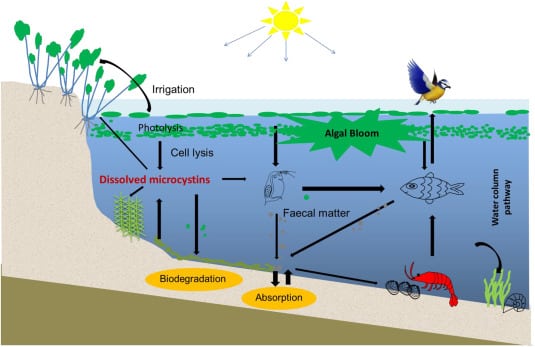
Aquatic Ecosystem Diagram
The aquatic ecosystem can be better understood using this diagram:
Aquatic Ecosystem Food Chain
A food chain in an aquatic ecosystem represents the flow of energy from one organism to another through successive levels of producers, consumers, and decomposers.
- Producers (Autotrophs)
- These are the base of the aquatic food chain.
- Include phytoplankton, algae, and aquatic plants.
- They perform photosynthesis using sunlight and nutrients, producing energy-rich compounds.
- Primary Consumers (Herbivores/Zooplankton)
- Feed directly on producers.
- Include zooplankton, small crustaceans, insect larvae, and mollusks.
- Act as a crucial link between producers and higher consumers.
- Secondary Consumers (Small Carnivores)
- Feed on primary consumers.
- Examples: small fish, crabs, frogs, jellyfish.
- Tertiary Consumers (Larger Carnivores)
- Feed on secondary consumers.
- Examples: large fish, squids, seals, water snakes.
- Apex Predators (Top Carnivores)
- Occupy the top of the food chain.
- Examples: sharks, dolphins, crocodiles, killer whales.
- Decomposers
- Break down dead organisms and recycle nutrients back into the system.
- Examples: bacteria, fungi, actinomycetes.
Phytoplankton → Zooplankton → Small Fish → Large Fish → Shark
Freshwater Ecosystem
A freshwater ecosystem is an aquatic ecosystem where the concentration of salts is very low, typically less than 1%. These ecosystems are continuously cycling and include rivers, lakes, and ponds. Though they cover only about 0.8% of the Earth’s surface, freshwater ecosystems are vital for sustaining terrestrial and aquatic life alike.
Examples: Pond ecosystem, lake ecosystem, and river ecosystem.
Freshwater Ecosystems Categories
Depending on the movement of water, freshwater ecosystem has two categories:
- Lentic Ecosystems (stagnant water bodies)
- Lotic Ecosystems (flowing water bodies)
Lentic Freshwater Ecosystem
These are closed systems where water remains largely still with no significant outflow. They usually form in depressions on the Earth’s surface where water accumulates from rainfall, streams, or underground sources. Because water is stagnant, lentic systems often show layering (stratification) with distinct ecological zones.
Lotic Freshwater Ecosystem
These are ecosystems with rapidly moving water flowing in a single direction, such as rivers, streams, springs, and mountain brooks. Their primary role is to channel surplus rainwater back to the oceans. Plant diversity in lotic systems is relatively low compared to lentic ones, as the continuous flow of water poses a survival challenge for rooted plants and larger vegetation.
Freshwater Ecosystems Types
Freshwater habitats are further divided into lakes, flood ponds, and rivers.
- Lakes: A lake is a relatively deep and large inland water body surrounded by land, often fed or drained by rivers and streams. Natural lakes are typically found in mountainous terrains, rift valleys, or glacial regions. Examples: Loktak Lake, Wular Lake.
- Flood Ponds: These seasonal ponds fill during monsoons but dry up in other parts of the year. Many organisms like algae, insects, snails, and worms remain dormant in the dry season and become active again when water returns.
- Rivers: Rivers are flowing freshwater systems that carry rainfall runoff across landscapes before discharging into seas or oceans. They are among the most dynamic freshwater systems.
Examples: Ganga, Yamuna, Tapti, Krishna, Cauvery, Narmada.
Marine Ecosystem
Marine ecosystems include the largest water bodies on Earth, such as oceans, lagoons, estuaries, mangroves, coral reefs, and even the deep-sea floor. These systems cover nearly 71% of the planet’s surface and are characterized by high salt content.
As one moves from coastal areas to the open ocean, depth increases, leading to the development of various ecological zones. Marine producers range from tiny phytoplankton to massive seaweeds, while consumers include fish, turtles, invertebrates, and mammals. The sunlit surface waters are highly productive, while deeper regions depend on organic matter descending from above.
Marine Ecosystems Zones
Marine ecosystems are divided into zones based on depth, light availability, and ecological conditions:
- Photic (Euphotic) Zone: Extends to about 200 meters; rich in sunlight and supports abundant photosynthesis by phytoplankton and algae. This is the most productive zone.
- Disphotic Zone: Extends from 200–1000 meters; receives dim light insufficient for photosynthesis but still supports specialized species adapted to low-light environments.
- Aphotic Zone: Begins below 1000 meters, completely dark and high-pressure. Life here relies on “marine snow,” i.e., organic debris falling from upper layers.
Marine Ecosystems Influencing Factors
The distribution of marine organisms is affected by:
- Light availability: highest biodiversity occurs in sunlit zones.
- Proximity to land: nutrient inflow from rivers enriches coastal ecosystems.
- Depth and pressure: organisms adapt uniquely to extreme depths and pressures.
Marine Ecosystems Types
Marine Ecosystem is sub-divided into the following types:
- Open Marine Ecosystem: Also called the euphotic zone, up to 150 meters deep. Hosts plankton, algae, jellyfish, whales, and other freely moving organisms.
- Ocean Floor Ecosystem: Found at great depths with little or no sunlight. Organisms here often produce their own bioluminescence for survival.
Examples: crabs, jellyfish, squids, corals, sperm whales.
Estuaries
Estuaries are transitional zones where rivers carrying freshwater and silt meet saline ocean waters. They represent ecotones and are among the most nutrient-rich and biodiverse ecosystems. They combine features of both freshwater and marine ecosystems, estuaries often support more biodiversity than either system alone.Examples: Coastal bays, lagoons, deltas, tidal marshes.
Mangroves
Mangroves are specialized trees growing in salty intertidal zones, particularly in river deltas. These forests are highly productive, act as nurseries for fish and crustaceans, and provide natural coastal protection from erosion, storms, and cyclones. Example: Sundarbans delta in India.
Coral Reefs
Coral reefs, often called the “rainforests of the sea,” are one of the most diverse and productive ecosystems on Earth. They are formed by coral polyps, tiny marine animals that secrete calcium carbonate skeletons. Reefs harbor countless species including sponges, mollusks, fish, turtles, sharks, and dolphins, making them important for marine biodiversity.
Seagrasses
Seagrasses are flowering plants that grow underwater, usually between coral reefs and mangrove habitats. They form dense meadows that serve as feeding grounds and shelters for commercially important species like snappers, lobsters, and crabs. Besides stabilizing sediments, seagrasses filter water and release oxygen, playing an important role in maintaining marine health.

 Last updated on March, 2026
→ UPSC Final Result 2025 is now out.
→ UPSC has released UPSC Toppers List 2025 with the Civil Services final result on its official website.
→ Anuj Agnihotri secured AIR 1 in the UPSC Civil Services Examination 2025.
→ UPSC Marksheet 2025 is now out.
→ UPSC Notification 2026 & UPSC IFoS Notification 2026 is now out on the official website at upsconline.nic.in.
→ UPSC Calendar 2026 has been released.
→ Check out the latest UPSC Syllabus 2026 here.
→ UPSC Prelims 2026 will be conducted on 24th May, 2026 & UPSC Mains 2026 will be conducted on 21st August 2026.
→ The UPSC Selection Process is of 3 stages-Prelims, Mains and Interview.
→ Prepare effectively with Vajiram & Ravi’s UPSC Prelims Test Series 2026 featuring full-length mock tests, detailed solutions, and performance analysis.
→ Enroll in Vajiram & Ravi’s UPSC Mains Test Series 2026 for structured answer writing practice, expert evaluation, and exam-oriented feedback.
→ Join Vajiram & Ravi’s Best UPSC Mentorship Program for personalized guidance, strategy planning, and one-to-one support from experienced mentors.
→ Shakti Dubey secures AIR 1 in UPSC CSE Exam 2024.
→ Also check Best UPSC Coaching in India
Aquatic Ecosystem FAQs
Q1. What are the three types of aquatic ecosystems?+
Q2. What is the aquatic lake ecosystem?+
Q3. What are the aquatic ecosystems in India?+
Q4. What is the freshwater ecosystem?+
Q5. What is seagrass?+
Tags: aquatic ecosystem