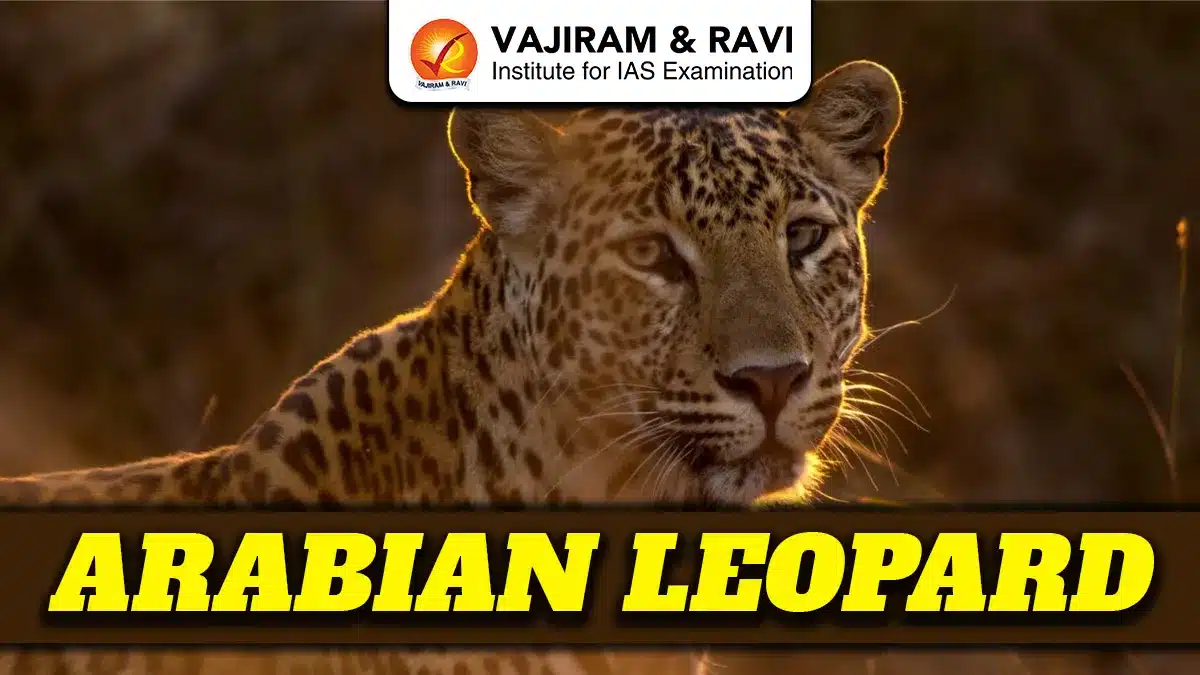
The Arabian leopard, scientifically known as Panthera pardus nimr, is one of the most elusive and critically endangered big cats in the world. They are renowned for their adaptability to harsh desert landscapes and rugged mountains. This leopard subspecies represents a critical component of the Arabian Peninsula’s biodiversity. Unfortunately, its survival is under severe threat due to habitat destruction, poaching, and declining prey populations.
Arabian Leopard Population and Conservation Status
-
- IUCN Red List Status: Critically Endangered since 1996
- Estimated Wild Population (2006): Fewer than 200 individuals
- Population Trend: Continuously declining
- Conservation Measures:
-
- Listed in CITES Appendix I, prohibiting international trade.
- Captive breeding programs, such as the Breeding Centre for Endangered Wildlife in Sharjah, aim to support future reintroduction and genetic diversity.
Arabian Leopard Ecology and Behavior
Arabian leopards are primarily nocturnal, though they can occasionally be active during the day. They are solitary predators, marking territories and hunting alone. Their diet consists of small to medium-sized prey species, which they stalk stealthily using their camouflage and agility.


Threats to Arabian Leopards
The survival of the Arabian leopard is threatened by several human-induced and environmental pressures:
- Habitat Loss and Fragmentation: Urban expansion, farming, and overgrazing reduce suitable habitats.
- Prey Depletion: Unregulated hunting of prey species diminishes food sources.
- Illegal Wildlife Trade: Trapping and poaching for fur and trophies continue to be significant threats.
- Retaliatory Killing: Leopards are sometimes killed in defense of livestock, further reducing their numbers.
Comparison with Other Leopard Subspecies
The Arabian leopard is one of several leopard species worldwide, each adapted to specific environments. The Comparison with Other Leopard Subspecies is given below.
| Comparison with Other Leopard Subspecies | ||||
| Leopard Species | Scientific Name | Region | Status | Details |
|
African Leopard |
Panthera pardus pardus |
Sub-Saharan Africa |
Vulnerable |
Largest subspecies; varied fur; found in savannas and forests; CITES Appendix I |
|
Persian Leopard |
Panthera pardus saxicolor |
Iran, Caucasus, Turkey |
Endangered |
Larger; adapted to mountains |
|
Indian Leopard |
Panthera pardus fusca |
India, Nepal, Sri Lanka |
Vulnerable |
Adapted to diverse habitats including human areas |
|
Sri Lankan Leopard |
Panthera pardus kotiya |
Sri Lanka |
Vulnerable |
Island subspecies; smaller; unique rosettes |
|
Javan Leopard |
Panthera pardus melas |
Java, Indonesia |
Endangered |
Small, isolated population in mountainous forests |
|
Amur Leopard |
Panthera pardus orientalis |
Russia (Siberia) |
Critically Endangered |
Most endangered; cold-climate adapted |
|
Snow Leopard |
Panthera uncia |
Central Asia, Himalayas |
Vulnerable |
High-altitude specialist; elusive and solitary |
|
Chinese Leopard |
Panthera pardus japonensis |
China |
Vulnerable |
Smaller; inhabits forests and mountains |

 Last updated on Oct, 2026
→ UPSC 2027 Notification will be released on 13 January 2027 at upsconline.nic.in.
→ Check Nobel Prize 2026 Winners List here.
→ Download PIB PRiSM Monthly Magazine 2026 here.
→ Check UPSC Monthly Current Affairs Magazine The Recitals here.
→ Check out the latest UPSC Syllabus here.
→ Download UPSC Model Answers for Mains 2026
→ UPSC Mains Question Paper 2026 is out now for Essay & GS Paper 1, 2, 3 & 4.
→ UPSC Calendar 2027 has been released.
→ Enroll in Vajiram & Ravi’s UPSC Mains Test Series 2027 for structured answer writing practice, expert evaluation, and exam-oriented feedback.
→ Join Vajiram & Ravi’s UPSC Mentorship Program 2027 for personalized guidance, strategy planning, and one-to-one support from experienced mentors.
→ Go through the UPSC Mains Previous Year Papers to enhance your preparation.
→ UPSC has released UPSC Toppers List 2025 with the Civil Services final result on its official website.
→ Also check Best UPSC Coaching in India
Arabian Leopard FAQs
Q1. What is the Arabian leopard?+
Q2. Where is the Arabian leopard found?+
Q3. What kind of habitat does it prefer?+
Q4. What is the size of an Arabian leopard?+
Q5. What does the Arabian leopard eat?+
Tags: arabian leopard