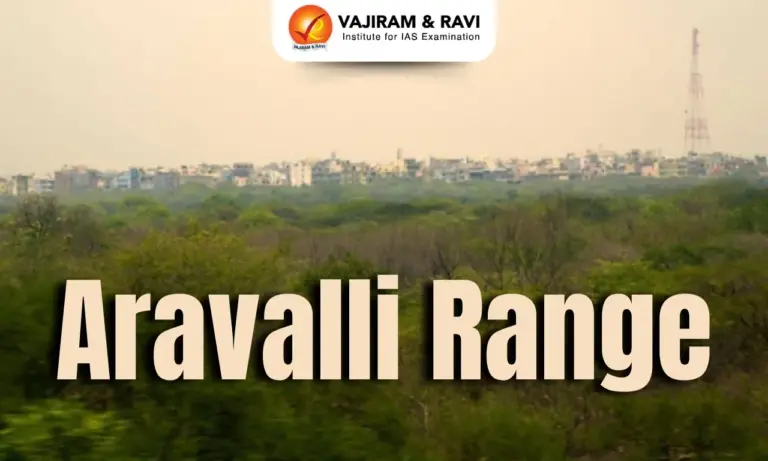
Aravalli Range Latest News
- The Supreme Court has settled a uniform definition of the Aravalli hills and ranges and paused fresh mining leases across Delhi, Haryana, Rajasthan, and Gujarat, while issuing directions for sustainable mining and ecological restoration of the region.
Aravalli Mountain Range: Geographic and Ecological Significance
- The Aravalli Mountain Range is one of the oldest mountain systems in the world, estimated to be nearly two billion years old.
- Stretching over 650 km from Delhi to Gujarat, the range passes through Haryana, Rajasthan, and Gujarat, forming a critical ecological spine in north-western India.
- Ecologically, the Aravalli’s act as a natural barrier against desertification, preventing the eastward expansion of the Thar Desert into the fertile Indo-Gangetic plains.
- They play a vital role in climate regulation, groundwater recharge, and biodiversity conservation.
- Several important rivers, such as the Chambal, Sabarmati, and Luni, originate from or are supported by the Aravalli system.
- The region is rich in minerals like limestone, marble, sandstone, copper, zinc, and tungsten, which have historically made it a mining hub.
- However, excessive quarrying over recent decades has severely degraded forests, reduced groundwater levels, and worsened air quality, especially in the National Capital Region (NCR).





Mining and Environmental Degradation
- Since the early 1990s, the Environment Ministry has issued regulations restricting mining to sanctioned projects.
- Despite this, widespread illegal and unregulated mining continued, particularly in parts of Haryana and Rajasthan.
- In 2009, the Supreme Court imposed a blanket ban on mining in Faridabad, Gurugram, and Mewat districts of Haryana. However, enforcement challenges persisted.
- Recognising the long-term ecological risks and India’s commitments under the UN Convention to Combat Desertification, the Court revisited the issue in recent years to adopt a more comprehensive and sustainable approach.
Supreme Court Intervention and Uniform Definition
- A major issue in protecting the Aravalli’s was the absence of a uniform definition.
- Different States and agencies used inconsistent criteria to identify Aravalli formations, leading to regulatory loopholes.
- To address this, the Supreme Court constituted a committee comprising representatives from the Environment Ministry, Forest Survey of India (FSI), Geological Survey of India, State Forest Departments, and the Central Empowered Committee (CEC).
- In 2025, the Court accepted the committee’s recommendation that hills above 100 metres in height would be considered part of the Aravalli range.
- While concerns were raised that this definition might exclude smaller formations, the Court held that it was more inclusive and workable than earlier slope-based or buffer-based definitions, which risked excluding large areas altogether.
Central Empowered Committee Recommendations
- The Central Empowered Committee proposed a science-based, multi-layered strategy for protecting the Aravalli’s. Key recommendations included:
- Comprehensive scientific mapping of the Aravalli range across all States
- Macro-level environmental impact assessment of mining activities
- Strict prohibition of mining in ecologically sensitive zones such as wildlife corridors, aquifer recharge areas, water bodies, and protected habitats
- No new mining leases or renewals until proper mapping and assessments are completed
- Tight regulation of stone-crushing units contributing to air pollution
- These recommendations were accepted by the Supreme Court in its November 2025 order.
Sustainable Mining and the Green Wall Initiative
- Instead of imposing a complete ban, the Supreme Court adopted a calibrated approach.
- It allowed existing legal mining to continue under strict regulation while pausing fresh approvals. The Court noted that total bans often fuel illegal mining mafias and unregulated extraction.
- Complementing judicial action, the Centre launched the Aravalli Green Wall Project in June 2025.
- The initiative aims to increase green cover in a five-kilometre buffer zone across 29 districts in Gujarat, Rajasthan, Haryana, and Delhi.
- The project targets the restoration of 26 million hectares of degraded land by 2030, strengthening India’s land degradation neutrality goals.

 Last updated on March, 2026
→ UPSC Final Result 2025 is now out.
→ UPSC has released UPSC Toppers List 2025 with the Civil Services final result on its official website.
→ Anuj Agnihotri secured AIR 1 in the UPSC Civil Services Examination 2025.
→ UPSC Marksheet 2025 is now out.
→ UPSC Notification 2026 & UPSC IFoS Notification 2026 is now out on the official website at upsconline.nic.in.
→ UPSC Calendar 2026 has been released.
→ Check out the latest UPSC Syllabus 2026 here.
→ UPSC Prelims 2026 will be conducted on 24th May, 2026 & UPSC Mains 2026 will be conducted on 21st August 2026.
→ The UPSC Selection Process is of 3 stages-Prelims, Mains and Interview.
→ Prepare effectively with Vajiram & Ravi’s UPSC Prelims Test Series 2026 featuring full-length mock tests, detailed solutions, and performance analysis.
→ Enroll in Vajiram & Ravi’s UPSC Mains Test Series 2026 for structured answer writing practice, expert evaluation, and exam-oriented feedback.
→ Join Vajiram & Ravi’s Best UPSC Mentorship Program for personalized guidance, strategy planning, and one-to-one support from experienced mentors.
→ Shakti Dubey secures AIR 1 in UPSC CSE Exam 2024.
→ Also check Best UPSC Coaching in India
Aravalli Range FAQs
Q1. Why is the Aravalli range ecologically important?+
Q2. Why did the Supreme Court define the Aravalli hills uniformly?+
Q3. Has mining been completely banned in the Aravallis?+
Q4. What is the Aravalli Green Wall Project? +
Q5. How does the Aravalli issue relate to India’s global commitments?+
Tags: aravalli range mains articles upsc current affairs upsc mains current affairs