Aravalli Range Latest News
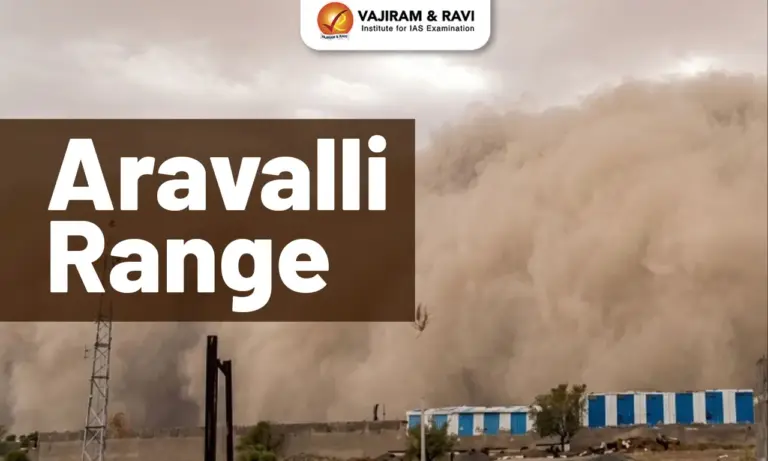
- A massive dust storm in Churu, Rajasthan recently — affecting districts including Hanumangarh, Sri Ganganagar, Bikaner, Nagaur, Alwar, and Sikar — went viral on social media.
- This drew attention to a critical but underappreciated ecological reality: the Aravalli range serves as India’s natural shield protecting the densely populated Indo-Gangetic plains from Thar Desert dust storms.
- However, this shield is rapidly weakening due to mining, deforestation, and urbanisation.
Dust Storms Over Northern India — The Climatic Context
- Dust storms originating from the Thar Desert are a regular pre-monsoon phenomenon in northern India (April-June), fuelled by intense heat, dry conditions, and south-westerly and westerly winds.
- The IMD’s Climate Hazards and Vulnerability Atlas of India (based on 1981-2010 data) shows that parts of northwest India fall in the highest dust-storm frequency class — averaging 0.89 to 1.55 dust-storm days.
- Delhi and neighbouring districts already lie in a high-exposure zone. In June specifically, Delhi records a storm frequency of 2.5 days — the highest in the country for that month.
- As the Aravallis degrade, the impact of these storms is intensifying.


The Aravalli Range — India’s Natural Dust Shield
- The Aravalli range stands physically between the Thar Desert and the Indo-Gangetic plains — one of the world’s most densely populated regions.
- When dust-laden winds blow in from the Middle East and the Thar Desert during the pre-monsoon months of April to June, they run into the Aravallis, lose speed, and drop their load of sand — preventing it from reaching Delhi, Punjab, Haryana, and Uttar Pradesh.
- This natural filtering process is visually evidenced by “obstacle dunes” — large sand deposits found on the western slopes of the Aravallis, directly exposed to hot winds from the west.
- The vegetation growing on these dunes resembles desert flora. Where additional tree cover exists, winds must pass through it — creating a “natural scrubbing effect” that reduces the movement of sand and dust.
- As per the environmental researchers, these dunes are visual proof of the protective role the Aravalli range plays in interception of dust.
State of the Aravalli Range — Alarming Degradation
- A Forest Survey of India (FSI) assessment of 2018 found that 31 of the 128 Aravalli hills in Rajasthan had completely disappeared due to anthropogenic (human-caused) pressures.
- There has also been a significant loss of hills with 200-600 metres elevation in areas like Naraina, Kalwar, Kotputli, Jhalana, and Sariska.
- The Environment Ministry’s Aravalli Restoration Framework flagged multiple causes behind the degradation:
- Mining of red silica, granite, and other minor minerals
- Deforestation and loss of vegetation cover
- Urbanisation and construction activities
- Land-use change and encroachments
- Pastoral activities (overgrazing)
- A 2009 Wildlife Institute of India (WII) study identified 12 gaps in the Aravalli range that have expanded further due to forest degradation and inadequate vegetation cover.
- These gaps act as unprotected corridors through which dust freely passes into the northern plains.
Consequences of Aravalli Degradation
- The weakening of the Aravalli shield has multiple cascading consequences:
- Increased Dust Storm Frequency — Growing gaps in the range threaten to increase the frequency of sand and dust storms in Delhi, Punjab, and Uttar Pradesh.
- Worsening Delhi’s Air Quality — Regular dust-laden winds contribute to particulate matter pollution — directly degrading air quality in the national capital region.
- Impact on Rainfall — The range’s degradation can affect rainfall patterns in surrounding regions — as mountains and forests influence precipitation.
- Alteration of Solar Radiation — Dust can affect the scattering of sunlight, temporarily altering surface temperatures over large areas — with implications for agriculture, human health, and regional climate.
- Scientists have underscored the need for “long-term investigation and analysis on dust frequency and load over northern India” — indicating that the full consequences of Aravalli degradation are still being understood.
Source: IE

 Last updated on Oct, 2026
→ UPSC 2027 Notification will be released on 13 January 2027 at upsconline.nic.in.
→ Check Nobel Prize 2026 Winners List here.
→ Download PIB PRiSM Monthly Magazine 2026 here.
→ Check UPSC Monthly Current Affairs Magazine The Recitals here.
→ Check out the latest UPSC Syllabus here.
→ Download UPSC Model Answers for Mains 2026
→ UPSC Mains Question Paper 2026 is out now for Essay & GS Paper 1, 2, 3 & 4.
→ UPSC Calendar 2027 has been released.
→ Enroll in Vajiram & Ravi’s UPSC Mains Test Series 2027 for structured answer writing practice, expert evaluation, and exam-oriented feedback.
→ Join Vajiram & Ravi’s UPSC Mentorship Program 2027 for personalized guidance, strategy planning, and one-to-one support from experienced mentors.
→ Go through the UPSC Mains Previous Year Papers to enhance your preparation.
→ UPSC has released UPSC Toppers List 2025 with the Civil Services final result on its official website.
→ Also check Best UPSC Coaching in India
Aravalli Range FAQ
Q1. Why is the Aravalli Range called India's natural dust shield?+
Q2. How does the Aravalli Range protect northern India?+
Q3. What threats does the Aravalli Range face?+
Q4. What are the consequences of degradation of the Aravalli Range?+
Q5. Why is the conservation of the Aravalli Range important?+
Tags: aravalli range mains articles upsc current affairs upsc mains current affairs