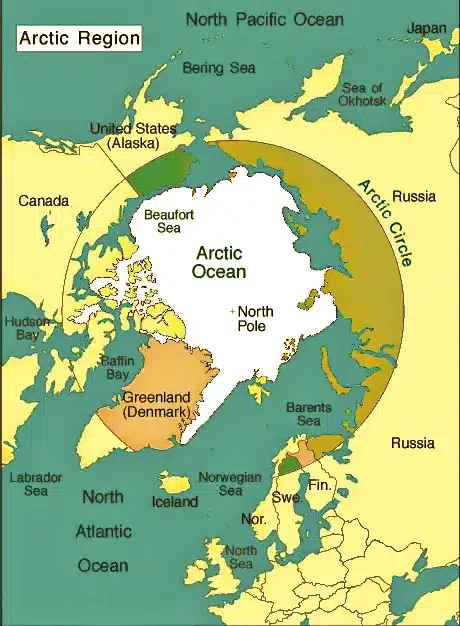
The Arctic Region lies north of the Arctic Circle and includes the Arctic Ocean, surrounding seas, islands, and parts of eight countries. It features sea ice, glaciers, permafrost, tundra, and unique polar ecosystems, making it environmentally sensitive. The Arctic region is also known as the frigid zone or the land of the midnight sun. The land of the midnight sun is called due to the Earth’s axial tilt, the sun remains visible for 24 hours a day for a period during the summer.
The Arctic Regions’ governance is guided by UNCLOS, the Arctic Council, the Polar Code, and the Svalbard Treaty, ensuring resource management and cooperation. Climate change is rapidly altering its ice cover and ecosystems, affecting global weather and sea levels.
Also Read: Atlantic Ocean
Arctic Region Geographical Features
- Location & Extent
- Lies north of the Arctic Circle (66° 33’ N).
- Includes the Arctic Ocean and parts of Canada, Denmark (Greenland), Finland, Iceland, Norway, Russia, Sweden, and the United States (Alaska)..
- Defined by extreme cold, polar climate, and unique ecosystems.
- Arctic Ocean
- World’s smallest and shallowest ocean.
- Composed of major basins: Eurasian Basin and Amerasian Basin.
- Bordered by marginal seas like Barents, Kara, Laptev, Chukchi, Beaufort, Greenland Sea.
- Sea Ice Cover
- Seasonal: expands in winter, shrinks sharply in summer.
- 2025 sea-ice maximum was the lowest ever recorded, showing rapid melting.
- Multi-year ice declining, replaced by thin first-year ice.
- Permafrost
- Permanently frozen ground found in Alaska, Canada, Russia, Greenland.
- Covers around 24% of Northern Hemisphere land area.
- Thawing releases methane and damages buildings, pipelines, and roads.
- Glaciers & Ice Sheets
- Greenland holds the second-largest ice sheet globally.
- Major glaciers rapidly retreating due to climate warming.
- Significant contributor to global sea-level rise.
- Tundra Biome
- Treeless landscape dominated by mosses, lichens, grasses, and shrubs.
- Extremely short summers support sudden plant and wildlife activity.
- Experiencing “Arctic greening” due to rising temperatures.
- Climate Characteristics
- Polar night in winter (24 hours darkness).
- Midnight sun in summer (24 hours daylight).
- Arctic warming 3-4 times faster than global average.
- Due to its high latitude, the Arctic experiences months of continuous daylight in summer and months of darkness in winter.
- Mountains & Landforms
- Ranges include Brooks Range (Alaska), Ural Mountains, Scandes.
- Landforms include fjords, frozen rivers, glaciers, coastal cliffs, braided streams.
- Coastal areas face rapid erosion due to ice melt and wave action.
- Islands & Archipelagos
- Major islands: Greenland, Svalbard, Iceland, Canadian Arctic Archipelago, Franz Josef Land.
- Most islands sparsely populated and highly sensitive to climate change.
- Ocean Currents
- Warm North Atlantic Current reduces ice in the European Arctic.
- Cold Arctic Basin circulations maintain sea-ice formation.
- Current changes influence global weather patterns.
- Unique Biodiversity
- Species adapted to extreme cold: polar bears, walrus, seals, Arctic fox, narwhal.
- Rich summer marine productivity due to sunlight and open water.
- Many species threatened by sea-ice loss.
Strategic Importance of the Arctic Region
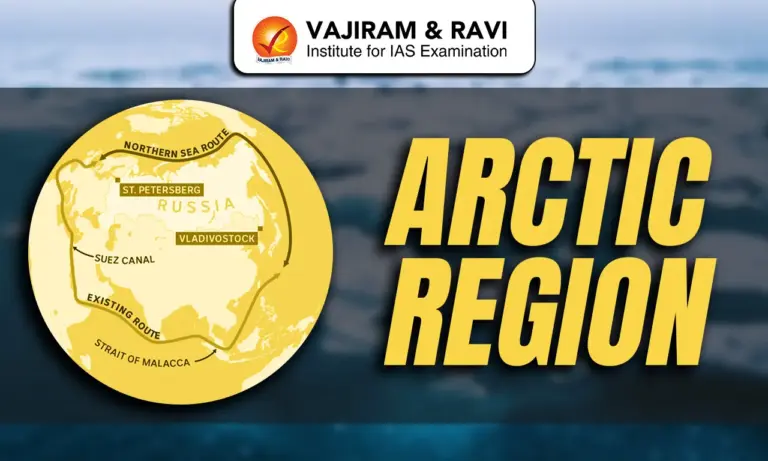
- The Arctic is becoming important because melting ice is opening new shorter shipping routes between Europe and Asia, saving 30-40% travel time compared to the Suez Canal route.
- It holds huge energy resources. Studies show the Arctic may contain 13% of the world’s undiscovered oil and 30% of undiscovered natural gas, making it valuable for future energy needs.
- Many countries are increasing their naval presence, patrols, and icebreaker ships in the region to protect their interests and secure new sea routes.
- Russia controls more than half of the Arctic coastline, and along with the USA, Canada, and Nordic countries, is strengthening military bases there.
- China calls itself a “Near-Arctic State” and is investing in research and shipping access, increasing global competition.
- Melting ice is opening access to new fishing grounds and mineral resources, which countries want to claim early.
- For India, the Arctic matters for climate impacts on monsoons, future trade routes, energy security, and participating in global rule-making.
Also Read: Pacific Ocean





Climate Change Impact on the Arctic
- The Arctic is warming 3 to 4 times faster than the rest of the world, making it the fastest-heating region on Earth.
- Sea ice is shrinking rapidly. In recent years, both winter maximum and summer minimum ice levels have hit record lows.
- As the ice melts, more sunlight is absorbed by dark ocean water, which makes the Arctic heat up even more. This is called the albedo effect.
- Greenland’s ice sheet is melting at high speed, adding significantly to global sea-level rise.
- Permafrost (permanently frozen ground) is thawing, releasing methane—a powerful greenhouse gas, which further increases global warming.
- Thawing permafrost damages roads, buildings, pipelines, and homes in Arctic communities, creating huge economic losses.
- Wildlife such as polar bears, walrus, seals, and Arctic foxes are losing their natural habitats, affecting food chains and survival.
- Warmer waters are changing fish migration patterns, impacting both local communities and global fisheries.
- Melting sea ice allows more shipping, tourism, and drilling, increasing risks of oil spills and accidents in fragile ecosystems.
India’s Engagement and Interests in the Arctic
India’s engagement in the Arctic Region focuses on scientific research, climate studies, and strengthening international cooperation through forums like the Arctic Council. India aims to understand climate impacts, secure future energy resources, and contribute to sustainable development in the region.
- India is connected to the Arctic mainly through climate, because changes in the Arctic affect India’s monsoon patterns, sea levels, and weather extremes.
- India became an Observer in the Arctic Council in 2013, giving it access to scientific cooperation, policy discussions, and research opportunities.
- India runs a permanent research station in Svalbard, Norway called Himadri (established in 2008), used for glaciology, atmospheric studies, and climate research.
- India also operates an underwater moored observatory called IndARC (since 2014) to study Arctic Ocean currents and how they influence the Indian monsoon.
- The National Centre for Polar and Ocean Research (NCPOR) leads India’s Arctic studies, focusing on ice-core analysis, permafrost studies, and climate change.
- India’s Arctic Policy (2022) aims to expand research, strengthen international cooperation, and explore opportunities in energy, minerals, and new shipping routes.
- Melting Arctic ice can create shorter shipping routes (like the Northern Sea Route), which may help India reduce travel time for trade with Europe.
Also Read: Indian Ocean
International Laws and Governance in the Arctic
- United Nations Convention on the Law of the Sea (UNCLOS) defines rights over territorial waters, Exclusive Economic Zones (EEZ), and the seabed, guiding how Arctic states use marine resources.
- Arctic Council acts as the main cooperation forum for Arctic issues, focusing on environment, research, and sustainable development (not security). The Arctic Council members include Canada, Denmark, Finland, Iceland, Norway, Sweden, Russia, and the United States.
- Svalbard Treaty (1920) allows Norway sovereignty over the Svalbard Islands but gives signatory countries equal rights to engage in commercial activities there. India too signed this treaty in 1920.
- Polar Code (IMO, 2017) sets safety and environmental rules for ships operating in Arctic waters.
- Search and Rescue (SAR) Agreement, 2011 under the Arctic Council ensures coordination among Arctic nations for emergencies.
- Fisheries Agreement (2018) bans unregulated commercial fishing in the Central Arctic Ocean for 16 years, promoting scientific study first.
Arctic Region Challenges
- Pollution and Black Carbon from shipping and industry accelerates ice melt and harms marine and terrestrial ecosystems.
- Unregulated Fishing Threats increase as warming waters attract commercial fish stocks to new regions.
- Limited Infrastructure (ports, rescue systems, weather stations) makes operations, tourism, and shipping unsafe and difficult.
- Geopolitical Tensions have grown as countries compete for energy reserves, minerals, and control over new sea routes like the Northern Sea Route.
- Loss of Sea Ice opens new shipping routes but increases risks like accidents, oil spills, and disturbance to marine life.
- Ecosystem Fragility makes Arctic wildlife, polar bears, seals, walruses, and migratory birds highly vulnerable to warming, pollution, and habitat change.
Way Forward
- Enforce Strong Environmental Protection: The Arctic has already lost over 75% of its summer sea ice volume since 1979. Strict rules on shipping, drilling, and pollution are needed to prevent irreversible ecological damage.
- Strengthen Global Climate Action: The Arctic is warming four times faster than the global average. Reducing global CO₂ and black-carbon emissions is essential to slow further ice melts.
- Expand Scientific Collaboration: Climate models show that a 1°C rise in Arctic temperature can increase extreme monsoon variability in Asia. Joint research by India, Arctic nations, and global bodies can improve climate predictions and disaster planning.
- Improve Search, Rescue & Infrastructure: Arctic shipping increased by 44% between 2013 and 2023 due to melting ice. More icebreakers, ports, and emergency systems are needed to handle accidents and oil spill risks.
- Promote Sustainable Resource Use: Commercial fishing is still banned in the Central Arctic Ocean until 2037, but warming waters could attract new species. A precautionary approach is necessary to avoid overfishing.
- Encourage Peaceful Cooperation: As Russia controls 53% of Arctic coastlines, tensions have risen. Diplomatic engagement is necessary to prevent militarization and keep the region peaceful.
- Enhance India’s Arctic Role: India’s Himadri station (since 2008) and its 2022 Arctic Policy support research on monsoons, climate, and polar science. Expanding these programs can strengthen India’s climate resilience.

 Last updated on April, 2026
→ UPSC Final Result 2025 is now out.
→ UPSC has released UPSC Toppers List 2025 with the Civil Services final result on its official website.
→ Anuj Agnihotri secured AIR 1 in the UPSC Civil Services Examination 2025.
→ UPSC Marksheet 2025 is now out.
→ UPSC Notification 2026 & UPSC IFoS Notification 2026 is now out on the official website at upsconline.nic.in.
→ UPSC Calendar 2026 has been released.
→ Check out the latest UPSC Syllabus 2026 here.
→ UPSC Prelims 2026 will be conducted on 24th May, 2026 & UPSC Mains 2026 will be conducted on 21st August 2026.
→ The UPSC Selection Process is of 3 stages-Prelims, Mains and Interview.
→ Prepare effectively with Vajiram & Ravi’s UPSC Prelims Test Series 2026 featuring full-length mock tests, detailed solutions, and performance analysis.
→ Enroll in Vajiram & Ravi’s UPSC Mains Test Series 2026 for structured answer writing practice, expert evaluation, and exam-oriented feedback.
→ Join Vajiram & Ravi’s Best UPSC Mentorship Program for personalized guidance, strategy planning, and one-to-one support from experienced mentors.
→ Shakti Dubey secures AIR 1 in UPSC CSE Exam 2024.
→ Also check Best UPSC Coaching in India
Arctic Region FAQs
Q1. What is known as the Arctic region?+
Q2. What are the 8 countries in the Arctic?+
Q3. Is Arctic land or ice?+
Q4. How does the Arctic impact India?+
Q5. How much of the Arctic ice is left?+
Tags: arctic region