About Arctic Tundra
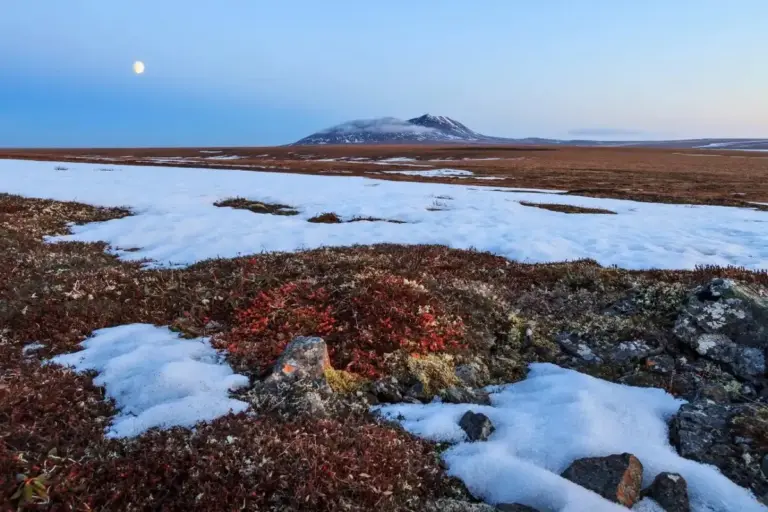
- The Arctic Tundra is a vast, treeless biome characterized by its cold, dry, and rocky terrain.
- The term “tundra” originates from the Finnish word tunturi, meaning a ‘treeless plain.’
Characteristics of the Arctic Tundra
- Permafrost: It refers to permanently frozen soil, starting within a meter of the surface. During summer, only the upper layer thaws, while deeper layers remain frozen.
- The frozen layer restricts plant root growth and prevents tree growth, resulting in a treeless landscape.
- Soil composition: The tundra’s soil is rocky and nutrient-poor due to low decomposition rates.
- Organic material accumulates in the form of peat (decayed sphagnum moss) and humus (organic matter), making it a significant carbon sink.
- Geographic location: The Arctic tundra is the northernmost biome, covering areas north of the Arctic Circle up to the polar ice cap, parts of Canada, Iceland, and Greenland.
- It spans approximately 11.5 million km².
- Climate: Temperatures range from 15.5°C in summer to -60°C in winter, with mean temperatures below 0°C for 6–10 months.
- Annual precipitation is low, ranging between 150–250 mm, but evaporation is minimal.
- Features 24-hour sunlight in summer and 24-hour darkness in winter.
- Natural vegetation: Vegetation is predominantly herbaceous due to the cold climate and short growing season. Includes grasses, mosses (e.g., reindeer moss), lichens, and liverworts.
- Woody plants like dwarf willows remain short and spread to withstand high winds.
- Animal life: Large mammals such as polar bears, caribou, musk ox, and Arctic foxes inhabit the tundra.
- Smaller animals like lemmings and Arctic hares adapt with fur that changes colour seasonally.
- Migratory birds, such as loons and snow geese, breed in the tundra during summer.
- Arctic Tundra as a Carbon Sink: Despite the absence of trees, the Arctic Tundra is a significant carbon sink.
- This is due to the accumulation of organic matter in: Peat (Decayed sphagnum moss) and Humus (Decomposed organic material).
- The cold conditions slow decomposition, trapping carbon in the permafrost for millennia.
Reasons for Emissions:
- Thawing permafrost: Rising temperatures activate microbes, breaking down organic matter and releasing CO₂ and CH₄ (methane).
- Methane is a more potent greenhouse gas than CO₂.
- Increased wildfires: Release additional GHGs and Accelerate permafrost thawing.
- Temperature trends: The Arctic is warming four times faster than the global average. 2024 marked the second-warmest year since records began in 1900.
- Global carbon trends:
- CO2 emissions in 2024 are projected to be 41.6 billion tonnes, up from 40.6 billion tonnes in 2023.
- Land-use changes add 4.2 billion tonnes of emissions annually.
Q1. What is the Arctic Council?
The Arctic Council is an intergovernmental forum focused on addressing and discussing matters related to the Arctic region. Its key areas of work include scientific research, promoting peaceful cooperation, and ensuring the sustainable use of resources in the Arctic. The Council was established in 1996 through the Ottawa Declaration by the eight Arctic States.






 Last updated on March, 2026
→ UPSC Final Result 2025 is now out.
→ UPSC has released UPSC Toppers List 2025 with the Civil Services final result on its official website.
→ Anuj Agnihotri secured AIR 1 in the UPSC Civil Services Examination 2025.
→ UPSC Marksheet 2025 is now out.
→ UPSC Notification 2026 & UPSC IFoS Notification 2026 is now out on the official website at upsconline.nic.in.
→ UPSC Calendar 2026 has been released.
→ Check out the latest UPSC Syllabus 2026 here.
→ UPSC Prelims 2026 will be conducted on 24th May, 2026 & UPSC Mains 2026 will be conducted on 21st August 2026.
→ The UPSC Selection Process is of 3 stages-Prelims, Mains and Interview.
→ Prepare effectively with Vajiram & Ravi’s UPSC Prelims Test Series 2026 featuring full-length mock tests, detailed solutions, and performance analysis.
→ Enroll in Vajiram & Ravi’s UPSC Mains Test Series 2026 for structured answer writing practice, expert evaluation, and exam-oriented feedback.
→ Join Vajiram & Ravi’s Best UPSC Mentorship Program for personalized guidance, strategy planning, and one-to-one support from experienced mentors.
→ Shakti Dubey secures AIR 1 in UPSC CSE Exam 2024.
→ Also check Best UPSC Coaching in India