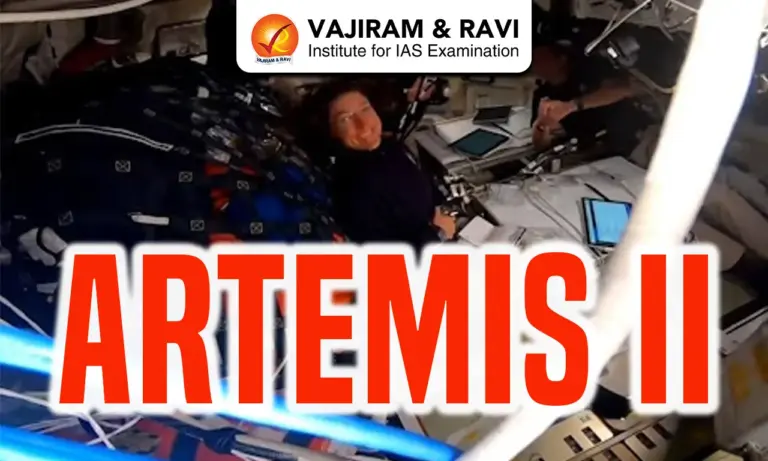
Artemis II Latest News
- The Artemis II mission astronauts travelled about 406,771 km from Earth, setting a new record for the farthest human spaceflight.
- The Orion spacecraft reached this distance while looping around the far side of the Moon.
- The previous record was set by Apollo 13 (1970), which went farther due to an emergency deviation.
- In contrast, Artemis II’s distance was planned, but it is not the main objective—rather a result of its mission trajectory.
Artemis II Flight Path: Free-Return Trajectory
- Artemis II is a crewed lunar flyby mission, not a landing mission. Unlike earlier missions like Apollo 8, which used a circular lunar orbit, Orion follows an elliptical free-return trajectory.
- This path uses the Moon’s gravity to slingshot the spacecraft back to Earth, reducing the need for engine burns.
- The mission is designed to test the Orion spacecraft’s capabilities under controlled conditions.





How the Free-Return Trajectory Works in Artemis II
- High Earth Orbit (HEO) Phase
- The mission begins with Orion entering an elliptical orbit around Earth, extending to about 74,000 km.
- This phase provides a 42-hour window for astronauts to test critical systems like environmental control and life support.
- If any issue arises, the spacecraft remains within Earth’s gravity, allowing a quick abort and safe splashdown.
- Translunar Slingshot Phase
- After system clearance, Orion is propelled toward the Moon, targeting a point about 10,300 km beyond the lunar far side.
- The Moon’s gravity then captures and slingshots the spacecraft around it, directing it back toward Earth without requiring additional propulsion.
Why the Free-Return Trajectory is Advantageous
- The flight path provides a built-in safety mechanism, ensuring the spacecraft can return to Earth even if engines fail, preventing astronauts from being stranded.
- It is highly fuel-efficient, as it avoids the heavy deceleration and acceleration burns required for a circular lunar orbit.
- By using the Moon’s gravity for direction change, the mission conserves propellant.
- Lower fuel needs also reduce launch weight and allow reserve fuel for emergencies.
Next Steps in the Artemis Programme
- The main goal of Artemis II is to test whether the Orion spacecraft and its systems can safely support human life in deep space conditions.
- The 10-day mission evaluates its ability to match Artemis I distances while ensuring crew safety.
- Orion’s return will provide critical data on performance and life-support systems for future missions.
- These insights will help prepare upcoming missions aimed at returning humans to the Moon and building a Moon Base.

 Last updated on April, 2026
→ UPSC Final Result 2025 is now out.
→ UPSC has released UPSC Toppers List 2025 with the Civil Services final result on its official website.
→ Anuj Agnihotri secured AIR 1 in the UPSC Civil Services Examination 2025.
→ UPSC Marksheet 2025 is now out.
→ UPSC Notification 2026 & UPSC IFoS Notification 2026 is now out on the official website at upsconline.nic.in.
→ UPSC Calendar 2026 has been released.
→ Check out the latest UPSC Syllabus 2026 here.
→ UPSC Prelims 2026 will be conducted on 24th May, 2026 & UPSC Mains 2026 will be conducted on 21st August 2026.
→ The UPSC Selection Process is of 3 stages-Prelims, Mains and Interview.
→ Prepare effectively with Vajiram & Ravi’s UPSC Prelims Test Series 2026 featuring full-length mock tests, detailed solutions, and performance analysis.
→ Enroll in Vajiram & Ravi’s UPSC Mains Test Series 2026 for structured answer writing practice, expert evaluation, and exam-oriented feedback.
→ Join Vajiram & Ravi’s Best UPSC Mentorship Program for personalized guidance, strategy planning, and one-to-one support from experienced mentors.
→ Shakti Dubey secures AIR 1 in UPSC CSE Exam 2024.
→ Also check Best UPSC Coaching in India
Artemis II FAQs
Q1. What is Artemis II mission?+
Q2. Why is Artemis II important?+
Q3. What is the Artemis II flight path?+
Q4. How does Artemis II ensure safety?+
Q5. What comes after Artemis II?+
Tags: Artemis II mains articles upsc current affairs upsc mains current affairs