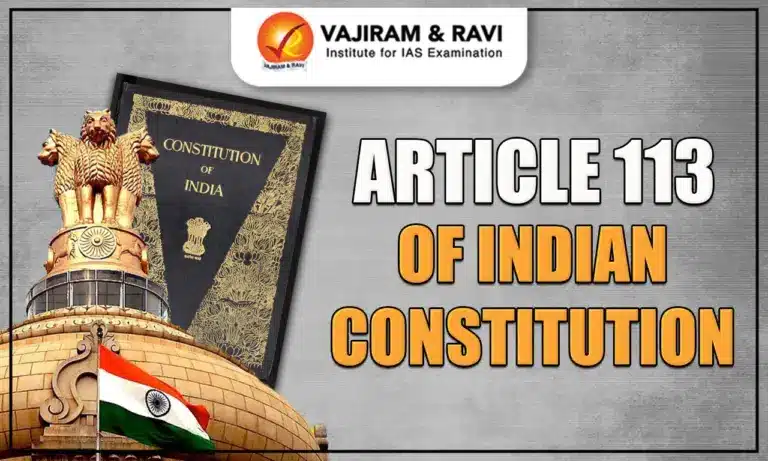
The Constitution of India was adopted on 26 November 1949, providing a detailed framework for governing the country. It defines the structure and functioning of governments at various levels. Article 113 of Indian Constitution deals with the procedure in Parliament regarding estimates, setting out the rules and guidelines for the budgeting process and the allocation of government funds.
Article 113 of Indian Constitution
- So much of the estimates as relates to expenditure charged upon the Consolidated Fund of India shall not be submitted to the vote of Parliament, but nothing in this clause shall be construed as preventing the discussion in either House of Parliament of any of those estimates.
- So much of the said estimates as relates to other expenditure shall be submitted in the form of demands for grants to the House of the People, and the House of the People shall have power to assent, or to refuse to assent, to any demand, or to assent to any demand subject to a reduction of the amount specified therein.
- No demand for a grant shall be made except on the recommendation of the President.
Article 113 of Indian Constitution Interpretation
Under Article 113 of the Indian Constitution, the President presents the annual financial statement to both Houses of Parliament. This statement contains the government’s estimated income and expenditure for the upcoming financial year.
The budget divides expenditure into two categories:
- Expenditure charged to the Consolidated Fund of India – Not subject to a vote in Parliament, though it can be discussed.
- Expenditure requiring parliamentary approval – These are presented as demands for grants in the Lok Sabha.
The provision also differentiates between revenue expenditure and other types of expenditure. While charged expenditures are only debated, demands for grants can be approved, rejected, or reduced by the Lok Sabha. Every demand for a grant must carry the President’s recommendation. This process ensures that the executive plays a key role in managing budgetary proposals.






 Last updated on March, 2026
→ UPSC Final Result 2025 is now out.
→ UPSC has released UPSC Toppers List 2025 with the Civil Services final result on its official website.
→ Anuj Agnihotri secured AIR 1 in the UPSC Civil Services Examination 2025.
→ UPSC Marksheet 2025 is now out.
→ UPSC Notification 2026 & UPSC IFoS Notification 2026 is now out on the official website at upsconline.nic.in.
→ UPSC Calendar 2026 has been released.
→ Check out the latest UPSC Syllabus 2026 here.
→ UPSC Prelims 2026 will be conducted on 24th May, 2026 & UPSC Mains 2026 will be conducted on 21st August 2026.
→ The UPSC Selection Process is of 3 stages-Prelims, Mains and Interview.
→ Prepare effectively with Vajiram & Ravi’s UPSC Prelims Test Series 2026 featuring full-length mock tests, detailed solutions, and performance analysis.
→ Enroll in Vajiram & Ravi’s UPSC Mains Test Series 2026 for structured answer writing practice, expert evaluation, and exam-oriented feedback.
→ Join Vajiram & Ravi’s Best UPSC Mentorship Program for personalized guidance, strategy planning, and one-to-one support from experienced mentors.
→ Shakti Dubey secures AIR 1 in UPSC CSE Exam 2024.
→ Also check Best UPSC Coaching in India
Article 113 of Indian Constitution FAQs
Q1. What does Article 113 deal with?+
Q2. Which House deals with the Estimates under Article 113?+
Q3. What is the meaning of ‘Estimates’ in Article 113?+
Q4. Can the Rajya Sabha discuss the Estimates?+
Q5. What is a Demand for Grant under Article 113?+
Tags: article 113 of indian constitution